


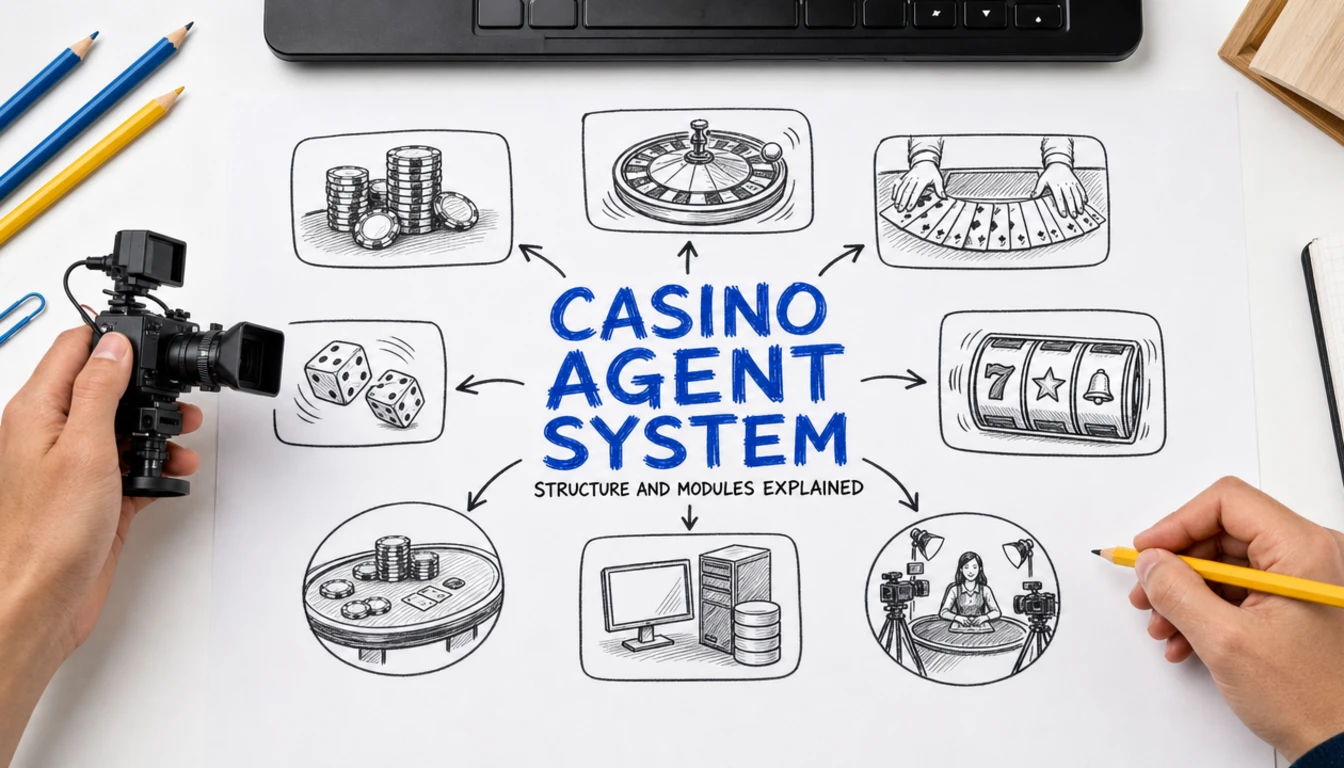
A casino agent system is operator software that manages a hierarchy of agents and their players, tracking commissions, credit and settlement at every level. It is the back-office layer that decides who earns what, who can extend credit, and which accounts each person can see. The phrase also appears in coverage of AI agents on casino floors and in support chat, and this post does not cover that meaning.
On this page
- What Is a Casino Agent System and How Is It Different From AI Agents?
- How Is a Casino Agent System Structured?
- Which Core Modules Does a Casino Agent System Need?
- How Should Operators Check Compliance and Security Before Buying?
- Rolling Out a Casino Agent System Without Breaking Commissions
What Is a Casino Agent System and How Is It Different From AI Agents?
A casino agent system is operator software that manages a hierarchy of agents and their players, with commissions and credit assigned to each level. This post uses “casino agent system” only in that sense. Search results mix it with AI agents, meaning automated assistants that handle player support, fraud detection or personalization. Those are a different product category with different buying criteria.
In the software sense, the agent is a human or a business that brings in players and manages them, usually for a commission and often on credit. The operator owns the license, the games and the wallet. The agents own the player relationships. The system sits between them and records every bet, every credit movement and every payout so that nobody argues about the numbers at settlement time.
Vendors sell it under several labels: agent management software, an iGaming agent platform, a master agent hierarchy, an agent commission system. They describe the same core job. You should read each label as a prompt to check the same four things: the tier structure, the commission engine, the credit and settlement flow, and the reporting.
It is also not the same thing as the acquisition side of the business. Agents recruit, but the brand still has to attract players through its own channels, which is a separate problem. If that is on your list, read how a CMS draws players to a brand. The agent system starts working once a player has an account tied to someone in the hierarchy.
The distinction from an affiliate platform is worth stating. Affiliate tools usually attribute a player to a referrer and pay a share of revenue or a fixed amount, with no downline control. An agent system adds hierarchy, credit limits, and the ability for an upline to manage its downline’s players directly. If your referrers never touch player accounts or extend credit, you may not need an agent system at all.
How Is a Casino Agent System Structured?
Most platforms use a five-level model: operator, master agent, agent, sub-agent and player. Each level sees only its own downline, and each level’s rates and limits are capped by the level above. The operator sits at the top and sees everything. A sub-agent sees only the players it brought in.
The table below shows what each tier typically controls and who sets it. Treat it as a reference model, since platforms name and split the tiers differently.
| Tier | What it controls | Who sets it |
|---|---|---|
| Operator | Global commission ceilings, top-level credit, full visibility of all agents and players | The operator, within its license terms |
| Master agent | Commission rates and credit limits for its agents, visibility of its whole downline | The operator |
| Agent | Rates and credit for its sub-agents, visibility of its own players and sub-agents | The master agent, within operator ceilings |
| Sub-agent | Credit extended to its players, visibility of its own players only | The agent, within its own limits |
| Player | Own balance and bet limits, no commission and no downline | The sub-agent or agent, within operator limits |
Two rules hold the structure together. First, a child value can never exceed its parent’s value. An agent cannot give a sub-agent a higher commission rate than the agent receives, and cannot allot more credit than it holds. Second, visibility follows the tree. A query from any account returns only records at or below that account.
Check how the platform enforces those rules. Some enforce them at the database level, so an invalid rate cannot be saved. Others only validate in the interface, which means an API call or an import can bypass them. Ask the vendor which one applies and test it with a deliberately invalid value.
Maximum depth varies by platform. Some stop at three agent levels, others allow deeper chains, and some let you configure it. Confirm the limit before purchase, and compare it with the structure you actually run today and the one you expect in two years. Adding a tier after launch usually means reworking commission rules, not just adding a role.
Which Core Modules Does a Casino Agent System Need?
A usable casino agent system needs five modules: player and wallet tracking, commission calculation with configurable rules, credit and settlement, role-based permissions, and reporting by tier. If any one is missing or bolted on through spreadsheets, the numbers will drift between what agents believe they are owed and what the operator pays.
- Player and wallet tracking: Every player maps to exactly one agent. Every bet, win, deposit, withdrawal, bonus and adjustment is a ledger entry tied to that player and, through the tree, to every upline.
- Commission calculation: A rules engine that applies rates by game category, by period and by tier, with the option of revenue share, turnover-based or hybrid models.
- Credit and settlement: Credit limits per account, running balances, settlement cycles, and a record of who paid whom and when.
- Role-based permissions: Controls over who can create agents, change rates, adjust balances, approve payouts and export data.
- Reporting by tier: Each level sees its own downline’s performance, and the operator sees a consolidated view that reconciles to the ledger.
The commission module deserves the closest look. There are two common ways to apply rules across levels. In the differential model, each tier earns the difference between its rate and its downline’s rate. In the stacked model, each tier is paid its own rate on its own base. As an illustration only, if a master agent holds 40% of net revenue and its agent holds 30%, the differential model pays the master agent the 10% gap on that agent’s players. Your commercial agreements decide which model fits. The software must be able to express it without custom code.
Rounding errors appear when commission is calculated per transaction and rounded each time, then summed against a period total that was rounded once. The two figures differ by small amounts that grow with volume and show up as disputes. Pick one rule, state it, and check that the platform applies it the same way in the ledger, the statements and the exports. Decide also which tier absorbs the remainder when a split does not divide evenly.
Reversal errors are the second weak point. A voided bet, a chargeback, a corrected game result or a clawed-back bonus can arrive after commission has been calculated or even paid. A sound system posts a reversing entry against every upline’s commission and carries any negative balance into the next period. A weak one edits history, which breaks the audit trail. Ask to see a reversal that crosses a settlement boundary, because that is where the logic usually fails.
How Should Operators Check Compliance and Security Before Buying?
Start with your own license, then check the platform’s audit trail, then player-data security and third-party testing. The agent system does not replace your license. It has to operate inside its conditions and produce the records your regulator expects.
License conditions come first because they decide whether an agent model is allowed at all in your market, and under what rules. Some jurisdictions restrict credit play or third-party player management, so confirm this with your regulator and counsel before you pick a vendor. The UK Gambling Commission guidance for licensed operators and the Nevada Gaming Control Board are examples of regulators whose published requirements you would map against the system’s records. For US plans, how the US state-by-state license process works shows why the answer differs by state.
Then examine player-data handling. Agents hold personal and financial information about their players, which makes the downline a data exposure. Look at how the platform encrypts data, how it separates tiers, how it handles agent departures, and how access is revoked. For the wider platform controls, see security steps for a betting platform.
Third-party testing is useful but narrow. A test lab certificate on a game or random number generator does not prove that the agent module calculates commissions correctly or restricts access properly. Read what GLI and ISO accreditations prove and ask the vendor exactly which components a certificate covers, on which version, and when it was issued.
Use this checklist in vendor demos:
- Audit logs: Does every rate change, balance adjustment, login and permission change record who did it, when, and the before and after values? Can an administrator edit or delete entries?
- Permission granularity: Can you grant a role the right to view without the right to edit, and limit an agent to its own downline in the API as well as the interface?
- Settlement exports: Can you export settlement statements per tier in a format finance can reconcile, including reversals and carried balances?
- Regulator reporting: Can the system produce the player, transaction and agent records your licensing authority asks for, without manual rebuilding?
- Data retention: Are retention periods configurable to your license requirements?
Rolling Out a Casino Agent System Without Breaking Commissions
Roll out in three steps: map the agent hierarchy and commission rules on paper, run a parallel settlement period against your current process, then migrate agents in tiers. Skipping the parallel run is the most common reason commissions break at go-live.
Begin on paper. Draw every agent, its parent, its rate by game category, its credit limit and its settlement cycle. Write the rounding rule and the reversal rule in plain language. Gaps in this document become disputes later, because the software will encode whatever ambiguity you give it. Get each master agent to confirm its own branch in writing.
Next, load the structure into the new system and run it in parallel with your existing process for at least one full settlement cycle. Real money still moves through the old process. The new system calculates the same period independently, and you compare results line by line. Do not shorten the cycle to save time, since monthly adjustments and late reversals only appear across a full period.
Migrate in tiers once the figures reconcile. Move the operator and master agents first, then agents, then sub-agents and their players. This order lets you correct rate and permission errors at the top before they multiply below.
Three failures recur, and each can be tested before live payouts:
- Duplicate player accounts: The same person registered under two agents splits turnover and commission. Test by importing a sample with known duplicates and checking whether the system flags matches on identity fields, then agree who owns a player in a dispute.
- Mismatched commission tiers: A rate in the new system differs from the signed agreement. Test by exporting every agent’s rates and comparing them against the paper map.
- Reporting gaps: Totals in agent statements fail to reconcile to the operator ledger. Test by summing all downline statements for a period and matching them to the ledger total, including reversals.
Use this checklist during the parallel run:
- Every agent’s rate and credit limit matches the signed agreement.
- Old and new commission totals match per agent, and any difference has a written cause.
- Rounding follows the one rule you documented, in statements and exports.
- At least one reversal that crosses a period boundary is posted correctly in every upline.
- Each role sees only its own downline, tested with real logins at each tier.
- Settlement exports reconcile with the ledger and with finance’s own records.
- Duplicate players have been identified and assigned to one agent.
- Master agents have reviewed and signed off their statements.
Go live only when two consecutive checks pass without unexplained differences. Keep the old process available for one more cycle as a fallback.

