


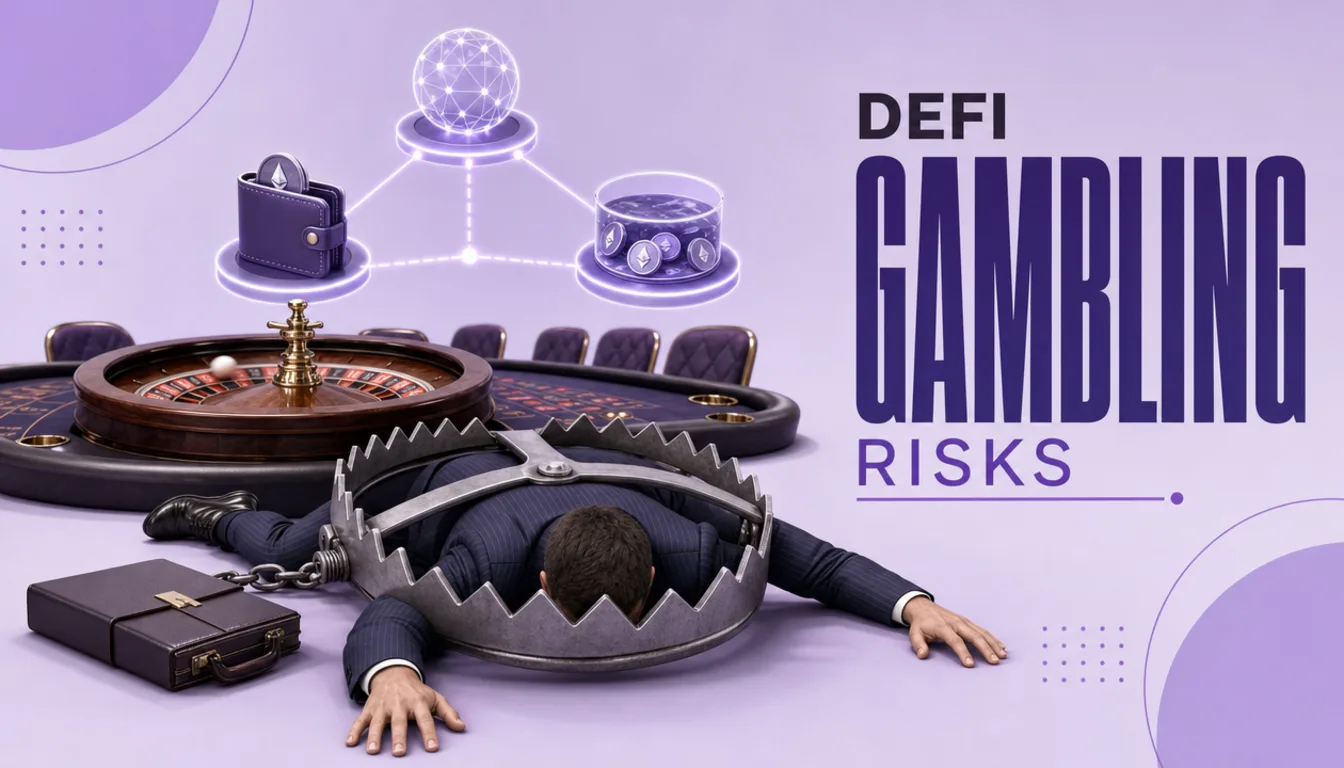
DeFi gambling moves the house’s jobs (holding funds, applying odds, paying winners) into code on a public chain. For an operator, that shifts risk from the balance sheet to engineering, custody design and compliance. Each claim made for the category should be tested against those three areas.
What Is DeFi Gambling and How Does It Differ from an Online Casino?
DeFi gambling is betting run by smart contracts on a public blockchain, with no company holding player funds. A licensed online casino works the other way around. The operator holds player balances, sets odds and limits, runs identity checks and settles disputes through support staff and, ultimately, a regulator.
Four terms carry the rest of this article:
- Smart contract: code deployed on a blockchain that accepts stakes, applies fixed rules and pays out without manual approval.
- Wallet: the player’s own key-controlled address. It replaces the account balance a casino would keep.
- Liquidity pool: a pot of assets, supplied by the operator or outside depositors, that backs payouts.
- Oracle: a service that feeds outside data into a contract, such as a random value or a match result.
The difference is structural. A casino is a counterparty you can sue, audit or license. A decentralized casino is a set of rules you can only read. If you run or list one, you inherit questions the traditional model answers by default: who is accountable, who can intervene, and who pays when something breaks. Ethereum’s own overview of decentralized finance is a useful baseline for the primitives involved. The gambling-specific part is that outcomes are adversarial, so every weakness gets probed by someone with money at stake.
Many products sold as on-chain are hybrids: a conventional game server with crypto deposits. Those are crypto casino games that accept digital currency but still hold custody, so they fall under the casino model, not the DeFi one.
How Does DeFi Gambling Settle Bets Without a House?
A smart contract holds the stake, applies fixed rules and releases the payout when the outcome is recorded. No one approves the withdrawal. The player signs a transaction from their wallet, the contract locks the stake, and a later transaction resolves the bet.
The liquidity pool is the bankroll. Winning bets are paid from it and losing stakes flow back in, so the house edge accrues to whoever supplied the pool. That makes pool sizing a risk-control decision. Maximum bet limits have to be set as a fraction of pool depth, or a single lucky player can drain it.
The oracle supplies the one thing a contract cannot produce alone. Blockchains are deterministic, so true randomness has to come from outside or from a cryptographic scheme. Sports and event bets need a result feed instead. Either way, the contract trusts whatever the oracle reports.
That is where provably fair betting comes in. The usual pattern is commit-reveal: a hashed seed is published before the bet, revealed afterward, and anyone can check that the result follows from it. Verifiable random function services do the same job with a cryptographic proof attached to each random value.
Provable fairness breaks down in specific places:
- Block hashes used as randomness can be influenced by validators when the stake is large enough.
- A front end can display something different from what the contract does, and players rarely verify.
- Upgradeable contracts let an admin key change the rules after the proof was published.
- A stalled or manipulated feed can freeze or misprice settlement.
The contract is only as sound as its code and its data. Fairness is a property of the whole system, not of the hash.
Is DeFi Gambling Legal in the United States?
Blockchain settlement does not remove gambling law, so legality depends on where the player sits and what the product offers. US regulators generally apply existing gambling and money-transmission rules regardless of the payment rails. A bet is a bet whether it settles in dollars or in a token.
Gambling is regulated primarily at the state level. Offering real-money wagering to residents of a state usually requires a license from that state, and a product with no operator of record does not escape the question. Regulators tend to look at who deployed the contract, who runs the front end, who markets it and who profits from the pool. “No one is in charge” is a weak defense when a visible team collects fees.
Federal rules add a second layer. FinCEN has treated certain businesses that accept and transmit convertible virtual currency as money transmitters, which brings registration and anti-money-laundering program duties. Whether your design triggers that depends on custody, control and fee structure, so get counsel to analyze the actual architecture, not the marketing description.
Tax is separate again. US tax authorities treat crypto as property, and gambling winnings are generally taxable, so a payout can create reporting questions for the player and for any business involved. Your product should at least export clean transaction records.
If you want a reference point for what regulators expect from a conventional operator, read how the state-by-state licensing process works. Rules differ by jurisdiction and change over time, so treat any single-state answer as provisional and recheck it before launch.
What Risks Do Players and Operators Face with DeFi Gambling?
The main risks are smart contract bugs, oracle manipulation, thin liquidity and irreversible transactions. A bug in a payout function is not a support ticket; it is a drained pool. Once funds leave, there is no chargeback and no reversal desk.
Oracle risk deserves its own line in any threat model. If an attacker can influence the feed, they can influence the outcome. Thin liquidity compounds this, because small pools are cheaper to attack and swing hard on a few large bets. Liquidity providers also carry variance they may not have priced in.
Compliance exposure is the risk operators most often underestimate. Pseudonymous wallets make it hard to know who is playing, where they are, and whether funds are clean. The FATF guidance on virtual assets sets the international expectation that service providers apply anti-money-laundering controls, including customer due diligence and the travel rule for transfers. National regulators have built on it, and a front end that touches customers is within reach of those expectations.
Player protection is the other gap. A traditional operator gives players:
- customer service and a dispute process
- deposit, loss and time limits
- self-exclusion tools
- age and identity verification
A bare contract provides none of these. Unless the front end adds them, a problem gambler has no brake and a disputed result has no judge. Regulators will notice that, and so will payment partners and app stores.
Infrastructure is the last layer. Even a fully on-chain game relies on nodes, RPC providers, front-end hosting and key management. See cloud infrastructure and security for iGaming platforms for the surrounding controls. A strong contract behind a compromised web host still loses players their funds.
How Should an Operator Evaluate a DeFi Gambling Build?
An operator should test the contract audit trail, the oracle design, the custody model and the compliance layer before launch. Treat each as a gate. A weakness in any one can sink the product regardless of how good the others are.
A short decision checklist:
- Who can pause or upgrade the contract? Identify every admin key, multisig and timelock. An upgrade path helps you patch bugs but also breaks the claim that rules are fixed. Decide what you disclose and how much delay players get before a change takes effect.
- How is randomness sourced and verified? Prefer a verifiable scheme over block data. Confirm that players can check results independently and that a failed request has a defined fallback.
- How is the liquidity pool capitalized? Document who funds it, how withdrawals work, what happens in a drawdown, and how maximum bets scale with pool depth.
- How are geo-blocking and KYC handled? Contracts cannot see location. Controls sit in the front end and in wallet screening, so confirm they exist, are logged and can be defended to a regulator.
- What does the audit actually cover? Ask for scope, findings, fixes and the exact deployed version. An audit of last quarter’s code says little about today’s.
Add operational questions: incident response, monitoring of pool balances and abnormal win rates, and a documented way to halt the product when something looks wrong. Keep the evidence in one place, because licensing bodies, banks and auditors will ask for it.
Your legal, finance and engineering teams will use the same words differently. Point them to the gambling glossary of operator terms so “custody,” “settlement” and “liquidity” mean the same thing in every review meeting.

