
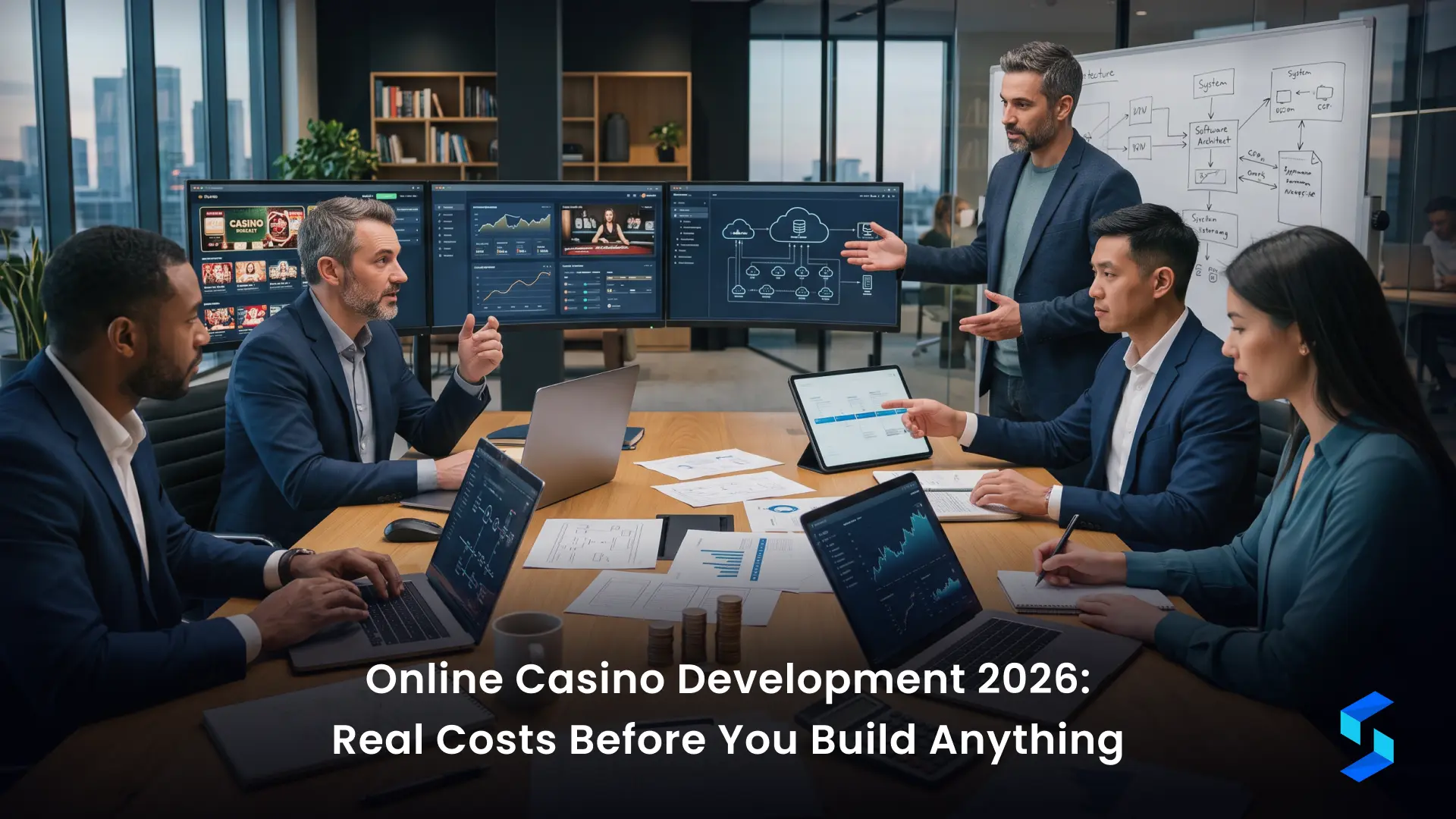
Online casino development in 2026 costs anywhere from $10,000 for a white-label launch to over $1,000,000 for a fully custom platform with proprietary game content and global compliance infrastructure. The gap between those numbers is not random — it is determined by five decisions that should be made before any development conversation begins. This guide covers those decisions and what each one costs.
The Five Decisions That Determine Your Casino Development Cost
Before requesting any quotes from a casino development company or platform provider, you need clarity on:
- White-label, licensed platform, or custom build? This alone determines whether your timeline is weeks or years.
- Which jurisdiction are you licensing in? Licensing determines what compliance tooling you need built into the platform.
- Which game content model are you using? Aggregated third-party content, exclusive contracted studios, or in-house development?
- Do you own the player data architecture? Bundled platform PAMs vs. standalone PAMs produce completely different long-term infrastructure costs.
- What markets are you targeting at launch vs. in 18 months? Building for a single market vs. multi-jurisdiction from day one changes technical scope significantly.
None of these questions have universal right answers. But failing to answer them before starting development is the single most common cause of igaming project overruns.
Online Casino Development Cost Breakdown 2026
| Development Path | Setup / Build Cost | Ongoing Monthly Cost | Launch Timeline |
|---|---|---|---|
| White-label casino (existing platform) | $10,000–$50,000 | $2,000–$20,000 + 10–25% GGR | 2–8 weeks |
| Licensed platform + custom front-end | $30,000–$120,000 | Platform license + infrastructure | 2–5 months |
| Custom casino build (full ownership) | $150,000–$600,000+ | Salaries, infrastructure, licensing | 8–18 months |
| Crypto casino platform (custom) | $80,000–$300,000+ | Infrastructure + smart contract audit amortisation | 5–12 months |
| Full turnkey (games + platform + license) | $20,000–$80,000 | 15–30% GGR or fixed $5,000–$25,000/month | 4–10 weeks |
These are platform costs. Gambling license fees ($10,000–$150,000 depending on jurisdiction), payment gateway setup ($5,000–$50,000), and ongoing game licensing are additional line items.
Online Casino Development Process: 8 Stages
Stage 1 – Market and Licensing Research
Identify your target player geography and confirm the licensing jurisdiction before any technology decision. Your jurisdiction determines your RNG certification requirements, responsible gambling tooling obligations, payment processor options, and game provider availability.
Stage 2 – Platform Architecture Decision
White-label, licensed platform, or custom? This is the highest-impact decision in the project. For most operators at launch, white-label or licensed platform is the correct answer — custom development only makes financial sense when sustained GGR volume makes the ongoing revenue share cost exceed the development investment.
For a full build-vs-buy financial model, see our igaming platform development complete guide.
Stage 3 – Game Content Strategy
Define your game aggregation model before selecting a platform:
- Which aggregators will provide your initial game library?
- Do you need live casino content at launch, or can that follow post-launch?
- Are you targeting any market-specific game types (Teen Patti for India, Baccarat for Asia, Crash games for crypto audiences)?
Our casino API provider guide covers aggregator selection in detail.
Stage 4 – PAM and Data Architecture
Decide whether you will use the bundled PAM that comes with your platform or a standalone PAM you own. This is not a technical decision — it is a business ownership decision. An operator using a bundled platform PAM does not own their player database in any portable sense; an operator using a standalone PAM does. The cost difference at launch is relatively small. The cost difference at migration time is enormous.
Stage 5 – Payment Infrastructure
Select your primary payment gateway, confirm your acquiring bank relationship, and identify the local payment methods required for your target market (UPI for India, PIX for Brazil, standard card + e-wallet for UK/Europe). Payment infrastructure and platform development need to run in parallel, not sequentially.
Stage 6 – Front-End Development and UX
Whether you are using a white-label front-end (fastest) or building custom UX (most differentiated), mobile-first design is non-negotiable. Mobile accounts for 57% of online casino GGR in mature markets and over 80% in mobile-first geographies. Casino UX has specific requirements — game lobby search, filtering, and load time — that differ meaningfully from standard web design patterns.
Stage 7 – Compliance and Testing
This stage is the one most frequently underestimated:
- RNG certification by an accredited testing lab (BMM, eCOGRA, iTech Labs, GLI) — 4–12 weeks typically
- Responsible gambling feature verification for your licensing jurisdiction
- Payment gateway compliance testing (PCI DSS, SCA for EU markets)
- Load testing at projected peak concurrent player volumes
Skipping or compressing Stage 7 is the most common cause of post-launch regulatory correspondence and is meaningfully more expensive to fix live than during development.
Stage 8 – Launch and Post-Launch
Soft launch (limited player acquisition) before full marketing investment is standard practice and strongly recommended. It identifies settlement edge cases, responsible gambling tool gaps, and mobile performance issues under real player behaviour that QA environments don’t replicate reliably.
Scoping an online casino development project?
Our team helps operators determine the right build path, estimate realistic costs, and structure the development to avoid the common overruns.
Custom Crypto Casino Development: What Changes
Custom crypto casino development adds cost and complexity to each stage of the standard process:
- Smart contract development for bet settlement and wallet custody adds $30,000–$150,000 depending on scope
- Smart contract security audit — non-negotiable; adds $15,000–$60,000
- Provably-fair RNG verification — on-chain fairness proof on top of standard RNG certification
- Multi-coin wallet integration adds $10,000–$40,000 depending on coin count and network support
- KYC design for wallet-based authentication — regulatory position on light-KYC crypto play varies significantly by jurisdiction
Our crypto casino solutions guide covers the crypto-specific architecture decisions in full.
Online Casino Development Company vs. Platform Licensing: Which Is Cheaper?
At startup volume, platform licensing is almost always cheaper:
| Volume | Platform License | Custom Development | Crossover Point |
|---|---|---|---|
| $20,000/month GGR | $4,000–$6,000/month (20–30% rev share) | $15,000–$30,000/month (team) | — |
| $100,000/month GGR | $15,000–$25,000/month (15–25% rev share) | $15,000–$30,000/month (team) | Approaching parity |
| $500,000/month GGR | $50,000–$125,000/month (10–25% rev share) | $15,000–$30,000/month (team) | Custom clearly wins |
The crossover point where custom development becomes cheaper than ongoing revenue share is typically in the $75,000–$150,000 monthly GGR range, depending on the specific revenue share rate and team cost profile.
How to Choose an Online Casino Development Company
When evaluating a casino development company (vs. a platform licensing approach), confirm:
- Live, regulated, real-money casino titles they have built and maintain
- RNG certification history — which testing labs, which jurisdictions, which dates
- Compliance expertise for your target jurisdiction (not just general “igaming experience”)
- Post-launch support terms — casino software requires ongoing security patching and feature updates; a one-time delivery contract is not appropriate
- Full-stack capability or specialist scope — some development companies build front-ends only; others offer complete stack builds
Final Thoughts: Scope the Licensing First, Then the Platform
The most expensive online casino development projects are those where the platform architecture was chosen before the licensing jurisdiction was confirmed — then had to be rebuilt when the compliance tooling didn’t match the regulator’s requirements. Confirm your licensing path before committing to any platform or development approach.
Need Help Planning Your Casino Build?
Source Code Lab helps operators model costs, choose the right platform, and align compliance with architecture — before development starts.