


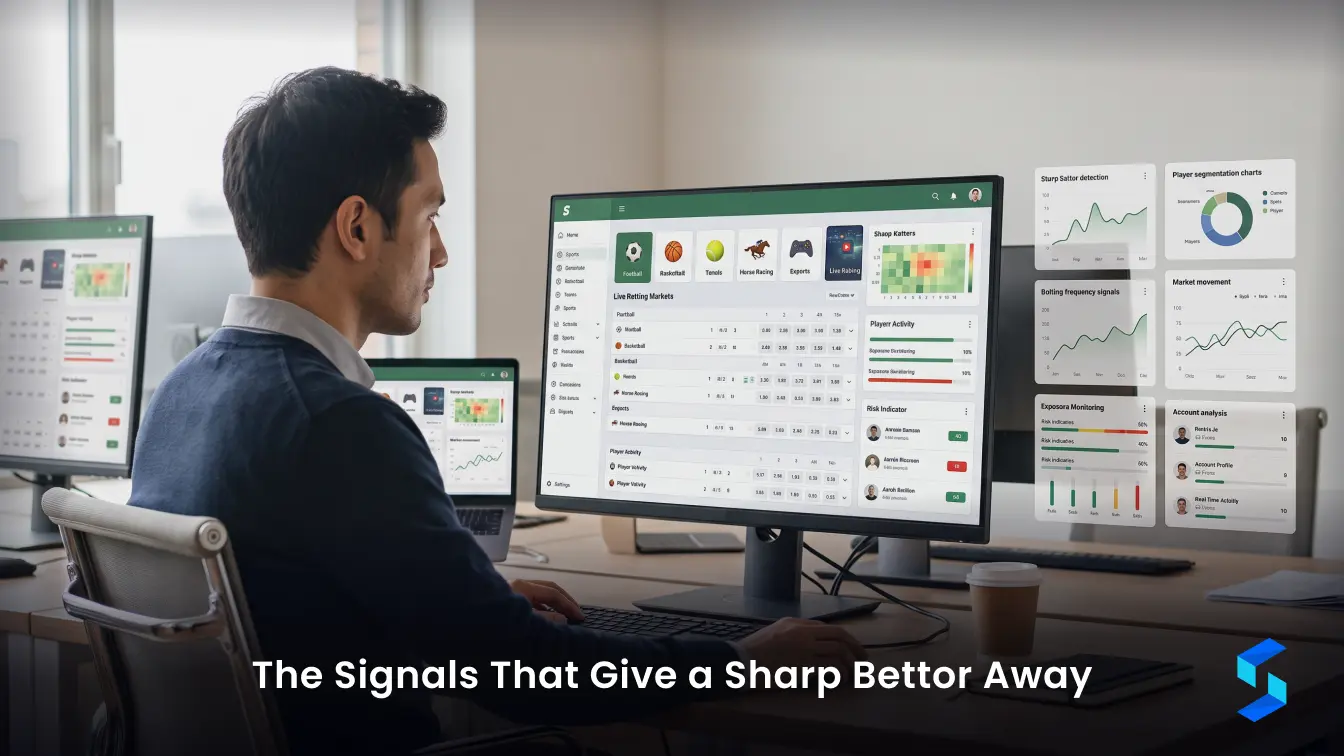
This guide is written for sportsbook operators and risk teams evaluating detection tooling — not a guide for bettors trying to evade it. Understanding the signals matters because getting detection wrong in either direction costs money: too loose, and a proprietary edge quietly drains margin; too aggressive, and recreational players get wrongly flagged.
What “Sharp” Actually Means to a Risk Team
A sharp bettor is one whose action is informed enough to consistently beat the market, as distinct from a recreational or “square” bettor whose action is closer to random relative to the closing price. Risk teams care less about whether someone wins in a given week and more about whether their action is predictive over time.
Closing Line Value: The Single Strongest Signal
Closing Line Value (CLV) whether a bettor consistently gets a better number than where the market closes is widely treated as the strongest predictor of long-term profitability, and risk teams weight it more heavily than short-term win/loss record. A bettor who reliably beats the close is demonstrating informational or modelling edge, whether or not last week’s results looked lucky or unlucky.
Other Detection Signals Risk Teams Watch
- Reverse line movement correlation betting consistently on the side the market moves toward, against public money
- Bet timing relative to line changes reacting within seconds of an odds update is a mechanical tell that manual bettors rarely produce
- Bet sizing patterns unusually precise, non-round stakes can indicate calculator-driven sizing rather than casual wagering
- Market concentration exclusively targeting mispriced or newly opened markets rather than mainstream, well-priced ones
Detection Signal Comparison Table
| Signal | What It Measures | Typical Operator Response |
|---|---|---|
| Closing Line Value | Whether a bettor consistently beats the closing number | Gradual limiting or targeted line adjustment |
| Reverse line movement correlation | Whether a bettor’s action aligns with sharp market moves | Flag for manual trader review |
| Bet timing | Speed of reaction to line changes | Automatic flag if consistently sub-second |
| Bet sizing pattern | Round vs unusually precise stake amounts | Secondary signal, rarely acted on alone |
| Market concentration | Focus on mispriced or niche markets | Elevated scrutiny, not automatic limiting |
Building or upgrading sharp-detection tooling?
The Regulatory Question Operators Can’t Ignore
Limiting winning bettors isn’t legally settled everywhere. Some US states have begun examining whether the practice constitutes an unfair business practice, and regulators including the Massachusetts Gaming Commission have held public discussions with operators on the topic. Building detection systems with a clear, documented, and consistently applied policy rather than ad hoc trader discretion matters as much for regulatory defensibility as for risk management itself.
Building a Detection System That Doesn’t Over-Trigger
- Require multiple corroborating signals before acting, since any single signal alone produces meaningful false positives on recreational players
- Use a graduated response reduced limits before an outright account restriction rather than a binary ban
- Route flagged accounts to human review rather than fully automated action, especially for borderline cases
- Keep a documented, consistent policy that could be explained to a regulator if challenged
Why This Matters Beyond a Single Sportsbook’s P&L
Sharp detection isn’t purely a defensive cost centre. A book that consistently misprices against sharp action bleeds margin across its entire portfolio, not just on the specific bettors it eventually limits by the time an account is flagged, the mispricing that let it profit has often already been visible in the book’s overall trading results for weeks. Detection tooling that surfaces signals early enough to correct pricing, not just to limit an individual account after the fact, protects margin more broadly than account-level action alone.
Ready to build a defensible sharp-detection framework?
Related Reading
- Sportsbook Risk Management Solutions 2026
- Retail Betting Client Fraud: Biometric Verification Cuts Commission Losses
- In-House Odds Engine vs Third-Party Feed
Further Reading & Sources
- IredellFreeNews — Sports Betting Data 2026: Public Betting Percentages, Line Moves & Handle Reports
- ESPN — Sportsbooks Defend Practice of Limiting How Much Sharp Customers Can Bet

