


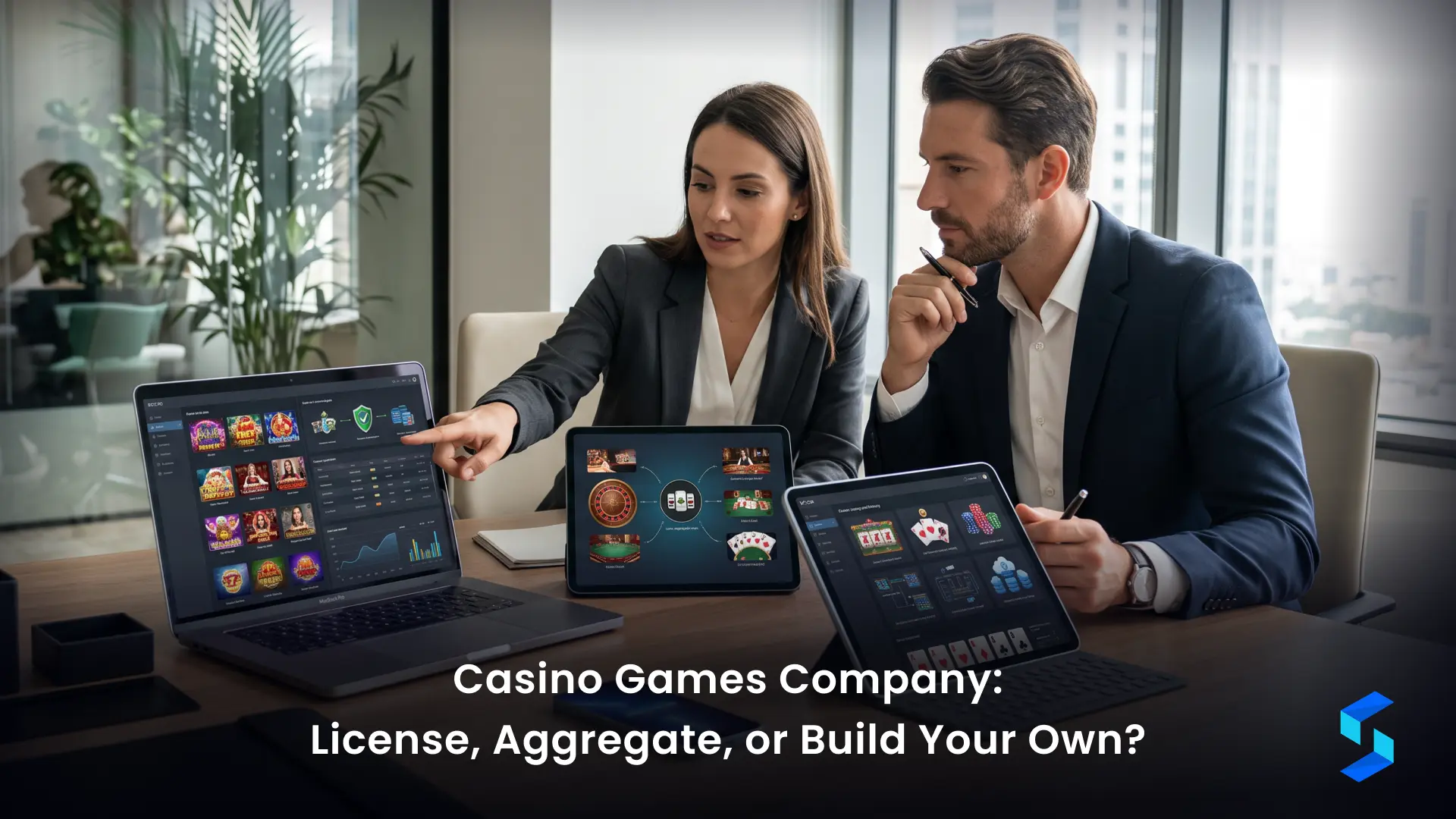
A casino games company is the studio that designs, develops, and certifies the game titles that run inside a casino platform—slots, table games, crash games, and live dealer content. As a casino operator, your relationship with game companies is one of the most commercially consequential decisions you make, because the game library is the primary reason players return or leave.
This guide is for operators who need to understand the difference between licensing content from a casino games company, aggregating through a multi-provider API, and commissioning original game development—and when each approach makes the most sense.
Types of Casino Games Companies
Game Studios (Content Creators)
A casino game studio designs and produces original game titles. They own the game IP, hold RNG certification for their titles, and license the content to casino operators directly or through aggregators.
Examples of what studios produce:
- Original slot titles with proprietary math models and art
- Branded table game variants (proprietary blackjack side bets, unique roulette formats)
- Crash games (Aviator-style, first-person perspective)
- Live dealer table content (if the studio runs a broadcast facility)
When you license directly from a game studio, you typically access their catalog through a revenue share arrangement (3–10% of GGR on their games) with a direct commercial relationship.
Game Aggregators
A game aggregator is a company that bundles content from multiple studios into a single API connection. Instead of negotiating directly with 50 studios, an operator connects once to the aggregator and accesses all 50 studios through one integration.
What aggregators add beyond studio access:
- Single API for all game types (slots, live, crash, table)
- Unified wallet transaction handling across all studio content
- Consolidated GGR reporting across all studios
- Technical maintenance of individual studio API connections
Most operators who search for a “casino games company” are actually looking for an aggregator—a single relationship that gives broad game library access, rather than 30 individual studio contracts.
Live Casino Studios
Live casino content producers are a specialised subset of game studios. They operate broadcast facilities with real dealers, cameras, and studio infrastructure, and stream live table games to operators. Unlike a standard slot studio, a live casino studio provides ongoing operational infrastructure (staffing, streaming, compliance) rather than a one-time licensed game title. For full detail on evaluating live casino content providers, our live casino software provider guide covers the criteria that matter specifically for live dealer selection.
Game Studio vs. Game Aggregator: The Key Differences
| Factor | Direct Studio Licensing | Game Aggregator |
|---|---|---|
| Integration effort | One integration per studio | One integration for all studios |
| Revenue share | 3–10% GGR per studio | 2–8% GGR (aggregator takes a share too) |
| Contract complexity | Separate contract per studio | Single commercial relationship |
| Game variety | Limited to one studio’s catalog | 50–200+ studio catalogs |
| Exclusivity options | Possible on custom games | Rarely available |
| Best fit | Flagship title strategy (1–3 studios) | Broad catalog strategy |
Most operators at launch use an aggregator for catalog breadth, then negotiate direct studio relationships for their highest-performing game categories once volume justifies the additional contract management.
Choosing Between Casino Game Studios and Aggregators?
Our team helps operators structure their game content strategy and negotiate provider relationships. Let us help you build a library that drives engagement.
How to Evaluate a Casino Games Company
RNG Certification Is the Non-Negotiable Starting Point
Any casino games company offering real-money content must hold RNG certification from an accredited independent testing laboratory. The major labs: BMM Testlabs, eCOGRA, iTech Labs, and Gaming Laboratories International (GLI).
A certification by any of these labs verifies that:
- The game’s random number generator produces outcomes with statistical randomness
- The game’s RTP (return to player) matches the published figure
- The game logic doesn’t contain exploitable patterns
A studio that cannot name its testing lab and produce a current certificate should not be on your shortlist, regardless of how impressive its portfolio looks.
Game Catalog Fit for Your Target Market
The best casino games company for your operation is the one whose game catalog overlaps with your target market’s player preferences:
- India: Teen Patti, Andar Bahar, Rummy, high-multiplier crash games
- Southeast Asia: Baccarat (especially Dragon Tiger variant), Fish shooting games, crash
- Europe and UK: Branded slots, Megaways mechanics, live roulette and blackjack
- Crypto / Web3: Provably-fair crash games, NFT-integrated slots, hash-based dice
A studio with 3,000 European-market slots and no South Asian game content is not a good fit for an India-facing operator, regardless of total catalog size.
New Release Cadence
A casino games company that hasn’t released new titles in 6 months is either struggling commercially or prioritising existing clients over new ones. Ask for a release schedule for the past 12 months. Studios actively investing in product release at least quarterly during that period.
Mobile Rendering Quality
Test the actual games on a mid-range Android device on a 4G connection—not in a desktop demo on the studio’s broadband. Mobile accounts for 57%+ of casino GGR. Games that load slowly or render poorly on mobile lose players before they bet.
When to Build Your Own Casino Games (Custom Development)
Commissioning original game development from a casino game development company makes commercial sense when:
- You want branded IP that no competitor can use—exclusive game mechanics, characters, or bonus formats
- Your target market has a game type that no studio currently serves well (specific regional card games)
- You’re building a crypto casino where provably-fair verification on your own RNG is a core trust proposition
- You’re at a GGR volume where the revenue share on a licensed game library exceeds what original development would cost
A basic branded slot costs $10,000–$25,000. A mid-tier original slot with custom bonus mechanics costs $30,000–$80,000. These ranges are meaningful investment for new operators but can pay back quickly if the exclusive title becomes a retention driver.
Casino Games Company Cost Structure
| Licensing Model | Typical Cost |
|---|---|
| Direct studio revenue share | 3–10% of GGR on that studio’s games |
| Aggregator API license | 2–8% of GGR (covers multiple studios) + sometimes a fixed monthly minimum |
| Exclusive game licensing | Higher share + often a minimum guarantee |
| Custom game development | $10,000–$500,000+ per title |
The Casino Game Providers Integration Process
Integrating a casino games company into your platform—whether a studio or aggregator—follows a standard technical pattern: 1) Commercial agreement signed, 2) Technical integration (API credentials, wallet connection), 3) Compliance review, 4) Staging environment testing, 5) Go-live. Our casino API provider guide covers the technical integration pattern including seamless wallet architecture.
Top Casino Game Providers: What to Look For in 2026
Rather than a ranked list, the filter for what makes a top casino game provider in 2026 for your specific operation includes: RNG certification in your licensing jurisdiction, game catalog alignment to player preferences, mobile rendering quality, quarterly title releases, transparent revenue share structure, and API sandbox access.
Red Flags to Watch For
- No RNG Certification Mention: Be cautious of any studio quoting a casino game build without mentioning RNG certification at all—that’s either inexperience or a plan to skip a step that real-money licensing requires.
- Suspiciously Underpriced Estimates: Be equally cautious of quotes that seem far below the market standards; underpriced contracts are a common source of mid-project scope disputes and quality shortfalls, particularly on math-model accuracy.