


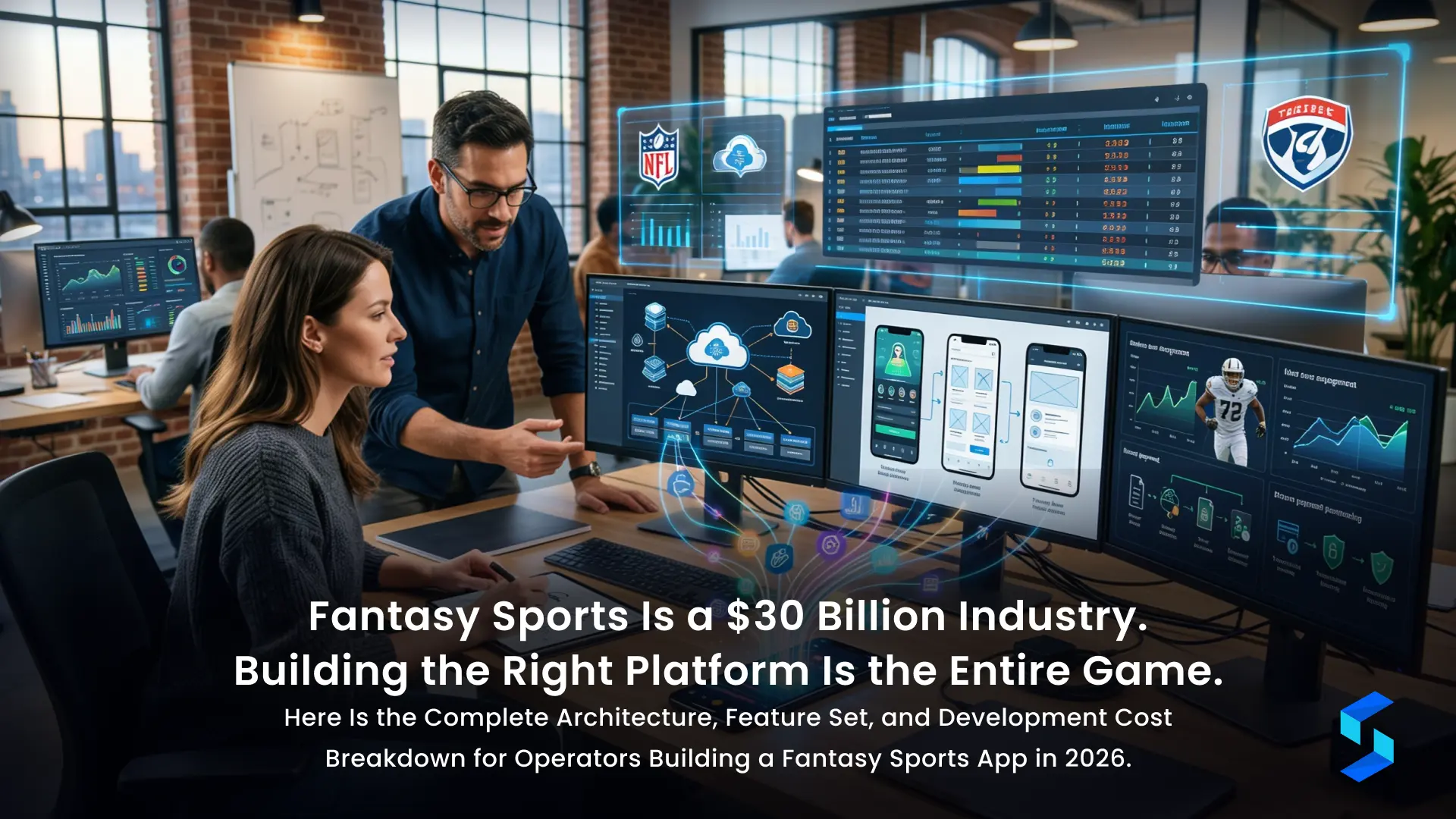
Fantasy sports is one of the most technically demanding products in the gaming industry – and one of the most commercially rewarding when built correctly. Unlike casino games where the platform generates random outcomes, a fantasy sports platform must ingest live player statistics from real-world sporting events, apply complex scoring algorithms in real time, manage thousands of concurrent contests with different scoring rules and prize structures, and deliver results to players with millisecond accuracy as games are being played.
The global fantasy sports market exceeded $30 billion in 2025 and continues to grow, driven by cricket in India, American football in North America, and football and cricket globally. But market size does not translate automatically into operator revenue – the platforms that win are the ones built with the right architecture from day one, not patched together as user volumes grow.
If you are evaluating whether to build or integrate a fantasy sports capability, our fantasy sports platform development service covers both the technology and the commercial model in detail.
Core Features Every Fantasy Sports App Needs at Launch
| Feature Category | Specific Features | Priority |
|---|---|---|
| Contest Management | Public and private contests, guaranteed prize pools, head-to-head, multi-entry | Launch critical |
| Draft System | Linear draft, snake draft, autopick fallback, draft lobby with real-time updates | Launch critical |
| Scoring Engine | Sport-specific scoring rules, bonus multipliers, captain/vice-captain mechanics | Launch critical |
| Live Score Feed | Real-time player stats ingested from data provider, points updated as events occur | Launch critical |
| Player Stats and Research | Historical performance, form guide, injury status, fixture difficulty rating | Launch critical |
| Wallet and Payments | Deposit, withdrawal, contest entry fee deduction, winnings credit, bonus management | Launch critical |
| Leaderboard and Results | Real-time rank updates during live contests, final results with prize distribution | Launch critical |
| KYC and Verification | Identity verification gated at withdrawal threshold; age verification at registration | Launch critical |
| Push Notifications | Contest start alerts, score milestones, contest result notifications, lineup deadline reminders | High priority |
| Social Features | Private leagues, friend invites, team name, team badge, head-to-head trash talk | Growth phase |
| Referral and Affiliate | Unique referral codes, referee bonus, referee first deposit tracking | Growth phase |
Platform Architecture: The Technical Stack
Data Feed Integration – The Most Critical Dependency
A fantasy sports platform is only as good as its data feed. Player statistics must arrive in real time, be accurate to the official record, and cover every player across every squad in every sport you offer. The major data providers for fantasy sports:
- Sportradar: widest coverage globally – NFL, NBA, MLB, Premier League, IPL, and 60+ other sports; offers fantasy-specific data packages with pre-computed fantasy points
- Stats Perform (Opta): premier football, rugby, and cricket data with historical depth for research features
- Genius Sports: NFL and NBA exclusive official data partnerships; critical for US-facing products
- CricketAPI / CricHeroes: specialist cricket data feeds for South Asian markets
Backend Architecture
The core backend services a fantasy sports platform requires:
- Contest service: manages contest creation, entry processing, prize pool calculation, and result finalization
- Scoring engine: subscribes to the live stats feed and applies sport-specific scoring rules to produce fantasy points in real time for every player in every active contest
- Lineup service: stores player team selections, validates lineups against contest rules (budget cap, player limits, team distribution), and locks lineups at contest start
- Leaderboard service: computes and caches real-time team rankings within every active contest – must handle high read throughput during live events
- Wallet service: manages player balances with double-entry ledger; processes entry fee collections and prize disbursements atomically
- Notification service: delivers push notifications, emails, and in-app alerts based on contest lifecycle events and player score milestones
Our fantasy sports technology stack and API overview covers the specific API integrations and backend architecture for each major sport.
Development Cost Breakdown for a Fantasy Sports App in 2026
| Development Component | MVP Estimate | Full-Feature Build |
|---|---|---|
| Core backend (contest, scoring, wallet, lineup) | $40,000 – $70,000 | $90,000 – $150,000 |
| Data feed integration (1 sport, 1 provider) | $8,000 – $15,000 | $20,000 – $40,000 (multi-sport) |
| Mobile app (iOS + Android) | $30,000 – $55,000 | $60,000 – $100,000 |
| Admin panel and contest management | $12,000 – $20,000 | $25,000 – $45,000 |
| KYC and payment integration | $10,000 – $18,000 | $18,000 – $35,000 |
| Real-time leaderboard and notifications | $8,000 – $15,000 | $15,000 – $28,000 |
| QA, security audit, and launch prep | $10,000 – $20,000 | $20,000 – $40,000 |
| TOTAL (approximate) | $118,000 – $213,000 | $248,000 – $438,000 |
These estimates assume a development partner with iGaming-specific experience building fantasy sports systems. Generic app development agencies building fantasy sports for the first time typically run 40–60% over these figures due to the domain-specific complexity of scoring engines, live data synchronisation, and real-money payment compliance.
Compliance and Licensing for Real-Money Fantasy Sports
Fantasy sports licensing varies dramatically by jurisdiction:
- India: fantasy sports operates under the skill game exemption from gambling law in most states; platforms must register with the Federation of Indian Fantasy Sports (FIFS) and comply with information technology and payment guidelines
- United States: real-money daily fantasy sports (DFS) requires state-level DFS licences – currently available in 45+ states; season-long leagues with prize pools may require gambling licences in some states
- United Kingdom: fantasy sports with cash prizes typically require a Gambling Commission remote gambling licence
- Rest of world: varies significantly – many jurisdictions treat fantasy sports as skill games exempt from gambling law; others require gambling licences for cash prize products
For a detailed breakdown of fantasy sports legal and monetisation models, our fantasy sports monetisation and legal framework guide covers the major markets.
Related Resources
- Fantasy Sports Platform Development Service – Full-service fantasy sports app development for operators
- Fantasy Sports Key Features and UI Guide – Feature specification for fantasy sports platform development
- Fantasy Sports Technology Stack and API Integration – Backend architecture and data feed integration for fantasy sports
- Fantasy Sports Monetisation and Legal Framework – Commercial models and jurisdiction-specific legal requirements
- iGaming Platform Development Cost Breakdown – Development cost context for iGaming platform builds
Ready to Build Your Fantasy Sports Platform?
Source Code Lab has built fantasy sports platforms for operators across India, Southeast Asia, and North America – with sport-specific scoring engines, live data integrations, and real-money payment compliance. Talk to our team.