
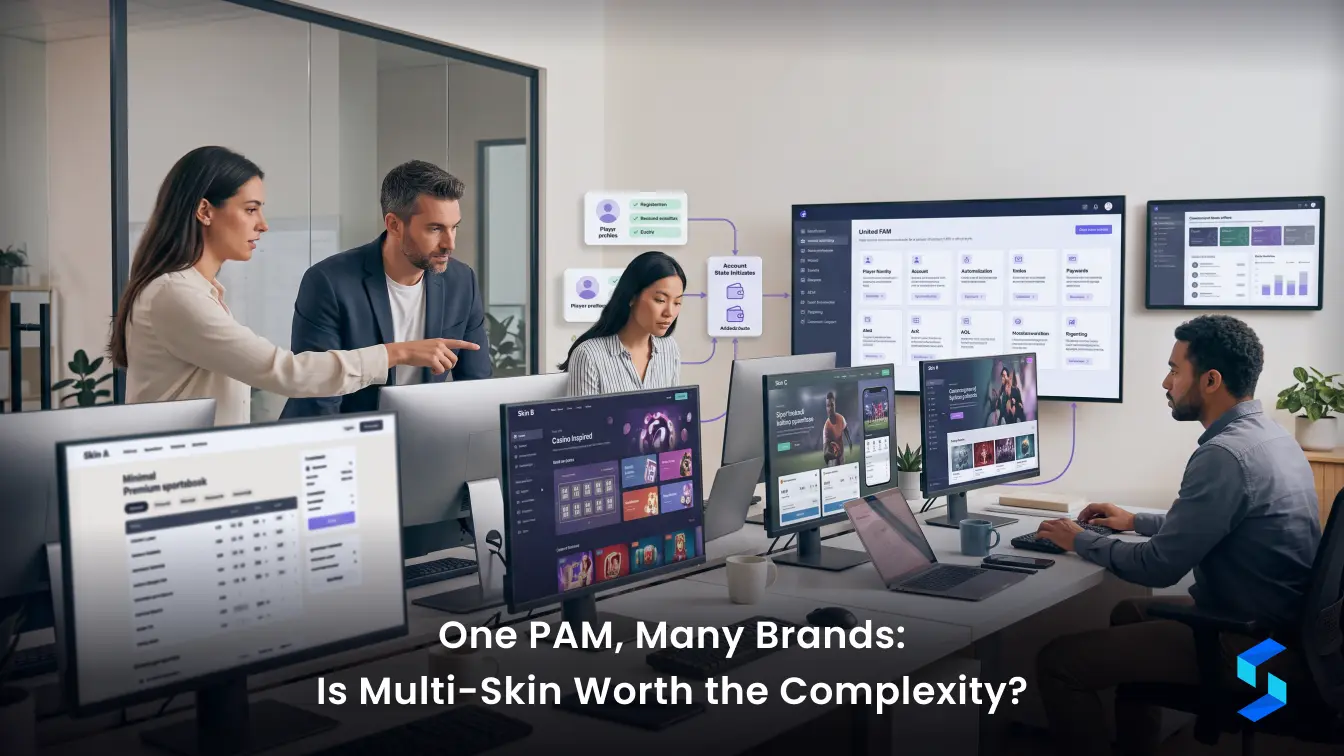
This builds on our broader guide to Player Account Management systems — this piece covers the specific architecture question of running multiple brands from one PAM.
What “Multi-Brand” Actually Means
A multi-brand (or multi-skin) PAM lets an operator run several distinct player-facing brands — different names, designs, and sometimes different target markets — from a single underlying back-office, player database, and compliance infrastructure, rather than standing up entirely separate technology stacks for each brand the company operates.
What’s Shared vs What’s Separate Between Skins
Typically Shared
- Core PAM infrastructure, database architecture, and payment processing relationships
- Game aggregator and content provider integrations
- Underlying compliance, KYC/AML, and responsible-gambling monitoring logic
Typically Kept Separate Per Skin
- Front-end design, branding, and domain
- Bonus and promotion structures, since different brands often target different player segments
- Licensing, in cases where each skin operates under a distinct gambling licence even on shared infrastructure
Comparison Table: Single-Brand vs Multi-Brand PAM
| Factor | Single-Brand PAM | Multi-Brand PAM |
|---|---|---|
| Infrastructure cost per brand | Full cost per new brand | Marginal cost for each additional skin |
| Time to launch a new brand | Full platform build | Weeks, once the core PAM is proven |
| Cross-brand data risk | None | Requires deliberate design to prevent balance/data leakage |
| Licensing complexity | Simple, single licence | May require separate licensing per skin depending on jurisdiction |
| Best fit | Operators with one clear target market | Operators targeting multiple segments or geographies |
Considering a multi-brand platform strategy?
Why Operators Choose Multi-Brand
Launching a new brand on proven, shared infrastructure is meaningfully cheaper and faster than building a new platform from scratch — which is exactly why multi-brand strategies are common among operators targeting several distinct player segments (a VIP-focused brand alongside a mass-market one) or several regional markets under one company.
The Design Decision That Determines Everything Else
Whether wallets are shared across skins within the same brand family, or kept fully isolated per skin, is usually the single decision that most affects downstream complexity — a shared cross-brand wallet is rare in practice, and where it exists it’s typically restricted by licensing terms that vary by jurisdiction, since regulators generally expect a clean separation of player funds by licensed entity.
Common Mistakes When Building Multi-Brand Support
- Retrofitting multi-brand logic onto a PAM that was architected assuming a single brand, which typically requires touching far more of the codebase than anticipated
- Sharing bonus and promotion logic across brands that are meant to target genuinely different player segments, diluting the differentiation the multi-brand strategy was supposed to create
- Underestimating the compliance overhead of maintaining separate licences per skin, treating it as a paperwork exercise rather than a genuine operational and reporting requirement
When Multi-Brand Doesn’t Make Sense
Not every operator benefits from a multi-brand strategy. If the target market and player segment are genuinely narrow, running a second brand mainly duplicates marketing spend and support overhead without meaningfully expanding reach — multi-brand architecture earns its complexity when it’s actually opening a distinct segment or geography, not when it’s simply splitting one audience across two names.
Ready to plan a multi-brand platform strategy?
Related Reading
- Player Account Management (PAM) Systems Explained
- White-Label vs Custom Casino Development: How to Choose the Right Model
- iGaming Platform Market Growth: Operators Guide