

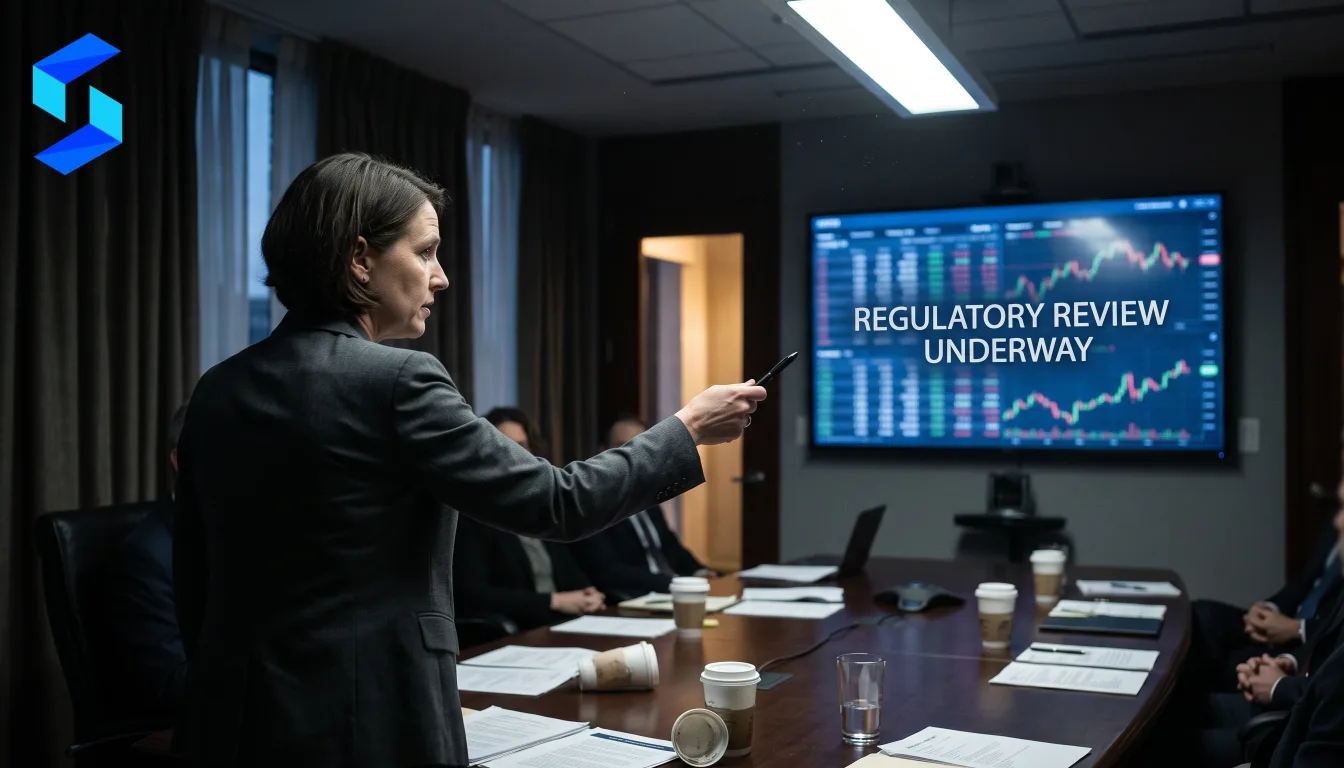
The US Commodity Futures Trading Commission has submitted two draft proposals to the White House that could fundamentally alter the regulatory treatment of event contracts, following recent court defeats that have emboldened the prediction market sector.
The CFTC on Monday sent the drafts to the White House Office of Information and Regulatory Affairs, seeking to modify the definition of a “swap” for prediction market purposes. A swap is broadly defined as a transaction that depends on the occurrence of an event associated with a “financial, economic, or commercial consequence”.
One proposal (RIN: 3038-AF82) seeks to broaden the definition of a swap to include event contracts. A separate proposal under review would determine whether swaps can exclude gaming-style products. If approved, the rule would prohibit Designated Contract Markets from listing contracts on online gaming products such as blackjack and craps.
Court Losses Prompt Regulatory Response
The proposals come fresh off two stinging circuit court defeats for the regulator. Last week, the US Court of Appeals for the Sixth Circuit ruled in favor of Tennessee, reversing a lower court decision. In 2025, Kalshi began offering event contracts in Tennessee, arguing that the products met the standard for swaps.
The drafts may appease iCasino advocates with concerns that prediction markets could unseat traditional gaming products in the coming years. The timetable for the next stages of the regulatory process are not immediately clear.
Gaming Industry Unites Against Prediction Markets at G2E
For the second consecutive year, states rights advocates took a united stand against prediction markets at the Global Gaming Expo in Las Vegas. The American Gaming Association, which has led the charge against the new asset class, estimates that states have lost more than $1 billion in tax revenue from the rise of predictions.
At this week’s show, the AGA joined forces with the Indian Gaming Association, which views prediction markets as an existential threat against the future of the US regulated gaming market. On an opening-day panel Monday, AGA President Bill Miller took exception with claims from predictions operators that the contracts can serve as viable hedging tools.
In Miller’s view, a customary Tuesday night baseball game “does not serve” an economic purpose, but is instead sports wagering. Miller was joined on stage by IGA Chair David Bean and Executive Director Jason Giles.
While Miller opined that the fight is likely headed to the Supreme Court, he believes the states have gained momentum on the back of recent lower court victories. “The only way we lose is if we take our foot off their throat,” Miller said.
Cruz College Bill Passes Senate
As the gaming industry converged on Las Vegas for the conference, a groundbreaking bill overwhelmingly passed in the US Senate. On Monday, the Protect College Sports Act, a bill from Texas Senator Ted Cruz on uniform standards in college athletics, passed by a margin of 77-22.
The act explicitly gives conferences and athletic associations the ability to restrict a player from participating in college sports if that athlete engages in sports betting or sports event contracts. The bill now heads to the US House of Representatives.
Also this week, reports surfaced that Kalshi has sought a new funding round of $1 billion that would value the company at approximately $40 billion. Kalshi’s valuation has more than doubled over the last year.
In other news, San Antonio Spurs center Victor Wembanyama weighed in on player endorsements of prediction market and sportsbook operators. Asked if he would consider endorsing either type of operator, Wembanyama responded: “Absolutely not, honestly, I think it’s very sad to see some players promote it.”

