

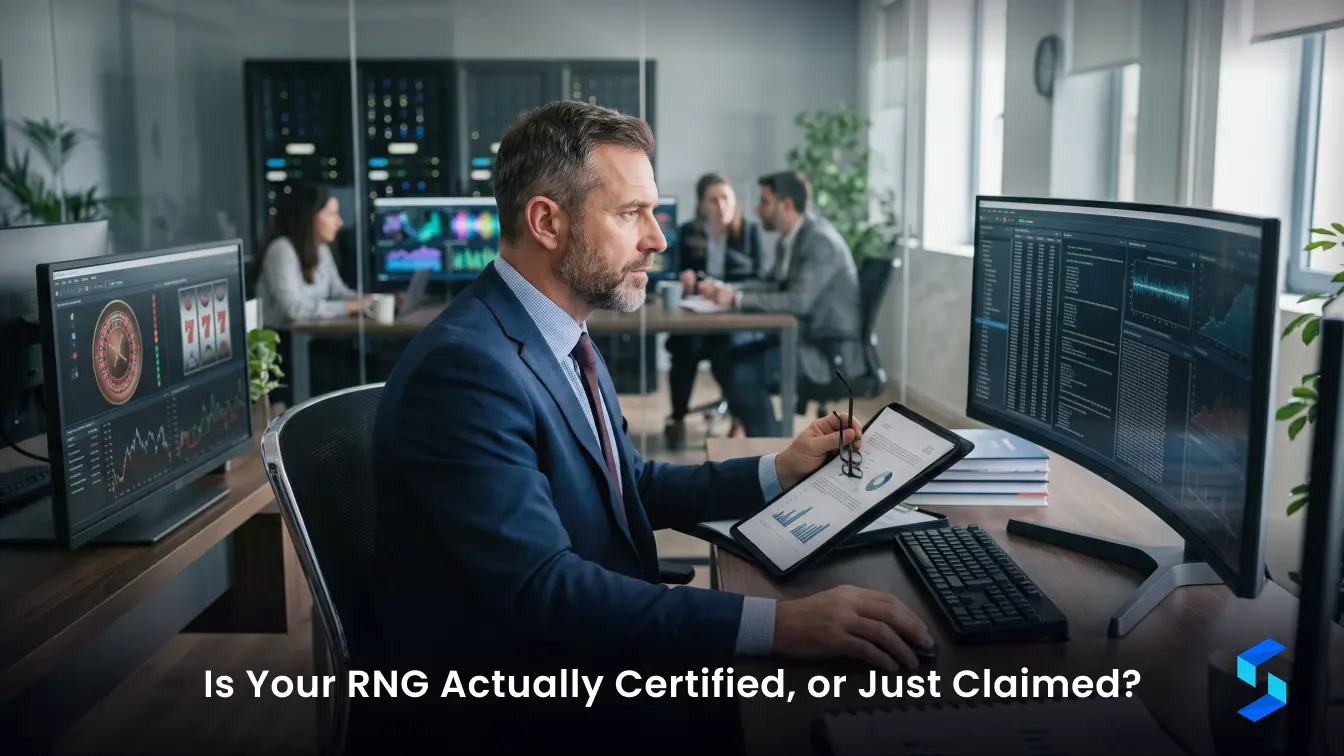
Our earlier guide on what RNG means in video games covers the concept. This one covers the part that actually gets an operator licensed: getting an RNG independently certified.
What RNG Certification Actually Tests
Certification verifies statistical randomness, uniform distribution, absence of predictability or bias, and that real-world outcomes match the game’s declared Return to Player (RTP). Labs run this analysis across millions to billions of simulated outcomes, using recognised statistical suites such as NIST SP 800-22 and chi-square testing, alongside a review of the source code itself for seed handling and predictability vectors.
Who Certifies RNGs: The Major Testing Labs
| Lab | Known For | Best Fit |
|---|---|---|
| GLI (Gaming Laboratories International) | Largest global footprint; land-based heritage | Widest US-state and international coverage; some jurisdictions (e.g. Nevada) favour GLI for server-based systems |
| BMM Testlabs | Strong US East Coast presence; fast table-game turnaround | Multi-state US operators |
| eCOGRA | UK-based since 2003; ISO/IEC 17025 accredited; player-protection focus | European markets |
| iTech Labs | Asia/Europe focus; acquired by GLI in 2023 | Markets that specifically accept iTech Labs certification |
| NMi / QUINEL / Gaming Associates | Regional and niche jurisdiction coverage | Confirm acceptance for your specific target market before engaging |
The Certification Process, Step by Step
- Compile the RNG specification, math model report, and system architecture documentation — missing documents are the single most common cause of delay
- Select a lab approved for every target jurisdiction, since approved test-house lists differ by regulator and change over time
- Statistical testing runs across millions of simulated rounds to confirm randomness and RTP accuracy
- Functional testing verifies every payout rule, bonus trigger, and edge case behaves as documented
- Source-code review checks for algorithmic soundness and correct seed handling
- Certificate is issued, and most labs continue monitoring for ongoing compliance after launch
How Long Does RNG Certification Actually Take?
Timelines vary more with documentation completeness than with the testing itself. A pre-submission consultation with the lab, used to catch documentation gaps before the formal review clock starts, is one of the more reliable ways to avoid an avoidable delay.
What Happens Without Certification
An uncertified RNG isn’t a grey area — serious regulators, payment partners, and banks simply treat unverified software as not legitimate for licensed operation. For players and due-diligence teams alike, a certification badge that isn’t clickable through to a live verification page on the lab’s own site is a real red flag, not a formality.
Choosing the Right Lab for Your Jurisdiction
- Match the lab to your target market’s currently approved test-house list — this changes over time, so confirm directly with the regulator rather than relying on last year’s list
- For US multi-state launches, GLI’s coverage is typically the broadest starting point
- For European markets, eCOGRA and iTech Labs are commonly accepted, subject to per-country confirmation
Common Mistakes That Cause Certification Delays
- Submitting a math model report that doesn’t match the actual shipped build, forcing a resubmission once the lab catches the discrepancy
- Assuming a certification from one jurisdiction automatically transfers to another, when most regulators require their own approved lab’s sign-off
- Treating certification as a one-time event rather than budgeting for ongoing monitoring and periodic re-testing as game rules or paytables change
- Choosing a lab based on price alone without confirming it’s actually accepted in every target jurisdiction on the roadmap
Most of these are avoidable with a short pre-submission consultation, which several labs offer specifically to catch documentation and scope issues before the formal review clock starts.
What Drives Certification Cost
- Number of games and jurisdictions being certified simultaneously — bundling reduces per-game overhead
- Whether documentation is submission-ready on day one, or needs back-and-forth revision with the lab
- Complexity of the game itself — a simple slot mechanic certifies faster and cheaper than a multi-feature bonus game with dozens of edge cases
- Ongoing monitoring and periodic re-certification as paytables or rules change post-launch
Need help scoping RNG certification for a new market?
Related Reading
- RNG: What It Means in Video Games
- Casino Game Development Company Cost Guide 2026
- Gambling Licence Types & Costs: Operator Guide
Further Reading & Sources
- SDLCCorp — RNG Certification for Casino Games: Complete Guide
- TechMast — Technical Gaming Standards Decoded: GLI-19, BMM, and State-Specific Requirements