


Crypto Poker Software for Operators
Crypto poker software for operators launching Bitcoin poker rooms: a game server, crypto wallet and cashier, anti-fraud tools and a back office, built by Sourcecodelab for iGaming businesses.
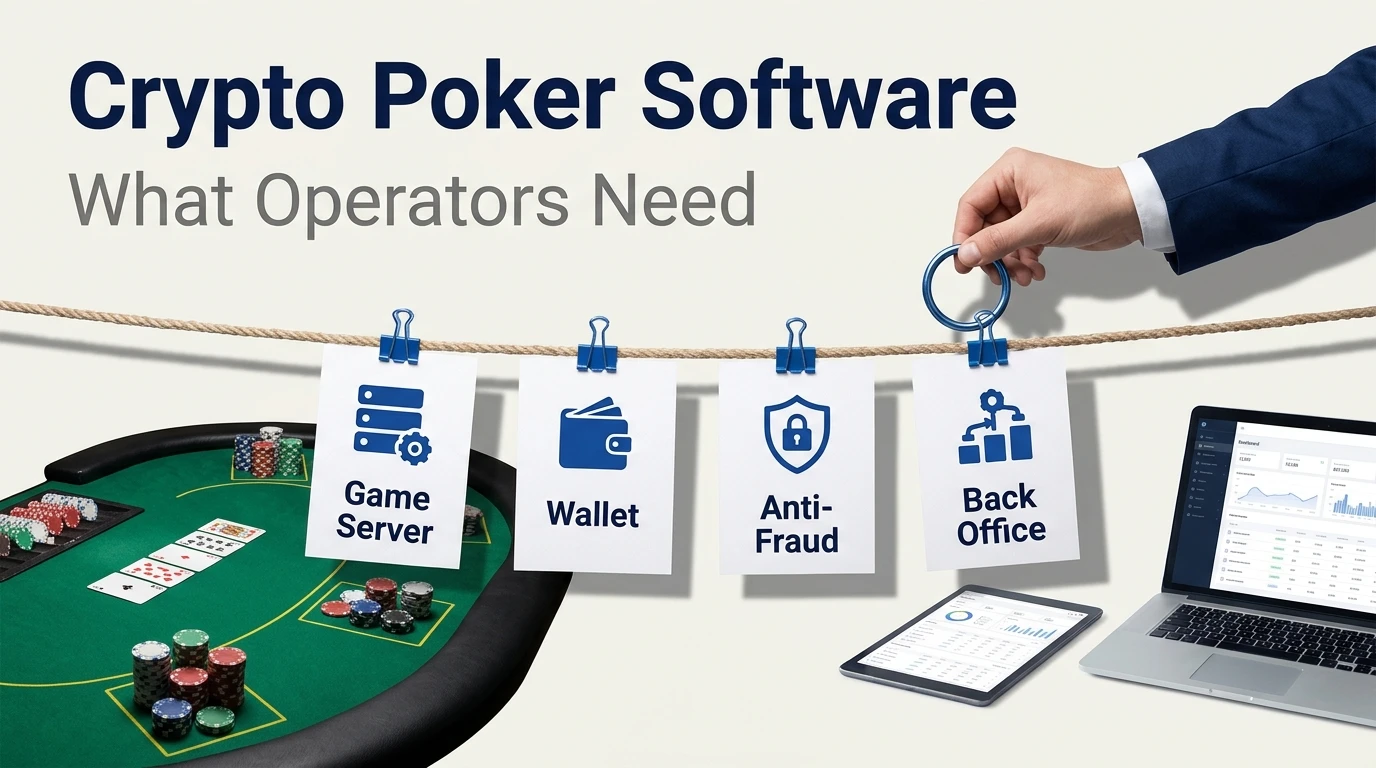
Why Bitcoin poker rooms struggle on generic poker software
Most poker platforms were designed around card payments and known players, and a crypto room breaks both assumptions.
Payments built for cards, not coins
Deposits arrive on-chain and confirm on the network's schedule, not the cashier's. A cashier designed for card processors has no clean way to handle confirmations, network fees or withdrawal addresses. Your support team ends up resolving payment tickets by hand.
Collusion is harder to spot
Crypto accounts can be opened quickly with little identity attached. That makes multi-accounting, chip dumping and bot play easier to start and harder to trace. Without hand-level monitoring and linked-account checks, you find out from players' complaints.
Wallet and table state drift apart
When the wallet, the game server and the back office each keep their own balance records, small mismatches build up. Finance cannot reconcile a session against a transaction. Every disputed hand then turns into a manual investigation.
What we hand over for a Bitcoin poker room
Each item below is a working part of the room, delivered with the source and notes your team needs to run it.
Ways to work with us on your poker room
Pick the model that matches how much of the product you want to own and how fast your scope is likely to change.
Fixed-scope build
- Scope agreed in writing before work starts
- Poker server, client, wallets and back office delivered together
- Regular demos so you see progress on a working build
- Source and documentation handed over at the end
Dedicated team
- Developers and QA working on your roadmap
- Priorities set by you, sprint by sprint
- Direct contact with the engineers doing the work
Ongoing support
- Monitoring and bug fixing on the delivered platform
- Updates for new coins, wallets or client changes
- A named contact for incidents
What a Bitcoin poker room needs from its software
A crypto poker platform has to handle coin payments, live table play and operator controls in one system.
Wallet and deposits
Players get their own deposit addresses, and the cashier credits balances once the network confirms the transfer.
Withdrawal controls
Set review rules, limits and approval steps so payouts leave the hot wallet only when your policy allows.
Multi-coin support
Accept Bitcoin and other coins or stablecoins, with balances and rates handled in the cashier.
Ledger reconciliation
Match on-chain movements against player balances so finance can trace every deposit and payout.
Cash game tables
Run Texas Hold'em and other variants with configurable stakes, seat counts and buy-in rules.
Tournament engine
Schedule sit and go and multi-table events with blind structures, late registration and prize pool settings.
Lobby and clients
Give players a lobby and table client that work on web and mobile.
Shuffle and RNG
Deal cards from a secure random source, with hand histories kept for dispute review.
Collusion monitoring
Flag suspicious seating, chip dumping and shared-account patterns for your risk team to review.
Account protection
Add two-factor login, session controls and withdrawal address checks to protect player balances.
Player management
Search accounts, review activity, apply limits and handle verification from one admin area.
Rake and promotions
Configure rake, rakeback and bonus rules without changing the game engine.
Reporting
Track deposits, withdrawals, rake and player activity in reports your team can export.
Technologies behind a crypto poker platform
These are the standards and tools a Bitcoin poker room typically relies on for payments, play and data.
Bitcoin Core
Full node for verifying deposits and broadcasting withdrawals.
Lightning Network
Fast, low-fee small deposits and withdrawals for cash game players.
BIP32 and BIP44
Derive unique deposit addresses per player from one key tree.
ERC-20 and TRC-20
Accept stablecoins such as USDT alongside Bitcoin.
WebSocket
Pushes table actions and chat to players in real time.
CSPRNG
Cryptographically secure randomness for shuffling and dealing cards.
PostgreSQL
Stores accounts, ledgers and hand histories with transactional integrity.
Redis
Holds live table state and player sessions in memory.
Compliance points for a Bitcoin poker room
A crypto poker room still answers to licensing, player protection and audit rules, and the software has to be built with those in mind.
Built around your licence terms
Each jurisdiction sets its own rules on which games, currencies and player types are allowed. The platform is configured to fit the terms of the licence you hold or plan to apply for.
Identity and source-of-funds checks
Crypto deposits move fast, so player verification and transaction monitoring need to sit inside the cashier flow. The work is designed to meet the AML and KYC obligations your regulator sets, with checks you can tune.
Fair dealing and audit trails
Shuffling, dealing and hand history need to be reproducible and open to independent testing. The poker engine is built to meet the standards that testing labs apply, and every hand is logged for review.
Player protection tools
Deposit limits, session reminders and self-exclusion should work the same way for crypto balances as for any other currency. These controls are part of the player account, not an add-on.
How a crypto poker build moves from brief to launch
The work runs in clear stages so you know what is decided, what is built and what is being tested at any point.
Scope the room
We agree the poker formats, supported coins, target markets and licence requirements. This sets the feature list and the integrations the room needs.
Design the platform
We map the poker engine, wallet and cashier, back office and player lobby into one architecture. Compliance and reporting needs are placed in the design from the start.
Build and integrate
We develop the modules and connect the crypto payment layer, KYC providers and any game content you plan to add. You see working builds as they are completed.
Test and certify
We test gameplay, wallet handling, load and security, and prepare the material your testing lab and regulator ask for. Issues are fixed before anything goes live.
Launch and support
We take the room live, watch performance and handle updates and fixes after release. Your team gets the back-office training it needs to run daily operations.
At each stage you get a clear deliverable to review and sign off before the next one starts.
Crypto poker software: questions operators ask
Plain answers to questions a buyer might raise before scoping a Bitcoin poker room.
What is crypto poker software?+
Crypto poker software is a poker platform that accepts deposits and pays out in digital currencies such as Bitcoin. Besides the tables and lobby, it needs wallet handling, transaction tracking and a cashier built around blockchain payments. The poker engine itself works much like any other, so most of the difference sits in payments and account handling.
What core modules does a Bitcoin poker room need?+
At minimum you need a game engine, a lobby, a tournament manager, a cashier with crypto wallet support and a back office. Player accounts, verification and reporting are also needed. Security tooling for spotting collusion and bot play matters as well, because players judge a room largely on whether games feel fair and payouts arrive.
How are crypto deposits and withdrawals handled?+
The cashier connects to wallets or a payment processor, watches the blockchain for incoming transactions and credits the player once the deposit meets your confirmation rules. Withdrawals need approval rules and checks before funds leave. Decide early how you will handle network fees, currency conversion and price swings, since these affect both player experience and your accounting.
Do I still need KYC and compliance for a crypto poker room?+
Usually yes, because paying in crypto does not remove licensing or anti-money-laundering expectations. Requirements depend on the jurisdiction and the licence you hold or plan to apply for. Speak to a legal adviser before launch, and build verification and geo-restriction controls into the platform from the start rather than adding them later.
How do I keep poker games fair and secure?+
Use a tested random number generator for shuffling and keep game logic on the server. Add monitoring to flag collusion, multi-accounting and bots. Independent testing of the RNG can build player trust, and clear audit logs let your team review disputed hands. Fairness is a product feature as much as a technical one.
Should I build custom poker software or use a white-label option?+
It depends on how much control you need and how fast you want to launch. White-label gets you to market sooner with less engineering work, while a custom build gives more freedom over features, branding and payments. Compare the long-term cost of each, and check how easily either option connects to your existing accounts and payment setup.
How does a new poker room get enough players at the tables?+
Liquidity is the hardest part of any poker launch. Options include joining a shared player network, running promotions and scheduled tournaments, or focusing on a niche audience. Software cannot create players by itself, so plan your acquisition and retention approach alongside the technical build and set realistic goals for the early weeks.
Plan your Bitcoin poker room with us
Tell Sourcecodelab which crypto payments, game modes and markets you need, and we will talk through how a poker platform can be built around them. You get a clear view of the software side before you commit.
Talk to our team
