


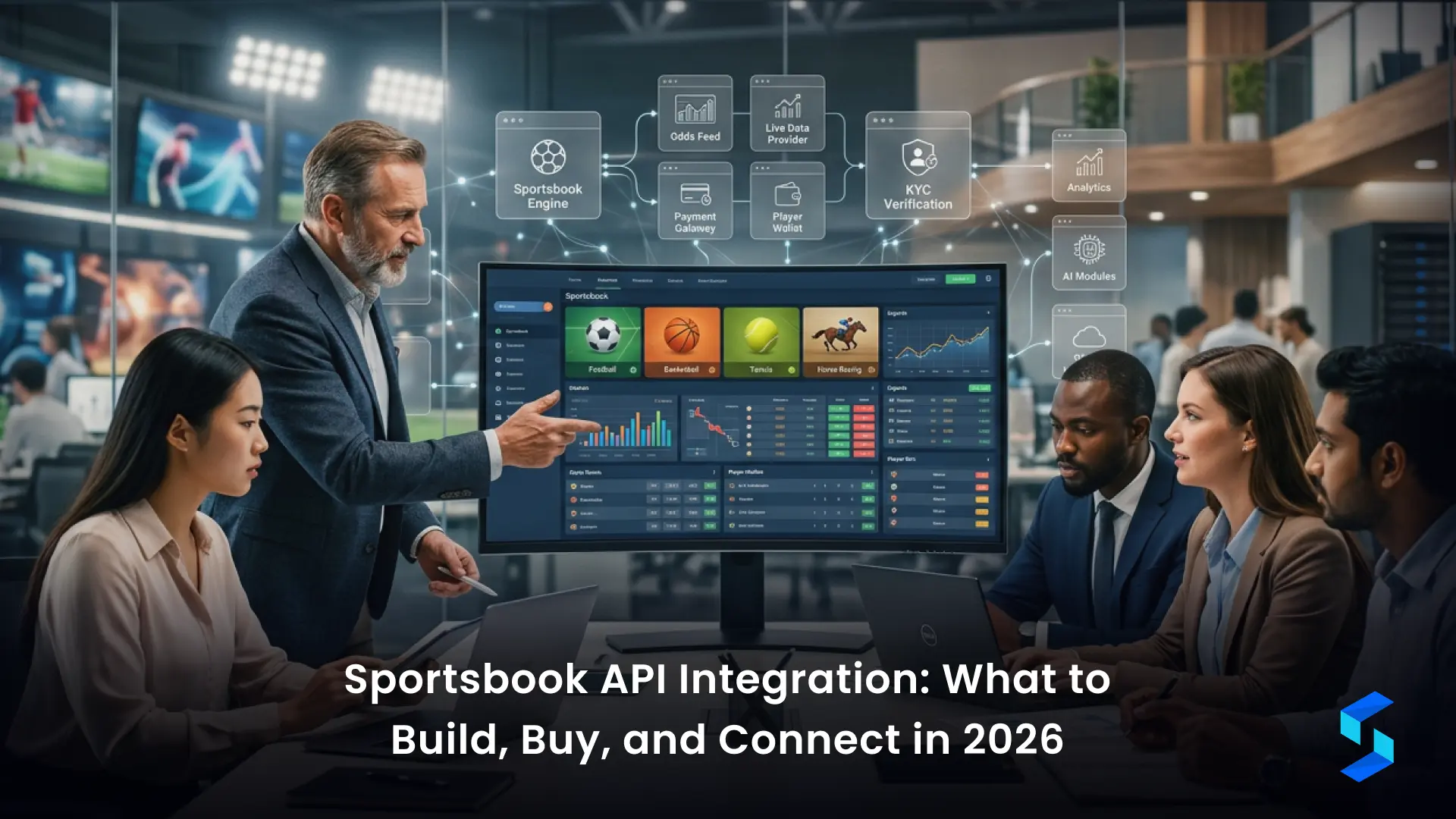
Sportsbook API integration is the technical process of connecting a sportsbook engine — its odds feed, bet placement logic, and settlement system — into an existing platform via API. It is how casino operators add sports betting to their product, how new sportsbook operators connect a pre-built engine to a custom front-end, and how B2B aggregators plug multiple sportsbook providers into one interface.
Done correctly, sportsbook API integration reduces your time-to-market by months versus building a sportsbook engine from scratch. Done without the right architecture, it creates reconciliation failures, wallet discrepancies, and odds delivery problems that are expensive and disruptive to fix live. This guide covers exactly what the integration involves and how to avoid the most common failure points.
What Does Sportsbook API Integration Actually Cover?
A sportsbook API is not a single connection — it is a set of distinct integrations that each serve a different function:
| API Component | What It Does |
|---|---|
| Odds feed API | Delivers real-time pre-match and in-play odds from the provider’s pricing engine |
| Event and market API | Supplies the list of upcoming events, markets, and selections available for betting |
| Bet placement API | Accepts bet requests, validates them against current odds and limits, and returns acceptance or rejection |
| Settlement API | Delivers outcome data and triggers the settlement of open bets |
| Wallet integration | Handles balance debit on bet placement and credit on settlement/win |
| Risk and limits API | Returns account-level stake limits for flagged players |
| Reporting and reconciliation API | Supplies GGR reports, bet history, and transaction logs |
Most operators who search “sportsbook API integration” are primarily thinking about the odds feed and bet placement connections — but the wallet integration and settlement API are where most integration failures actually occur in production.
Sportsbook API Integration Architecture: The Three Models
Model 1 — Transfer Wallet Integration
In a transfer wallet setup, the sportsbook provider holds its own wallet. When a player places a bet, funds are transferred from the operator’s main wallet into the provider’s betting wallet before the bet is accepted. On win or settlement, funds transfer back.
Pros: Simpler to integrate; provider handles bet validity against available balance
Cons: Player balance is split across two wallets during active betting sessions; transfer latency can cause visible balance discrepancies; poor experience for players moving between casino and sportsbook under a single account
Model 2 — Seamless Wallet Integration
In seamless wallet integration, the player’s balance lives entirely on the operator’s platform. For every bet, the provider’s API calls the operator’s wallet API in real time to debit the stake; for every win, it calls again to credit. The provider never holds the player’s funds.
Pros: Unified balance across casino and sportsbook; better player experience; operator retains full wallet control
Cons: Higher technical complexity; operator’s wallet API must be reliably available for every bet — any wallet downtime causes bet failures
Seamless wallet is the industry standard for operators running a combined casino and sportsbook. The extra technical investment pays back quickly in player experience and reconciliation simplicity.
Model 3 — Aggregator Layer Integration
Rather than integrating a single sportsbook API directly, the operator integrates a sportsbook aggregator that normalises multiple sportsbook providers’ APIs into one standard connection. Useful for operators who want to switch providers or run multiple sportsbooks behind one interface without re-integrating.
Best for: Operators who anticipate needing to change or add sportsbook providers within 12–24 months
Scoping a sportsbook API integration?
Our team connects sportsbook engines, odds feeds, and wallet systems for operators across 15+ markets.
Step-by-Step Sportsbook API Integration Process
Step 1 — Select Your Sportsbook API Provider
Before any technical work, confirm your commercial relationship with a sportsbook software provider or odds feed supplier. The API documentation you’ll integrate against is determined by this choice. Our sportsbook API overview covers what to look for at the provider selection stage.
Key technical questions to ask any provider before step 2:
- What authentication method does the API use? (OAuth2, API key, HMAC signature)
- What is the documented rate limit for odds feed polling?
- Is there a WebSocket real-time feed or is polling required for live odds?
- What is the settlement event notification mechanism — webhook, polling, or manual pull?
- Is there sandbox environment access before production credentials?
Step 2 — Sandbox Environment Setup and API Documentation Review
Before writing a single line of production code, set up a sandbox integration and work through the API documentation fully. Specifically:
- Map every endpoint you will use to its corresponding business function
- Identify all error codes and document your error-handling strategy for each
- Test bet placement flow end-to-end in sandbox — from odds fetch through bet acceptance through settlement
- Confirm wallet debit/credit event timing and sequence
Most integration failures begin here: teams skip thorough sandbox testing because of timeline pressure, then discover edge cases in production during high-volume events.
Step 3 — Wallet Integration Architecture
Decide between transfer wallet and seamless wallet (covered above) before writing wallet code. This is an architectural decision with significant downstream consequences — switching from transfer to seamless mid-integration is almost a complete rebuild.
Seamless wallet implementation requires:
- A wallet API on your platform that handles debit and credit calls with sub-100ms response time
- Idempotent transaction IDs on every wallet call (prevents double-debit on network retry)
- Balance lock mechanism during the bet placement call (prevents overdraft between balance check and bet acceptance)
Step 4 — Odds Feed Connection
Connect the odds feed API using either WebSocket (preferred for live betting — push updates as odds change) or REST polling (acceptable for pre-match; problematic for in-play at high market frequency).
For in-play sportsbook integration specifically:
- WebSocket connection with automatic reconnect logic (network drops are common at scale)
- Odds staleness detection — if a WebSocket message hasn’t arrived within your configured threshold, suspend the market rather than display stale odds
- Market suspension event handling — when the provider suspends a market (goal, red card, injury), your platform must immediately disable bet acceptance on that market, not just stop displaying the odds
Step 5 — Bet Placement Flow Integration
The bet placement flow is the most latency-sensitive part of the integration. The sequence must be:
- Player selects outcome; front-end fetches current odds from odds cache
- Player submits bet; front-end sends bet request to your back-end
- Back-end calls sportsbook provider bet placement API with bet details and current odds
- Provider responds with acceptance (with confirmed odds) or rejection (with reason code)
- On acceptance: back-end calls wallet API to debit stake; confirms bet to player
- On rejection: error reason displayed to player; no wallet debit
Critical implementation detail: Never debit the wallet before receiving bet acceptance from the provider. Payment before confirmation creates wallet discrepancies that require manual reconciliation.
Step 6 — Settlement Integration
Settlement events arrive from the provider’s API as event outcome notifications. Your settlement integration must:
- Process settlement events idempotently (re-processing the same settlement must not credit a win twice)
- Handle partial settlement (some markets settling before others on the same event)
- Handle void bets (selections voided for legitimate reasons — return stake to wallet)
- Log every settlement event with the provider’s event ID for reconciliation
Step 7 — Reporting and Reconciliation
Implement daily reconciliation between your wallet transaction logs and the provider’s settlement reports. Discrepancies between these two data sources indicate integration bugs, network failures, or settlement processing errors — all of which require investigation before they compound.
Common Sportsbook API Integration Mistakes
Not implementing idempotent wallet transactions — allows double-credits on settlement retries, which is both financially damaging and a compliance risk.
Polling in-play odds rather than using WebSocket — creates a systemic latency disadvantage on live betting that causes bet rejections and player complaints during high-frequency markets.
Not testing odds staleness handling — when the provider’s feed is slow or unavailable, displaying the last-known odds and accepting bets against them exposes the operator to adverse selection by players with faster data sources.
Transfer wallet without a reconciliation routine — operators running transfer wallet integrations who don’t reconcile daily frequently discover balance discrepancies in the tens of thousands of dollars that could have been caught in the first week.
Sportsbook API Integration Timeline and Cost
| Integration Type | Typical Timeline | Development Cost |
|---|---|---|
| Basic pre-match odds (polling) + transfer wallet | 4–8 weeks | $15,000–$40,000 |
| Full pre-match + in-play (WebSocket) + seamless wallet | 2–4 months | $30,000–$80,000 |
| Aggregator layer + multi-provider + seamless wallet | 3–6 months | $50,000–$150,000 |
For context on where sportsbook API integration fits within the broader sportsbook technology decision, our sports betting software provider vs. in-house comparison covers when it makes sense to integrate an API vs. build the engine yourself.
Final Thoughts: Integration Quality Determines Live Betting Quality
Sportsbook API integration is not a one-time project. The in-play odds feed requires monitoring. Settlement reconciliation should run daily. Odds staleness handling needs load testing before every major event. The operators who treat integration as complete on launch day consistently face the live betting performance issues that the operators who treat it as an ongoing engineering practice don’t.
Ready to Integrate Your Sportsbook API?
Talk to our sportsbook integration team about odds feed connection, seamless wallet architecture, and integration timeline for your platform.