
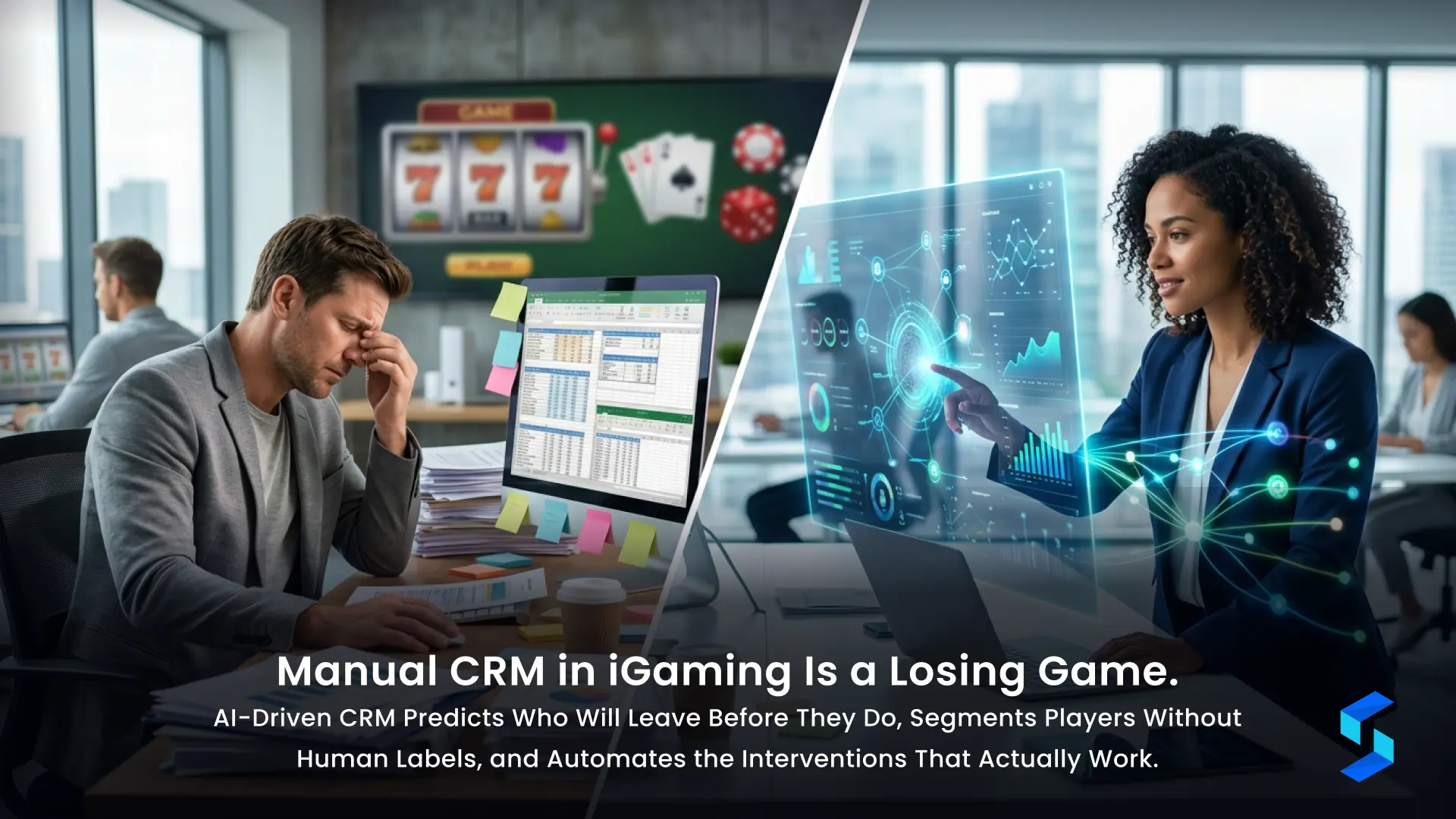
Customer relationship management in iGaming has traditionally meant two things: a database of player profiles and a marketing team that sends batch promotions to manually defined segments. This approach is not wrong — it just leaves most of the value on the table. An AI-driven CRM operates on a fundamentally different model: machine learning to identify natural clusters in your player population, continuous lifecycle automation responding to individual behaviour signals in real time, and measurement by outcomes rather than by campaigns sent.
Operators who have deployed AI-driven CRM systems are seeing 20–35% reductions in churn among at-risk player segments, 30–50% improvements in reactivation campaign conversion, and 40–60% reductions in manual CRM workload. This guide covers how to build one.
The Architecture of an AI-Driven iGaming CRM
| CRM Layer | Component | Function | Key Technology |
|---|---|---|---|
| Data | Event stream | Captures all player behavioural events in real time | Kafka, Kinesis, or equivalent |
| Data | Feature store | Computes and serves player features for models | Feast, Tecton, or custom |
| Intelligence | Churn prediction model | Scores every player’s churn probability daily | XGBoost, LightGBM |
| Intelligence | Segmentation engine | Identifies natural player clusters without manual labels | K-means, DBSCAN, embedding clustering |
| Intelligence | Next-best-action model | Predicts the most effective CRM intervention per player | Contextual bandit or supervised model |
| Execution | Campaign orchestration | Executes targeted campaigns based on model outputs | Custom or integrated CRM platform |
| Measurement | A/B testing and attribution | Measures the causal impact of each intervention | Experiment platform with statistical significance |
Churn Prediction: The Core Intelligence Layer
Defining Churn for Your Platform
Before building a churn model, define churn precisely. Common definitions: no login in 14 days; no real-money bet in 30 days; no deposit in 60 days. The definition must match your business goal — you want to predict the churn event with the most commercial impact. For a casino with high-frequency players, 14-day inactivity may be too generous; for a sportsbook with seasonal players, 60 days may be too aggressive.
Feature Engineering for Churn Prediction
- Session recency trend: has the player’s session frequency been declining over the last 7, 14, and 30 days?
- Deposit recency and value: days since last deposit; trend in deposit amounts over the last 60 days
- Net gaming revenue trajectory: is the player’s win/loss balance trending in a direction associated with disengagement?
- Bonus response rate: is the player stopping to engage with promotional offers, or ignoring them?
- Support interaction recency: a recent negative support interaction is a churn signal; a resolved one is a retention signal
Model Output and Deployment
The churn model outputs a probability score (0–1) for each player, refreshed daily. A tiered alert system triggers different intervention workflows at different score thresholds: moderate risk (0.5–0.7) triggers a personalised game recommendation or modest bonus; high risk (0.7–0.85) triggers direct outreach with a more substantial offer; critical risk (>0.85) triggers a VIP account manager call or the highest-value reactivation offer in your intervention library.
AI-Powered Segmentation: Beyond Manual Cohorts
Manual player segmentation captures broad behavioural archetypes but misses the nuance that drives different CRM strategies. AI segmentation discovers the natural clusters in your player population from the data, without imposing predefined categories.
What AI Segmentation Reveals
- The ‘bonus arbitrageur’ cluster: players who deposit heavily around promotions and reduce activity in promotion-free periods — require bonus-gating strategies, not more promotions
- The ‘weekend recreational’ cluster: very consistent session timing (Friday–Sunday evenings) — respond strongly to event-specific promotions timed to their natural play window
- The ‘progressive high-value’ cluster: players whose average session value has been growing over 60–90 days — developing VIPs who should receive proactive relationship management before they self-identify as high-value
- The ‘single-game specialist’ cluster: players who almost exclusively play one game type — respond poorly to generic promotions but strongly to targeted offers on their specific game
Lifecycle Automation: Replacing Manual Campaign Calendars
| Trigger Signal | Automated Intervention | Channel | Timing |
|---|---|---|---|
| Churn score > 0.65 | Game recommendation + 10 free spins | Push + in-app | 2h post-update |
| 3 sessions declining bet size | Session protection + RG check | In-app | Next session start |
| First deposit anniversary | Loyalty milestone recognition | On anniversary | |
| 48 hours since last session | ‘We miss you’ message | Email / SMS | 48-hour mark |
| New game launch | Early access notification | Push + email | Day of launch |
| Withdrawal completed | Satisfaction survey | 24h post-withdrawal | |
| Wagering 80% complete | Completion encouragement | In-app | At 80% threshold |
Measurement: How to Know If Your AI CRM Is Working
- Churn prediction model performance: AUC-ROC (target > 0.80); precision and recall at your intervention threshold
- Intervention causal impact: A/B test every intervention workflow — a randomised holdout group that does not receive the intervention measures the true causal retention effect
- CRM operational efficiency: manual campaign workload before and after AI automation deployment
- Retention economics: cost per retained player versus LTV of retained player — AI CRM should improve this ratio measurably
Run your churn prediction model’s first month in shadow mode — score every player, generate intervention recommendations, but do not execute them. Use this period to validate model calibration against actual churn events before the model drives real CRM spend.
Related Resources
- AI Consulting Services for iGaming Platforms
- Artificial Intelligence Solutions for iGaming
- Predictive Analytics in Casino Games
- Player Account Management for iGaming Platforms
- Gamification Services for iGaming
- CRM Role in Sportsbook and iGaming Operations
Build an AI-Driven CRM for Your iGaming Platform.
Source Code Lab designs and builds AI CRM systems for casino and sportsbook operators — from churn prediction models through to lifecycle automation and measurement infrastructure. Talk to our AI team.