


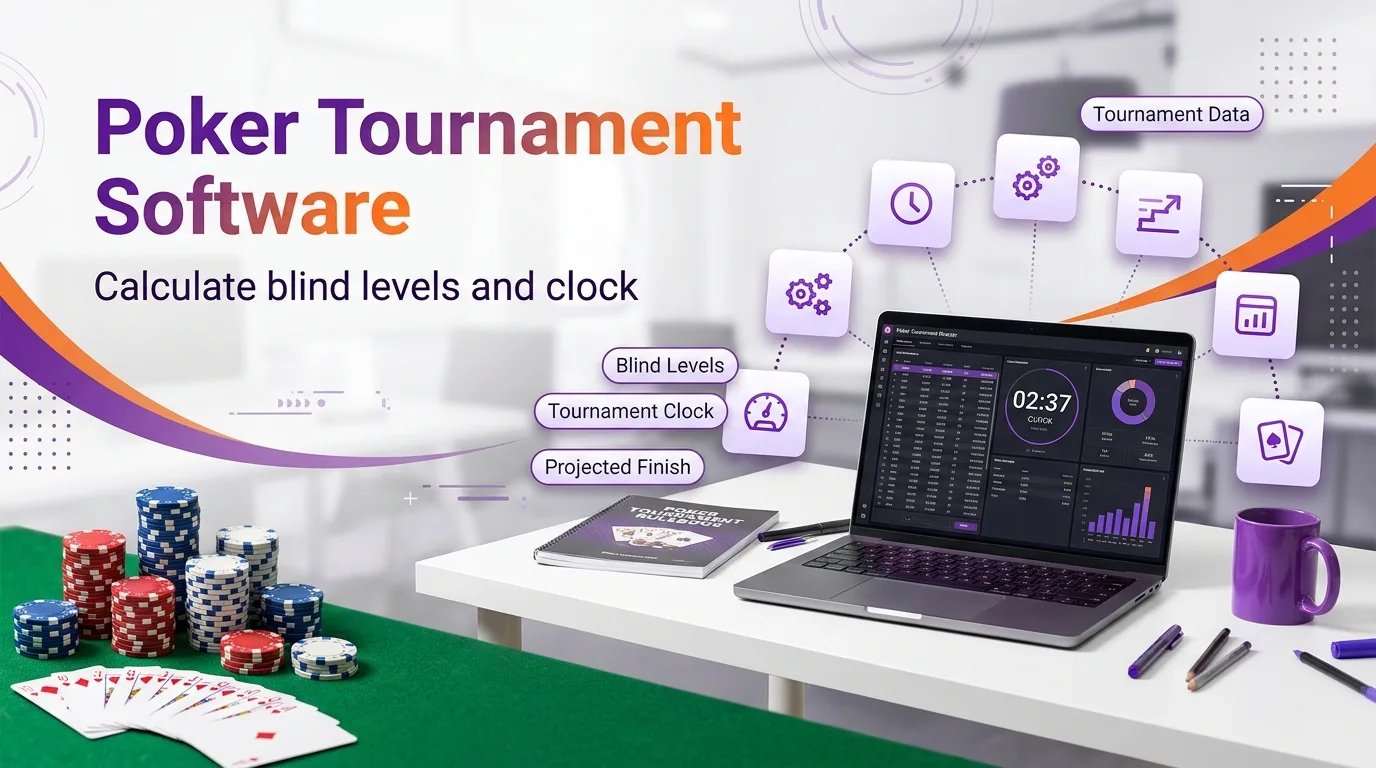
Poker tournament software has to compute more than a countdown. It must hold each level as a record of blinds, ante and length, calculate the rise between levels, project total runtime, set a finish blind, and place the clock by elapsed time. Get those right and poker blind levels stay accurate through pauses and edits.
What Does a Poker Blind Level Actually Define?
A poker blind level defines the small blind, big blind, ante status, and duration for one stage of play. Everything else in the event, from the clock display to the payout timing, reads from that definition. The Wikipedia entry on blind structure in poker covers the mechanics of forced bets, but your software needs them as data.
Each level needs a record with these fields:
- Level number: The position in the schedule, starting at 1.
- Blinds: Small blind and big blind as integers in chips.
- Ante: An amount, or zero when antes are off for that level.
- Length in minutes: The scheduled duration of the level.
- Break flag: Whether a break follows the level, and how long it lasts.
Store these as one row per level, not as a formula that regenerates values on demand. A formula looks tidy until a director edits level 7 by hand. Then the generator and the displayed schedule disagree, and nobody knows which one the clock is following. A table of rows can be edited, audited and rendered on a lobby screen without recomputation.
The schedule is the source of truth for the clock. A timer that runs on its own and merely shows whatever level it believes is current will drift from the schedule the moment someone touches either. The clock should only ever ask the schedule where it is. Most poker tournament software features that directors notice, such as late registration cutoffs and payout timing, depend on this one design decision.
How Much Should Poker Blind Levels Rise Each Round?
A consistent multiplier of about 1.3× to 1.6× per level is the working range. Published guidance varies in how it states this, but the numbers sit close together. A PartyPot guide from 2026 gives a per-level increase of 25% to 60%, depending on how fast you want to finish. A Shuffle Up and Deal guide recommends a multiplier of 1.3× to 1.6× per level.
“In addition to the purpose explained above, blinds are also used to control how long the tournament will last.”
The rise controls runtime directly. A faster rise reaches the finish blind in fewer levels and shortens the event. A slower rise adds levels and lengthens it. For a typical 9-player home game, PartyPot says roughly 40% per level with 15 to 20 minute levels lands in a 3 to 4 hour window.
Doubling blinds every level is now described as too steep outside hyper-turbo events, according to LynxPoker’s guide, which puts the usual rise at roughly 25% to 50% per level. So doubling should not be a hardcoded default. Treat the rise as an input the director sets, and let the software warn when a chosen value falls outside the usual range rather than block it.
Rounding is where generators go wrong. A 1.4× rise on a 300 big blind gives 420, which nobody can pay cleanly with the chips on the table. Your software needs explicit rounding rules:
- Round every blind to a multiple the smallest chip in play can pay.
- Keep the small blind at half the big blind where the denominations allow it.
- Round ante values by the same rule, so the total pot never contains an unpayable amount.
- Let the director override any rounded value, then mark that row as manually set.
For a look at how a major series handles its ladder, see our breakdown of the World Series of Poker tournament structure.
How Long Should Each Poker Blind Level Last?
Level length depends on the event type. Use 10 to 12 minutes for a quick home game, 15 to 20 minutes for a standard casual event, and 15 minutes or less for turbo. Longer formats run well beyond that.
| Event type | Typical level length | Source |
|---|---|---|
| Quick home game | 10 to 12 minutes | Chips of Fury blind calculator |
| Standard casual | 15 to 20 minutes | Chips of Fury blind calculator |
| Turbo | 15 minutes or less | LynxPoker |
| Club structure | 20 to 30 minutes | LynxPoker |
| Deepstack and major events | 30 to 45 minutes or more | LynxPoker |
LynxPoker also advises keeping level length constant through the structure. That is a sound rule to build in. Constant length makes runtime predictable, and it keeps players from feeling the pace change mid-event. The software can still permit a different length on a given row, but it should flag the exception.
Runtime then becomes a calculation, not an estimate. Add up the length of every level from the schedule, add the scheduled break time, and show the total. The 40% rise with 15 to 20 minute levels that fits a 9-player game into 3 to 4 hours is a useful sanity check against your own output. If your projection for that setup comes back at six hours, something in the schedule is wrong.
Recompute the projection every time a row changes. A director who shortens level 5 should see the finish time move at once, not learn of the effect an hour later.
How Should a Tournament Clock Handle Pauses and Schedule Changes?
The clock should store elapsed time and derive the current level from it. Pauses, resumes and edits then cannot cause drift, because the level is a lookup and not a running state.
The failure mode is a countdown that tracks only remaining time in the current level. Each pause and resume involves a small timestamp gap, and those gaps accumulate. After a handful of pauses for a rules dispute, a table break or a late registration, the clock no longer matches the schedule. A 2026 ranking on Gitnux carries the same warning, noting that mid-event schedule changes need careful director action to avoid drift. Your software should make that care unnecessary where it can.
Build the behavior this way:
- Pause: Freeze the counter and write the elapsed time to storage.
- Resume: Continue from the stored elapsed time, never from a recalculated remaining time.
- Level lookup: Walk the cumulative lengths of the schedule rows until elapsed time falls inside one, and show that level.
- Edit to a future level: Recalculate the remaining runtime from the current position and leave every past row untouched.
- Edit to the current level: Keep the time already played in that level and apply the new length to the remainder.
Past levels should be locked once played, because they are the record of what players actually faced. If a director needs a correction, log it as an adjustment with a timestamp, not an overwritten row. The Tournament Directors Association publishes rules that directors rely on for rulings, and a clean audit trail makes it far easier to apply them after a dispute.
What Must the Software Calculate Before an Event Starts?
Before the first level starts, the software should calculate the finish blind as 5% to 10% of total chips in play and show the projected runtime. Shuffle Up and Deal targets that same 5% to 10% range for the finish blind.
Take a 9-player event with 10,000-chip starting stacks. Chips in play are 90,000, so the finish blind range is 4,500 to 9,000. Assume a starting big blind of 200. A 1.4× rise needs roughly 11 levels to reach 4,500 and roughly 13 to reach 9,000, before rounding to chip denominations. At 15 minutes per level, that is about 165 to 195 minutes of play, plus breaks. Change the multiplier or level length and the software should redraw all of this immediately.
Antes need a start level too. The Chips of Fury calculator advises keeping antes off for the first few levels and adding them around level 4 or 5. Make that a setting with a sensible default, not a fixed value.
Before launch, the director should see these outputs on one screen:
- Final blind: The big blind of the last level, compared with the 5% to 10% target.
- Level count: The total number of rows in the schedule.
- Projected runtime: Total level time plus breaks, in hours and minutes.
- Ante start level: The first level with a nonzero ante.
- Break schedule: Which levels are followed by a break, and for how long.
If you are scoping these calculations as part of a larger build, our pages on poker platform features and poker game development show how tournament tooling fits into a full poker product.