


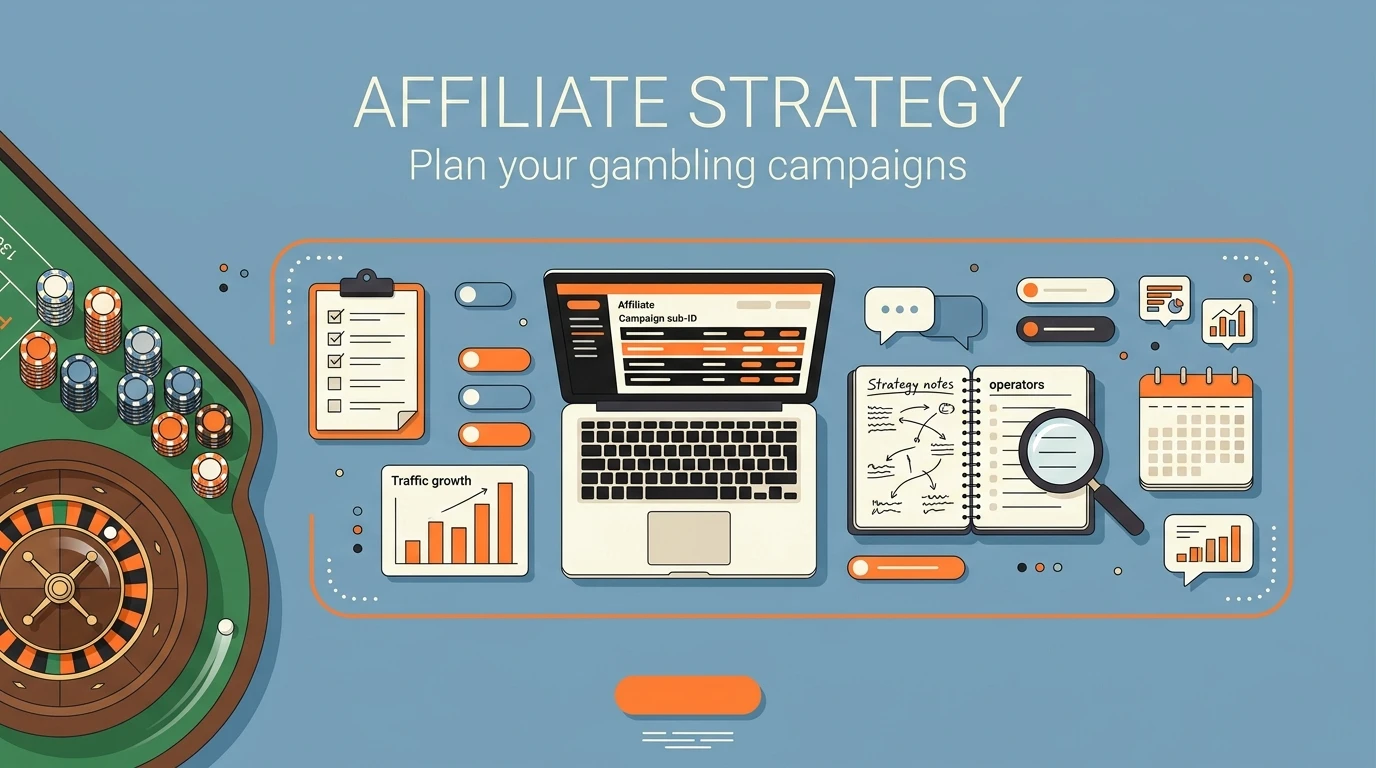
A gambling affiliate strategy is a planned way for a publisher to earn commission by sending qualified players to a licensed operator’s offers. It sets who you promote, to whom, through which channel, and how you prove and collect payment for the results. This plan puts the steps in the order a new partner should take them, with the checks that come before any money goes into traffic.
On this page
- What is a gambling affiliate strategy?
- Picking a niche and vetting operators come first
- Setting up tracking before the first campaign
- Converting traffic into player signups
- Measuring results and scaling what pays
What is a Gambling Affiliate Strategy?
A gambling affiliate strategy is a planned way for a publisher to earn commission by sending qualified players to a licensed operator’s offers. The word “planned” matters. Most new partners start by buying clicks, then try to work out what happened. The cheaper path is to decide five things on paper before the first campaign goes live.
- Niche: The vertical and audience you will serve, such as sports betting in one country or slots reviews for one language group.
- Operators: The licensed brands you will promote, and the markets each one may legally accept.
- Traffic source: Where your visitors come from, whether that is search, a content site, email, social or paid media.
- Tracking: How each click, signup and deposit is tied back to the source that produced it.
- Payout terms: The commission model, the thresholds, the review periods and the payment schedule.
Each choice limits the next one. A niche narrows the operators you can sensibly promote. The operators decide which countries you can target. The countries and the audience decide which traffic sources are allowed and affordable. Tracking and payout terms then tell you whether the whole arrangement makes money.
Payout terms deserve attention early because they shape your cash flow. A gambling affiliate program may pay a revenue share, a fixed fee per qualified player, or a hybrid of the two. Each model changes how quickly you see income and how much risk you carry on player quality. Our guide to commission structures and tiers explains how these models are built, so you can compare offers on the same basis before you sign up.
Affiliate marketing for gambling also carries rules that most other verticals do not. Licensing, age limits and advertising standards apply to you as well as to the operator. A strategy that ignores them can lose an account, a domain or a payout. That is why the next step is not traffic. It is choosing a niche and checking who you are allowed to promote.
Picking a Niche and Vetting Operators Come First
Choose one niche and only operators licensed in the markets you can legally reach. Everything else, from content to tracking, depends on that decision, and changing it later means rebuilding pages and audiences.
Start with the niche. Pick a vertical you can describe in one sentence and a country or language you can serve properly. “Sports betting guides for one regulated market” is a niche. “Gambling” is not. A narrow niche gives you a clear audience, a short list of relevant operators and a cleaner read on what works. You can add a second niche once the first one produces tracked deposits.
Then vet each operator before you apply to its program. Work through these checks in order:
- License number and regulator: Find the license number and the name of the regulator in the operator’s site footer or legal pages. Then confirm it with the regulator itself. For UK-facing offers, the UK Gambling Commission licensing register is the place to check. Other regulators publish their own registers, and you should use the one that matches the claim.
- Territory coverage: A valid license does not mean the operator may accept players from every country. Confirm that the license covers the country your audience lives in, and that the operator actually accepts players there.
- Minimum age: Age limits differ by country and sometimes by product. Check the minimum gambling age in each country you plan to target, and make sure your content and targeting never reach younger audiences.
- Promotion rules: Read the operator’s affiliate terms and the advertising rules for your market. Note what it bans, such as certain keywords, bonus wording, social channels or paid placements.
- Disclosure: Your audience must be able to tell that you earn commission. If you publish to US audiences, the Federal Trade Commission advertising guidance covers disclosing material connections such as affiliate relationships. Other countries have their own standards, so check the one that applies to your readers.
Keep a short record of what you checked and when. Licenses can be suspended or restricted, and a dated note shows you did your homework if a question comes up later. If an operator cannot show a verifiable license for your target market, drop it from the plan. No commission rate makes up for a brand you cannot legally promote.
Setting up Tracking Before the First Campaign
Set up unique tracking links and a conversion record before buying any traffic, so every signup can be traced to a source. If you cannot say which placement produced a player, you cannot say which placement to pay for again.
An affiliate tracking setup has three layers. The first is the tracking link the operator or network gives you. The second is the sub-ID parameter you add to that link. The third is your own record of what happened after the click.
Sub-IDs are what let you separate campaigns. A single affiliate link sends all your visitors under one label, so the dashboard shows a total and nothing more. Add a different sub-ID for each source, placement, creative or landing page, and the dashboard can break results down for you. Use a naming pattern you can read six months from now, for example source, then placement, then date. Keep it consistent, because messy labels are almost as bad as none.
Before you spend, test the chain end to end:
- Click test: Click your own link and confirm the click appears in the dashboard with the right sub-ID.
- Signup test: Complete a test registration where the program allows it, or ask the affiliate manager how to verify one.
- Postback check: If you use server-to-server postbacks, compare the events your tracker receives with the events in the affiliate dashboard. Counts should match, apart from known delays or rejected conversions.
- Cross-device check: Open the link on mobile and desktop, and check that the parameters survive any redirects.
Then keep a simple log. A spreadsheet is enough at the start. Record one row per campaign or sub-ID with these fields:
| Field | What it tells you |
|---|---|
| Sub-ID | Which source, placement or creative the row describes |
| Clicks | How much traffic arrived |
| Signups | How many visitors registered |
| Deposits | How many registrants became paying players |
| Cost | What you spent on that traffic |
| Commission status | Whether the payout is pending, approved or rejected |
The log gives you an independent view that you can reconcile against the operator’s statements. For a deeper look at how programs handle attribution and payments, see our guide to affiliate tracking and payout management. It is written from the operator side, which helps you see what the program is measuring on its end.
Converting Traffic into Player Signups
Send traffic to a landing page that matches the offer’s promise, with one call to action. A visitor who arrives expecting a specific bet type, game or welcome offer and finds something else leaves, and you have paid for that click.
Start by matching the page to the audience. A visitor from a football preview article wants football betting, so show the sports offer and the markets that interest them. A visitor from a slots review wants the game lineup and the terms of the free spins. Use the same language, country and currency as the source. If the operator has different offers for different regions, send each region to its own page.
Keep the page focused. One main call to action, repeated where it makes sense, beats a menu of five brands competing for attention. Place the key information a player needs near the button: what the offer is, who it applies to, and where to find the full terms. Add the age notice and responsible gambling information that your market requires. These belong on the page for legal reasons, and they also build trust with careful readers.
Test one change at a time. Change the headline, then the button text, then the layout, and give each version enough traffic to say something. If you change three things at once and results move, you will not know why. Record each test in your log against the sub-ID so the result is tied to the version that produced it. For specific page patterns and offer presentation, see our guide to converting offers with landing pages.
Be strict about bonus claims. Describe an offer only as the operator’s current terms support it. Do not call a bonus “free” if it carries wagering requirements, do not promise winnings, and do not repeat an old offer that has changed. Quote the terms or link to them, and recheck your pages whenever the operator updates a promotion. Inaccurate claims can breach advertising rules and your affiliate agreement, and they bring in players who feel misled, which usually shows up later as poor player quality.
Measuring Results and Scaling what Pays
Scale only the campaigns whose tracked signups and deposits cover their cost. Clicks and signups alone are not proof of a profitable campaign. A placement that fills your dashboard with registrations but few deposits is a cost, not an asset.
Run a review once a month, with the log in front of you. Look at three measures for each sub-ID:
- Cost per signup: What you paid for each registration from that source.
- Player quality: How many signups made a deposit, and whether those players stayed active after the first one. Ask your affiliate manager how the program defines a qualified player, because rejected conversions change your real numbers.
- Payout timing: How long approved commission takes to arrive compared with when you paid for the traffic.
Payout timing is the one new partners underestimate. Early payouts often wait for minimum thresholds and review periods, so commission can arrive well after the spend that earned it. Plan your budget around that gap, and read the payment terms before you commit to a large test. Results also vary widely between partners. Niche, market, traffic source and operator all change the outcome, so treat other affiliates’ stories as context rather than a forecast.
Once the data is in, cut weak placements. If a source has had a fair test and its signups and deposits do not cover its cost, stop it and move the budget. Do not keep paying for a placement because you like the brand or because it once worked. Pause rather than delete, and note why, so you do not repeat the experiment by accident.
Increase budget gradually on what works. Raise spend in steps, and check that cost per signup and deposit rates hold after each step. Performance often shifts when you reach a wider audience, because the first visitors tend to be the most relevant. If numbers slip, hold the budget where it is and look at the landing page or the targeting before spending more.
When one niche is stable and profitable, you can add a second operator, a new market or a new traffic source. Add one at a time, run it through the same sequence of licensing checks, tracking setup, landing page tests and monthly review, and keep the log growing. That repeatable order is the strategy.

