


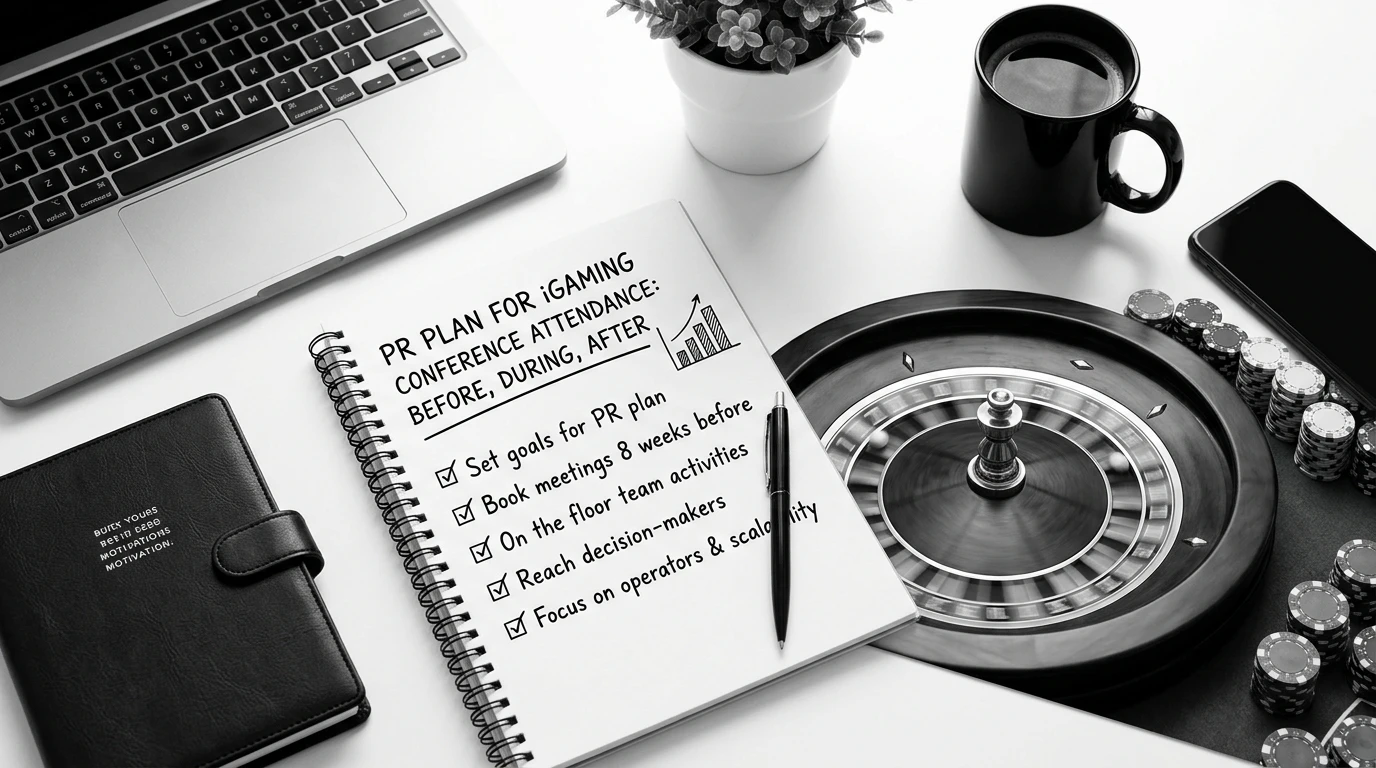
An iGaming conference PR plan works when it is built in three timed phases: book meetings and media about eight weeks out, run the stand with defined roles during the event, and follow up personally within 48 hours. Set measurable goals first, then review the results at 90 days against those goals.
On this page
- Setting goals for your iGaming conference PR plan
- Booking meetings eight weeks before the event keeps the calendar full
- What your team should do on the floor during the event
- Following up within 48 hours after the event
- Measuring whether your conference PR plan worked at 90 days
Setting goals for your iGaming conference PR plan
Set two or three measurable goals before you book a stand or a speaker slot. Good candidates are a set number of meetings with named target companies, a set number of new partner or supplier contacts, and a set number of press pickups tied to the event. The numbers are yours to choose. What matters is that they exist before the budget is spent, because they decide whether you need a full stand, a meeting table or only a delegate pass.
Goals get sharper once you are clear about who is in the building. Attendees at iGaming events usually fall into a few groups:
- Operators: Casino and sportsbook brands looking for platforms, content and managed services.
- Suppliers: Game studios, platform vendors and data providers looking for distribution and integrations.
- Payment firms: Processors and alternative payment providers looking for operators to onboard.
- Affiliates: Traffic partners comparing brands and commission terms.
- Regulators’ staff: Officials who attend panels and talk to licensed firms, usually not to buy anything.
These groups want different things from the same conversation. An operator wants to hear about integration scope and time to launch. An affiliate wants to hear about conversion and payout terms. A regulator’s representative wants evidence that you take compliance seriously. One booth message rarely fits all of them, so decide which one or two groups matter most for this event and write the plan around them.
Build the target list and the positioning line
Turn the priority groups into a named target list. Work from the event’s published attendee and exhibitor information, your CRM and your sales team’s existing conversations. A list of named companies, each with a named contact where you have one, is more useful than a list of job titles. Mark each entry as must-meet, should-meet or opportunistic, so your team knows where to spend scarce calendar slots.
Then write one positioning statement of a single line. It should say what you do, for whom, and what changes for them. Everyone on the team uses it, from the booth host to the CEO. If two people describe the company differently in the same hour, press and prospects will notice. Test the line by asking someone outside the company to repeat it back to you. If they cannot, shorten it.
Booking meetings eight weeks before the event keeps the calendar full
Send first meeting requests about eight weeks before the event and a reminder about two weeks out. Diaries at major iGaming shows fill early, and the people you most want to meet often have their schedules set weeks ahead. A request sent in the final fortnight competes with every other exhibitor doing the same thing.
The timeline below shows how the pre-event work usually breaks down.
| Timing | Action | Owner |
|---|---|---|
| Eight weeks out | Send first meeting requests and the speaker or panel pitch | Meeting lead, PR lead |
| Six weeks out | Finalize the media kit and the compliance pack | PR lead, compliance owner |
| Four weeks out | Follow up on unanswered requests, pitch trade press for pre-event briefings | Meeting lead, PR lead |
| Two weeks out | Send reminders, brief the whole team on the positioning line | Event lead |
| Before travel | Set up the shared CRM fields and test them on a dummy record | Sales operations |
The pre-event checklist
Each item on the checklist has a specific job.
- Named target list: The list from your goal-setting, with priorities and an owner for each account.
- Meeting request template: Three or four lines that name the person’s company, say why a conversation is useful to them and offer two time slots. Personalize the first sentence every time.
- Speaker or panel pitch: A specific topic, a named speaker and one concrete takeaway for the audience. Organizers get many generic pitches and few that are specific.
- Media kit: A company description, the positioning line, spokesperson bios, product images and a press contact who will actually answer the phone at the show.
- Short compliance pack: A one- or two-page summary of your licensing position and testing status. Where you hold certifications, point to your GLI and ISO accreditations and state only what you actually hold.
- Staff briefing: A short session on the positioning line, the target list and what each person should and should not say about roadmap and pricing.
- Shared CRM field set: The fields every conversation will be logged in, agreed and tested before anyone boards a plane.
Two parts of the checklist often depend on earlier work. If one of your goals is recruiting traffic partners, plan that outreach alongside the event and draw on your approach to affiliate outreach and partner recruiting so show conversations continue an existing thread rather than start from nothing. If you expect operators to ask about launching on a platform, have your answers ready on what to plan before a white label launch, including scope, integrations and timing, so the stand team does not improvise on those points.
What your team should do on the floor during the event
Assign every team member a role and log every conversation the same day. A stand without roles drifts. Three people chat with the same visitor while a scheduled meeting waits unattended. Four roles cover most setups:
- Booth host: Greets visitors, qualifies them in a minute and routes them.
- Meeting lead: Owns the calendar, brings people to the table on time and keeps meetings to their slot.
- Lead capture: Records conversations in the shared CRM fields, even when the host or meeting lead is the one talking.
- Press contact: Handles journalist requests, interview slots and any on-the-spot comment.
At small events one person may hold two roles. That is fine as long as the roles are named and the handoffs are clear.
Daily rhythm and message discipline
Run a short stand-up each morning before the doors open. Cover the day’s confirmed meetings, who is covering the stand during sessions, any press commitments and anything that changed the day before. Run a second, shorter review late in the day to check that every conversation is logged. Memory fades fast after a few days of back-to-back meetings, and a note written at 6 p.m. is far better than one reconstructed on the flight home.
Keep the booth message consistent. Everyone uses the same positioning line, the same product descriptions and the same answers on certifications and markets served. If someone does not know an answer, the correct response is to note the question and promise a reply, not to guess.
What to record
For each conversation, capture the contact’s name, company and role, the market or markets they operate in, the product or service they were interested in, and the agreed next step with a date. The role and market matter most. They decide which materials you send and which colleague picks up the lead. A card scan with no context is nearly worthless two weeks later.
Press requests, hospitality and giveaways
Route every press request to the press contact, who should confirm the outlet, the topic and the deadline before agreeing to anything. Do not let a quick hallway comment turn into a quoted statement without the spokesperson’s agreement.
Be careful with hospitality and giveaways. Rules on gifts, entertainment and anything of value differ by jurisdiction and by the status of the recipient. Before offering a dinner, a ticket or a branded item to a prospect, check the rules that apply where they are licensed or based, starting with the UK Gambling Commission for UK-facing contacts and the relevant state regulator for US ones. Where you cannot confirm that something is allowed, do not offer it. Your compliance owner should review the plan before the event, not during it.
Following up within 48 hours after the event
Send personal follow-ups within 48 hours, while the conversation is still fresh in both heads. After a few days the contact has met dozens of other suppliers and your name blurs into them. A short, specific message that refers to something you actually discussed will stand out against the stream of generic post-show emails.
Sort before you send
Start by sorting the logged leads by market and product interest. An operator licensed in one regulated market needs different material than a prospect serving several. Within each group, rank by the agreed next step. Leads that asked for a demo or a proposal come first, leads who requested information come second and contacts who only exchanged cards come last.
Each follow-up should do three things:
- Refer to a specific point from the conversation.
- Attach or link the materials you promised, and nothing you did not.
- Propose a dated next step, such as a call on a named day or a deadline for sending a proposal.
A vague line such as “let’s stay in touch” leaves the decision to the recipient, and most will let it lapse.
Public recap and handoff
Publish a short recap post or social update within the same window. Keep it factual: what you showed, who spoke, what you heard from the market. Tag partners and speakers only where they have agreed. If your update involves paid or incentivized endorsements, check the Federal Trade Commission’s guidance on endorsements and disclosures before publishing. A recap is also a good moment to send journalists you met a short note with any assets they asked for.
Then pass qualified leads to the sales and onboarding owners with the full conversation record attached. The handoff should include the contact’s role, the market, the product interest and the next step already promised, so the new owner does not restart the conversation. To connect these leads to measurable steps, set up your landing page and tracking setup before the event, with event-specific links or codes so you can see which post-show contacts visit, register and convert.
Measuring whether your conference PR plan worked at 90 days
Review the results at 90 days against the goals you set at the start. Count the meetings held, the pipeline created and the press mentions that can be tied to the event. If you set a target for each, the review is a simple comparison. If you did not, the review turns into an argument about impressions, which is why goals come first.
The numbers worth tracking
Work through a short set of measures:
- Meetings held: Compare scheduled meetings with those that took place, and with the target list.
- Qualified leads: Count the contacts that sales accepted as real opportunities, not every card collected.
- Cost per qualified lead: Divide the total event cost, including stand, travel, staff time and hospitality, by the qualified leads. Track it over time rather than reading it in isolation.
- Second meetings: Note which contacts moved from the show conversation to a call, demo or proposal review. This is often the best early signal of real interest.
- Press mentions: List coverage that cites the event, your spokesperson or your announcement, with the outlet and date.
Why early reviews undercount
iGaming deals often take several months to close. Licensing, integration scoping, compliance checks and commercial negotiation all take time. A review at 30 days will usually show few signed contracts, and that does not mean the event failed. Treat the 90-day review as a check on pipeline and momentum, then keep tracking the same leads until they close or drop out. Record the source on each opportunity so later revenue can be traced back to the show.
Reusing the plan
Finish the review with a short written debrief. Note which target accounts came, which meeting requests worked, which roles on the stand held up and which follow-ups got replies. Update the target list, the request template, the compliance pack and the CRM fields with what you learned. Save the timeline as a template with dates expressed as weeks before the event. For the next show, you start from a tested plan and spend your time on the new target list instead of rebuilding the process.

