
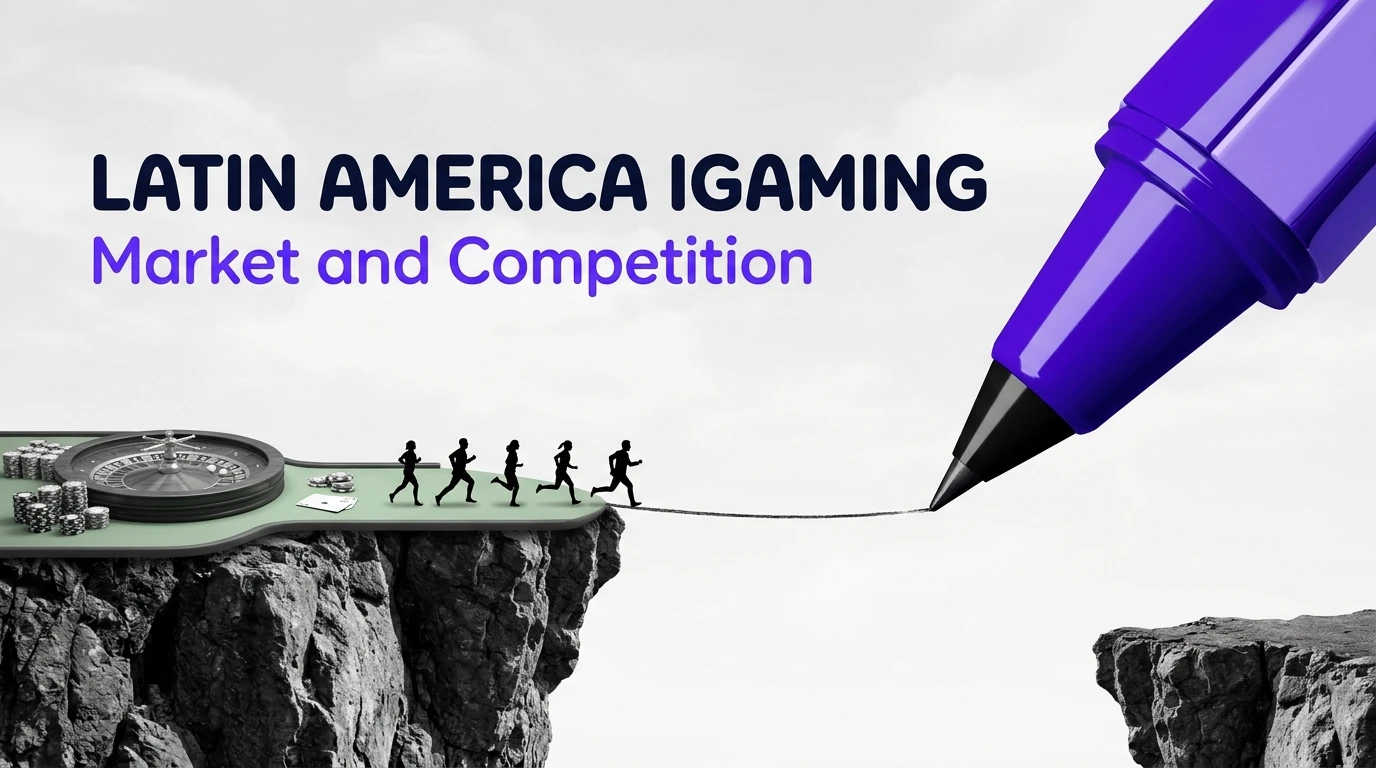
Brazil, Colombia, Peru and Argentina (through provincial permits) have licensed online gambling. Mexico remains largely unsettled at the federal level. The operators competing in these markets fall into three groups: large international brands, regional groups with land-based roots, and smaller local operators. This article sorts the region by licensing model first, then maps who competes under each.
On this page
- Which Latin American markets are open to iGaming operators?
- Why licensing models differ across Latin American markets
- Who are the iGaming operators in Latin America competing for players?
- Where do local operators hold an advantage over global brands?
- What should an operator check before entering Latin America?
Which Latin American markets are open to iGaming operators?
Five markets matter most for a Latin American iGaming plan: Brazil, Colombia, Peru, Argentina and Mexico. Four have a legal route to a licensed online offer. Mexico does not have a clean one. The table groups them by licensing model, which is a more useful cut than geography because the model decides who can apply, where you can operate, and how much of your stack must be local.
| Market | Licensing model | Who oversees it |
|---|---|---|
| Brazil | National license | Secretariat of Prizes and Bets, within the Ministry of Finance |
| Colombia | National license | Coljuegos |
| Peru | National license | The tourism ministry, MINCETUR, through its gaming directorate |
| Argentina | Provincial permits | Individual provincial and city lottery bodies |
| Mexico | Federal permits written for land-based gaming, online status unsettled | The Interior Ministry (Segob) |
Brazil: The country moved from a legal gray area to a national regime with its betting law, and the regulated market is overseen from Brazil’s Ministry of Finance. A license covers fixed-odds sports betting and online casino-style games under the rules the ministry sets. Brazil is the largest prize in the region by population, which is why it dominates most entry discussions about Brazil iGaming regulation.
Colombia: Coljuegos, Colombia’s gambling regulator, licenses online operators nationally. Colombia was an early mover in the region, so its framework is better understood than most. Operators work under a national authorization and report to the regulator directly.
Peru: Peru created a national framework for online betting and online casino games more recently. The licensing route exists, and the market is still maturing as rules and secondary regulations settle.
Argentina: There is no single national online license. Each province or city decides for itself, so an operator licensed in one jurisdiction serves players located in that jurisdiction only. Buenos Aires City and Buenos Aires Province are the best-known examples, and other provinces have their own tenders and rules.
Mexico: Federal gaming law dates from long before online play. Permits issued by Segob are tied to land-based and related activity, and how far they extend online is contested. Many offers reach Mexican players from outside the country, and reform proposals have come and gone.
Reform status in this region changes quickly. Treat everything above as a map of the model, not a current legal opinion, and verify each regulator’s published rules before you commit budget.
Why licensing models differ across Latin American markets
Licensing models differ because each country wrote its gambling law at a different time, for a different industry. Some countries built national online licenses from scratch, some inherited provincial lottery powers, and some have no online-specific rules at all. The commercial terms follow from that history.
Five practical differences shape your business case. None of them can be reduced to a single regional number, so check each market’s current text.
- Tax: Regimes differ on the tax base. Some tax gross gaming revenue and others tax turnover or stakes, and that choice changes which products stay viable. A low-margin sportsbook feels a turnover-based tax far more than a casino operation does.
- License fees: National regimes usually combine an application fee, a recurring fee and some form of financial guarantee. Provincial systems often layer their own fees on top, so a multi-province Argentine plan multiplies the paperwork as well as the cost.
- Product restrictions: Some frameworks cover both sports betting and online casino. Others begin with sports betting or limit categories of games. Check whether live dealer, slots, poker and virtual sports each fall inside the license you want.
- Payment rules: Regulators commonly expect deposits and withdrawals to run through local or locally approved channels and tied to verified player accounts. Instant bank-transfer systems such as Pix in Brazil and PSE in Colombia shape player expectations, so a card-only cashier will convert poorly.
- Advertising limits: Rules on sponsorship, broadcast ads, bonus wording and influencer content are tightening in several markets. Your marketing plan must be written per country, not copied across the region.
The model also decides how you grow. A national license gives you one compliance relationship covering one large territory. A provincial model means separate approvals, separate player-location checks and separate reporting. An unsettled model like Mexico’s means you are betting on interpretation, and your legal advisers matter as much as your product team.
Age limits add one more variable. Most markets set 18 as the minimum, but exact rules can vary by jurisdiction and product. The gambling age rules by country guide covers how those thresholds compare, and it is worth reading before you finalize onboarding flows.
Who are the iGaming operators in Latin America competing for players?
The main competitors are large international sportsbook and casino brands, regional groups with long land-based histories, and smaller local operators. Brands such as Bet365, Betano, Betsson, Codere and Caliente are active in the region. They are named here for context and are not ranked. Which one leads depends on the country, the product and the date you check.
International brands. Bet365, Betano and Betsson are the names most often associated with this group. Their strengths are mature sportsbook trading, deep casino catalogs, and experience with licensing in regulated European markets. They typically enter a Latin American country once a clear license path exists, then bring familiar product standards and large marketing budgets. Their weakness is local texture. Odds on regional football, local payment habits and the tone of customer support take time to get right.
Regional groups with land-based histories. Codere, a Spanish group with a long presence across Latin America, and Caliente, rooted in Mexico, are the clearest examples. These groups have physical venues, retail relationships and a brand that players already recognize from the street. Their online offers often connect to that retail footprint. Cash-based players can be pulled into digital accounts through shops, agents and branded venues, something a pure online brand cannot copy quickly.
Smaller local operators. These range from provincial licensees in Argentina to startups in Brazil and Colombia. They rarely win on budget. They win on a narrow focus: one province, one sport, one payment method, one community. Many rely on white label or turnkey platforms, which lets a small team launch a licensed product without building the stack from scratch. If that route interests you, the white label iGaming integration guide explains what the integration work involves.
The three groups compete on different axes. International brands compete on product depth and advertising reach. Regional groups compete on brand familiarity and physical presence. Local operators compete on fit and speed. In practice, partnerships blur the lines, because international brands often seek local media, payment and retail partners to close their own gaps.
Platform and software suppliers sit behind many of these operators. Providers such as SoftSwiss and GammaStack are examples of companies that supply technology to iGaming businesses globally. They are not operators, but they influence how quickly a newcomer can enter and how much it must build itself.
Where do local operators hold an advantage over global brands?
Local operators usually hold an advantage in payment methods, Spanish or Portuguese localization, and existing relationships with regulators and retail networks. Global brands counter with capital, product depth and marketing reach. Both sets of strengths are real, and the balance shifts by market.
Payments. A local operator already knows which methods players trust, how bank transfers fail, how cash vouchers work and which processors settle quickly. Deposit friction is one of the fastest ways to lose a new player. A global brand that bolts local payments on late often sees higher abandonment at the cashier, and that cost is invisible in a marketing dashboard.
Language and culture. Localization is more than translation. Spanish varies between Mexico, Colombia, Peru and Argentina, and Brazilian Portuguese needs its own tone. Betting markets, team names, promotions and even the way odds are discussed vary by country. Local operators absorb this naturally. Global brands must hire for it.
Regulators and retail. An operator that has dealt with a regulator for years understands how reviews go, how queries are answered and which documents matter. Retail networks add distribution, cash handling and credibility. For players who are wary of online betting, a shop on the corner is a form of reassurance.
Global brands respond in four ways:
- Capital: They can absorb license costs, guarantees and slow early returns in a way smaller companies cannot.
- Product depth: They bring in-play betting, bet builders, large casino libraries and mature mobile apps.
- Marketing reach: Sponsorship and brand campaigns, where permitted, build awareness faster than organic growth.
- Local deals: Acquisitions, partnerships and agreements with local firms close the gaps above.
Trust and support decide who keeps players after the first bonus. Fast withdrawals, clear terms and support in the player’s own language are what players cite when they stay or leave. A brand that pays quickly and answers in plain Spanish or Portuguese earns repeat deposits. A brand that delays a payout once can lose a player for good, and word spreads in tight communities. Responsible gambling tools and visible licensing also matter more as regulators expect them and as players look for signs that an operator is legitimate.
What should an operator check before entering Latin America?
Before entering, confirm the license category you need in each target country, the local payment and tax obligations, and the player-age and advertising rules. Then work through them in order, because later decisions depend on earlier ones.
- Check the regulator’s current register. Start with the official source for each market, such as the licensing pages of Coljuegos or the Brazilian ministry. Confirm which categories exist, which operators are authorized and whether applications are open. Do not rely on a blog post or a vendor’s summary, including this one, for current status.
- Match your products to a license category. Decide whether you need sports betting, online casino, or both, and confirm that each is covered. Look at restrictions on game types and on bonus structures.
- Budget for local compliance. Include application and recurring fees, guarantees, local legal counsel, audit and reporting needs, and any requirement for a local entity or representative. Tax treatment should be modeled against your expected margins before you commit.
- Map payments. List the local methods players expect, confirm that your processors support them and check whether the regulator limits channels.
- Set age and advertising controls. Verify the minimum age and identity verification expectations for each market. For Mexico specifically, the Gambling age in Mexico guide covers the legal threshold and how it interacts with online access.
- Plan localization and geo-restriction. Your platform needs language variants, local currencies, country-specific content and reliable geo-location. Provincial models like Argentina’s demand the strictest controls, since a player outside the licensed territory must be blocked.
The platform choice sits underneath all of this. You can build, buy a licensed engine, or launch on a white label. Each route changes your control over localization, cashier integrations and compliance reporting. The online casino and gambling software platform buyer’s guide sets out what to ask suppliers, and the white label guide above covers integration.
One last point. Do not treat Latin America as a single market with one launch date. Sequence it. Pick the country where your license path is clearest, prove your payments and support there, and use that operating record when you approach the next regulator.