


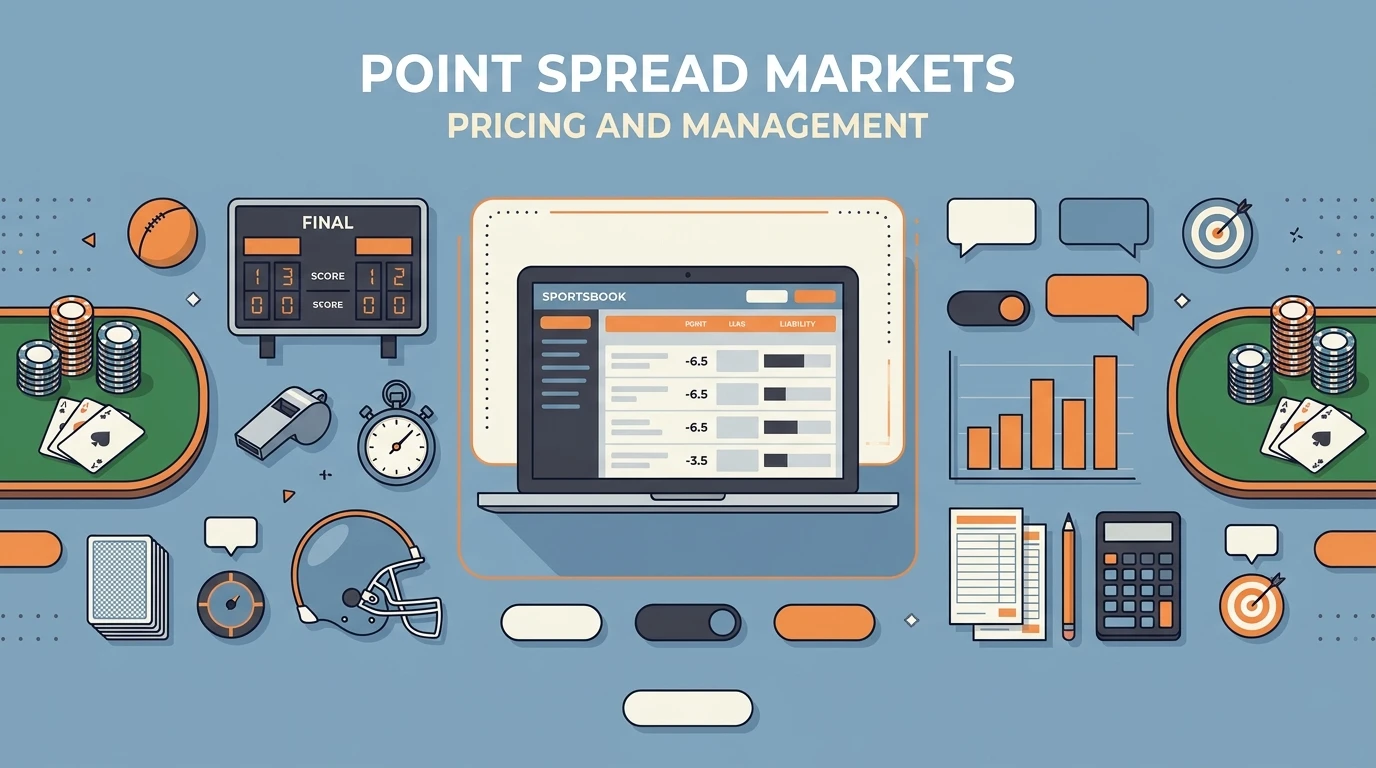
A point spread market adjusts the final score with a handicap, so the favorite must win by more than the line and the underdog can lose by less than the line and still win the bet. The sportsbook sets the number, prices both sides near -110, settles against the official final score and manages exposure by side until kickoff. This guide follows one spread through each of those stages.
On this page
- What Is a Point Spread Market and How Does It Work?
- How Sportsbooks Price Point Spread Markets
- Point Spread Markets Settle Against the Final Score
- Managing Point Spread Market Risk Before Kickoff
- What Operators Should Check Before Offering Point Spread Markets
What Is a Point Spread Market and How Does It Work?
A point spread is a handicap applied to the margin of victory. The favorite carries a minus number and the underdog carries the same number with a plus sign. The bettor is not picking who wins the game. The bettor is picking who covers the number.
Take an illustrative example. Team A is listed at -6.5 and Team B at +6.5, both at -110. A bet on Team A wins only if Team A wins by seven or more. A bet on Team B wins if Team B wins outright, or loses by six or fewer. If the final score is 27-21, Team A won the game but won by six. Team A backers lose and Team B backers collect.
At -6, a six-point win by Team A lands exactly on the number. Neither side wins, the bet is a push and stakes are returned. That makes the choice between whole numbers and half points a pricing decision as much as a presentation one.
The table compares the spread with the other two common markets.
| Market | What the bettor picks | Typical price format | What settles the bet |
|---|---|---|---|
| Point spread | A side after the handicap is applied | Line plus price, such as -6.5 at -110 | Final score adjusted by the line |
| Moneyline | The outright winner | Odds that differ by side, such as -250 and +210 | Which team wins the game |
| Totals | Over or under a combined score | Total plus price, such as 47.5 at -110 | Combined final score of both teams |
The structural difference is the price. On a moneyline, the odds carry the gap between a strong team and a weak one. On a spread, the line carries that gap and the price stays close to even on both sides. The operator is trying to attract roughly balanced opinion on a single number, which makes the spread a tool for managing demand as well as a bet type.
Point spreads are most associated with American football and basketball. Other sports use the same logic under different names, such as the run line in baseball, the puck line in hockey and the Asian handicap in soccer.
How Sportsbooks Price Point Spread Markets
Sportsbooks set the opening spread from internal power ratings and projected margins, then price both sides near -110 so the vig is built in. The line is an estimate of the expected margin, adjusted for what the trading team expects the market to do with it.
Each team gets a numerical strength rating, adjusted for venue, rest, injuries and recent form. The difference between two ratings, plus a home-field adjustment, produces a projected margin. A trader or a model rounds that projection to a number that can be offered. Many books also compare their number with a reference price from a sharper market before posting, which is why opening lines across the industry often look alike.
Where the vig sits
At -110 on both sides, a bettor risks 110 to win 100. The break-even win rate on each side is about 52.4 percent, so a bettor who picks sides at random loses over time and the book keeps the difference. That built-in margin is the vigorish, usually shortened to the vig. If action splits evenly, the book collects the vig from the losing side whichever team covers. Balanced action is the ideal, not the norm.
Key numbers
Not every point on the scale carries the same weight. In American football, scores cluster because of field goals and touchdowns, so final margins land on 3 and 7 more often than on neighboring numbers. A move from -2.5 to -3.5 changes the probability of covering far more than a move from -4.5 to -5.5. Traders treat the three and the seven as key numbers. They are reluctant to move through them and will often change the price instead. A line might stay at -3 while the price shifts from -110 to -115 on the favorite before the number itself moves to -3.5.
Why lines move
Lines move for two broad reasons. The first is information. An injury to a starting quarterback, a weather forecast or a lineup change alters the projected margin, and the book changes the number to match. The second is money. If bets pile up on one side, the book may shift the line to attract the other side and reduce its liability.
Not all money is equal. A sharp bettor is one whose wagers tend to predict where the closing line will settle. When a known sharp account bets a side, the trader reads it as information and may move the line immediately. A thousand small recreational bets on a popular favorite may produce a smaller move than one large wager from a respected account.
Why prices vary by book
Two sportsbooks can show different spreads and prices for the same game. The reasons are practical:
- Customer mix: A book with mostly recreational customers may shade the line toward popular teams because its bettors will back them anyway.
- Risk appetite: Some operators accept higher exposure on one side, while others protect their margin by moving early.
- Data and models: Different ratings, feeds and trading staff produce different projections.
- Margin targets: Some books quote -108 or -105 to attract volume, while others hold -115 on one side.
Those differences make line shopping possible, and they let a bettor find an edge by comparing books.
Point Spread Markets Settle Against the Final Score
A point spread bet settles by applying the line to the final score, with three possible results: win, loss or push. Add the underdog’s line to the underdog’s score or subtract the favorite’s line from the favorite’s score, then compare the adjusted totals. Where they are equal, the bet is a push and the stake is returned. Where they differ, the side with the higher adjusted score wins.
“A point spread is a range of outcomes and the bet is whether the outcome will be above or below the spread.”
Half points and pushes
A half-point line cannot produce a push because no game ends with a fractional margin. That has operational value. A push means refunding stakes, which creates support queries and affects reported turnover. Books that want clean results lean toward half points. Books that want to hold a key number as a whole, such as 3 or 7, accept pushes as part of the price.
Overtime and rule changes
The rules need to say whether overtime counts. For most American football and basketball spreads, the final score includes overtime, so a game tied at the end of regulation goes to the extra period and the winner is decided there. Some markets are offered on regulation time only, and this must be labeled. If the league changes its overtime format or scoring rules, the market rules must say which version applies. A settlement dispute almost always traces back to a rule that was left implicit.
Postponed or abandoned games
When a game is postponed or abandoned, the usual treatment is one of two paths. The bets are voided and stakes are returned, or they stay open for a rescheduled date within a window set in the terms. Abandoned games raise a harder question: whether a game that reached a certain point is official. The terms should state the threshold, such as a minimum number of minutes or innings, rather than leave it to staff judgment after the fact.
The official result source
Operators need to name the source they use to confirm the final score. It might be the league’s official statistics, a licensed data provider or both, with a clear rule on what happens when they disagree. Scores can also be corrected after the game, and the terms need to say whether corrections after settlement change results. Documenting the source gives support staff a reference and gives regulators something to audit.
Managing Point Spread Market Risk Before Kickoff
Sportsbooks manage point spread exposure by balancing liability on each side and by adjusting lines and limits before kickoff. The aim is not a perfectly even book, which rarely happens. The aim is to keep the worst-case outcome within a tolerance the operator has set in advance.
Liability per side
Liability is what the book pays out if a given side covers, minus the stakes it keeps from the other side. A trader needs to see this figure for each side of every spread, rather than just the total handle. A market with equal money on both sides can still carry uneven liability if prices differ or if a few large bets sit on one team. A good trading view shows the profit or loss under each result, including the push when the line is a whole number.
Limits for sharp accounts
Maximum bet limits are the first control. Books set limits by sport, market and time before the game, and they usually keep them low when a line is newly posted and information is thin. Limits rise as the market matures. Accounts that consistently beat the closing line may be limited to smaller stakes, which is the practical difference described in the guide to soft and sharp bookmaking. Operators should write down how limits are decided and applied, because inconsistent limiting invites complaints.
Moving the line in small steps
When one side attracts heavy action, the trader can move the line instead of accepting unlimited exposure. Small steps are the standard approach. A half-point move makes the other side more attractive without inviting a swing in the opposite direction. Large jumps can be exploited: a bettor who took -3 and sees the line move to -5 can back the other side at +5, creating a possible middle where both bets win. Traders also move the price before the number when a key number is close.
Laying off excess risk
If the book still holds more exposure than it wants, it can lay off the excess by placing a bet with another book or an exchange. That transfers part of the risk but costs the vig on the offsetting bet, and it can signal to the other book where the exposure sits. Smaller operators often use a trading provider or a managed risk service instead.
None of these controls guarantees a profit on any game. A book can take a loss on a well-balanced market. Risk management reduces the chance of an outsized loss. It does not remove variance.
What Operators Should Check Before Offering Point Spread Markets
An operator needs a reliable odds feed, a trading tool that shows exposure by side and clear settlement rules before listing spreads. If any of the three is weak, the market can lose money in ways that are hard to trace.
Odds feed and latency
The line is only as current as the last update. If your feed lags behind the market after an injury announcement, bettors can place wagers at a stale price. Ask providers about update frequency, how they handle suspended markets and what happens to your lines if the feed drops. Test with real traffic before launch, rather than only in a demo environment. Hosting matters too, and the guide on cloud hosting for sportsbooks covers how those choices affect speed and uptime during peak events.
Trading tools and audit trails
The trading tool should show liability by side, by market and by customer segment, and allow traders to change lines, prices and limits quickly. Every change needs a log entry: who made it, when, the old value, the new value and the reason if one is recorded. Audit trails help resolve disputes about which price was live when a bet was accepted, support internal review of trader decisions and give regulators the evidence they ask for.
Responsible-gaming limits
Spread markets are fast and repetitive, with many bets on the same weekend slate. Deposit limits, loss limits, session reminders and self-exclusion tools should work across every market and be easy for customers to set. Build them in from the start. Adding them after launch usually costs more and tends to leave gaps.
Licensing across jurisdictions
Licensing rules differ by jurisdiction and affect which leagues and bet types you can offer, which data sources you must use, how you must define settlement and what records you must keep. Some regulators require official league data for certain markets. Others restrict bets on specific events or require approval of house rules. Confirm the requirements with legal counsel in each target market before listing the first spread.
Related guides
If you are planning the wider business, the bookmaking launch roadmap sets out the steps from licensing to go-live. For the commercial side, see the guide to building a sports betting company. Both give context for the decisions above, from the way you set limits to the way you staff trading.

