
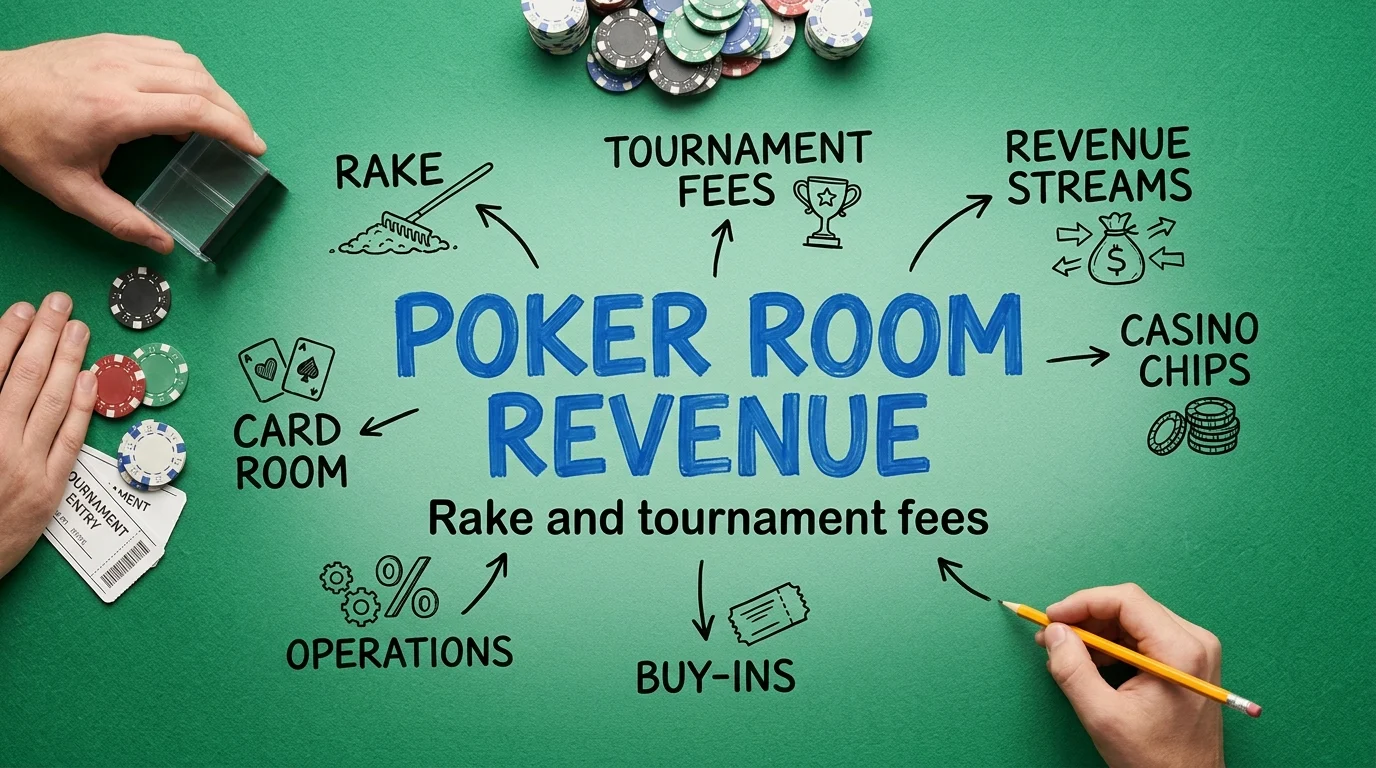
A poker room makes money by keeping a small share of what players wager. In cash games that share is rake, taken from each pot. In tournaments it is a fee added to the buy-in. Some rooms charge for time at the table instead. Together these form one revenue model, and the balance between them depends on the games you run and the players you attract.
On this page
- What Is Rake in Poker and How Do Rooms Take It?
- Where Poker Room Revenue Comes From Beyond Rake
- How Tournament Fees Work and Why Rooms Depend on Them
- How Rake Rates Compare Across Major Poker Networks
- How Regulation Shapes Poker Room Revenue in the United States
What Is Rake in Poker and How Do Rooms Take It?
Rake is the fee a poker room keeps from each pot in cash games. The room does not bet against players. It hosts the game, deals it and settles it, and it is paid for that service out of the money in play. PokerTube puts a typical cash-game rake between 3% and 10% of the pot, and the figure moves with stake level and room policy.
The mechanics are simple. The room removes the rake from the pot as the hand plays out or when it ends, and the winner receives what remains. Most rooms apply a per-hand cap, so the percentage stops mattering once the pot is large enough. Many also apply a no-flop-no-drop rule, meaning a hand that ends before the flop produces no rake. Details differ by room, so the rake table in each room’s rules is the authority.
A worked example shows why the cap matters. Take a hypothetical 5% rake with a $3 cap. A $40 pot yields $2. A $100 pot would yield $5 at the full percentage, but the cap holds it to $3. The room’s effective rate falls as pots grow.
Why rake is the core of cash-game income
Rake scales with activity. Every hand dealt at a populated table produces a small, repeatable amount, and the room carries no exposure to who wins. That makes rake the most predictable part of cash-game income. Revenue follows hands dealt, so player liquidity, table availability and game speed drive it more than any single pricing decision.
How stake levels change the rate
Stake level changes both the percentage and the cap. Lower-stakes games often carry a higher percentage because the pots are small and the room still has to cover table costs. At higher stakes, pots reach the cap more often, so the effective rate paid by players drops even if the published percentage looks similar. Rooms set these tables deliberately. They want low stakes to cover costs and high stakes to stay attractive to players who would otherwise move elsewhere.
Where Poker Room Revenue Comes From Beyond Rake
Poker room revenue comes from several streams, and rake is only one of them. A room that ran on cash-game rake alone would depend heavily on one player type and one game format. Most operators add time fees, tournament entry fees and other paid features to spread that dependence.
Time fees
PokerTube notes that some rooms skip per-hand rake and charge a time fee instead. In a time-fee game, each player pays a fixed amount per block of time at the table, whether or not they win pots. This is common in live rooms and appears at some online tables. It suits higher-stakes games, where a percentage of the pot would feel steep, and it gives the room income that does not swing with the size of individual pots. The tradeoff is that players who fold often still pay full price, so the format works best where players accept that cost.
Tournament entry fees
Tournaments carry a separate fee on top of the prize-pool contribution. It is a distinct income line with different economics from cash rake, covered in the next section.
Other paid features
Beyond rake, time charges and tournament fees, rooms may earn from side formats and optional features. Examples include jackpot-style contributions, fast-fold or lottery-style sit-and-go games, and branded events. The mix varies a lot. A room built around casual players may weight toward fast formats and promotions. A room serving grinders may rely on high-volume cash tables and a deep tournament schedule.
Rooms also carry costs that reduce net revenue, such as loyalty programs and rakeback offers. These return part of the rake to players, so gross rake and retained revenue are different numbers. Your product decisions, from game selection to loyalty design, shape the mix. For a view of where player demand is heading, see our look at online poker game trends.
How Tournament Fees Work and Why Rooms Depend on Them
The fee portion of a tournament buy-in is kept by the room and sits apart from the prize pool. A buy-in written as $100+$10 means $100 goes to the prize pool and $10 goes to the room. Players pay both amounts to enter, but only the first is redistributed to winners.
Fixed and percentage-based fees
Some tournaments use a fixed fee, a flat amount regardless of the event’s structure. Others use a percentage of the buy-in. The $100+$10 example above is a 10% fee, though that figure is illustrative and not a market standard. Larger events often have lower percentage fees, and smaller ones may carry a higher percentage so the fee still covers the room’s costs. Whichever model you choose, the fee is stated separately so players can see exactly what they are paying.
What the fee covers
The fee pays for running the event: software and server load, support, staffing, promotion and, in live rooms, dealers and floor staff. Whatever remains after those costs is the room’s margin. Guaranteed prize pools add another factor. If registrations fall short of the guarantee, the room covers the shortfall, known as an overlay, so fees from well-attended events help absorb that risk.
Why tournament traffic matters
Tournaments are scheduled, which makes them easier to plan around than cash traffic. Players register ahead of time, late registration extends the window, and a long event keeps players engaged for hours. A strong schedule gives a room a base of recurring entries that does not depend on how many cash tables happen to fill on a given evening. Understanding how large events are built helps here. Our breakdown of the World Series of Poker tournament structure shows how buy-ins, fields and payouts fit together.
Fees are shown in the lobby before entry, so players see the split between prize-pool contribution and room fee before they commit. The software behind that display matters too. If you are building or evaluating a platform, the poker tournament software features worth checking before launch include fee configuration, late registration controls and guarantee handling.
How Rake Rates Compare Across Major Poker Networks
Among the major networks, WPTGlobal publishes the lowest base cash rake in 2026 at 4%, while GGPoker, CoinPoker and the Winning Poker Network each take 5%. The Winning Poker Network also applies a flat $3 cap at every stake. These figures come from YourPokerDream’s 2026 comparison, published in October.
| Network | Base cash rake | Note |
|---|---|---|
| WPTGlobal | 4% | Lowest base rate among the major networks |
| GGPoker | 5% | Standard base rate |
| CoinPoker | 5% | Standard base rate |
| Winning Poker Network | 5% | Flat $3 cap at every stake |
Reading the numbers
A one-point gap looks small but compounds over many hands. On a pot that stays under any cap, a 4% rate takes one-fifth less than a 5% rate. For players, that difference accumulates. For a room, it means giving up margin per hand and betting on something else to make it back.
That something is volume. A lower base rate can attract more players, and more players mean more hands dealt and more tournament entries. If the extra traffic outweighs the lower take per hand, total revenue can rise. If it does not, the lower rate simply shrinks income. This is why a rate on its own says little about how a room performs.
The flat $3 cap at the Winning Poker Network shows a different lever. A uniform cap limits what players pay in large pots at every stake, so the room trades some high-stakes income for a simple, predictable offer. Whether that is the right trade depends on where its players sit on the stakes ladder.
Treat every figure here as a published rate and not a guarantee. Rooms revise rake tables, promotions and rakeback terms, and a headline base rate does not capture loyalty returns or per-game differences. Check each network’s current rake schedule before you use the numbers in a business case.
How Regulation Shapes Poker Room Revenue in the United States
In the United States, state law decides whether a room can legally serve players and how it may charge them. There is no single national framework for online poker, so the same room model can be allowed in one state and unavailable in the next. For a state-by-state view, our guide to US betting laws by state is a useful starting point.
California as an example
California shows how law, not pricing, can set the ceiling on revenue. As of this writing, online poker is not offered to adult residents under regulation in the state. A room with an excellent rake structure and a full tournament schedule still has no regulated route to earn from those players. For an operator, state size and player demand count for little until the legal path exists.
Licensing terms and fee rules
Where a state does regulate online poker, licensing terms can shape the revenue model directly. Conditions may touch how rake and fees are charged, how they must be disclosed to players, and how funds are handled. Outside the US, regulators such as the UK Gambling Commission set licence conditions for operators serving their markets, which shows how widely these rules can differ by jurisdiction. Disclosure rules matter in practice. If a license requires fees to be displayed before a player commits, your lobby and cashier flows need to support it.
Player taxes are a separate matter from room revenue, but they affect how you present and report activity. The IRS publishes guidance on gambling income, and operators should confirm any reporting duties that apply to their setup with a qualified adviser.
Check current law before launch
Laws change, and legislative proposals do not always become law. Before you commit to a market, confirm the current status in that state, the license type and fee conditions that apply, and any reporting duties. Build rake and fee settings so they can be adjusted per jurisdiction, because a model priced for one market may not be permitted in another.