
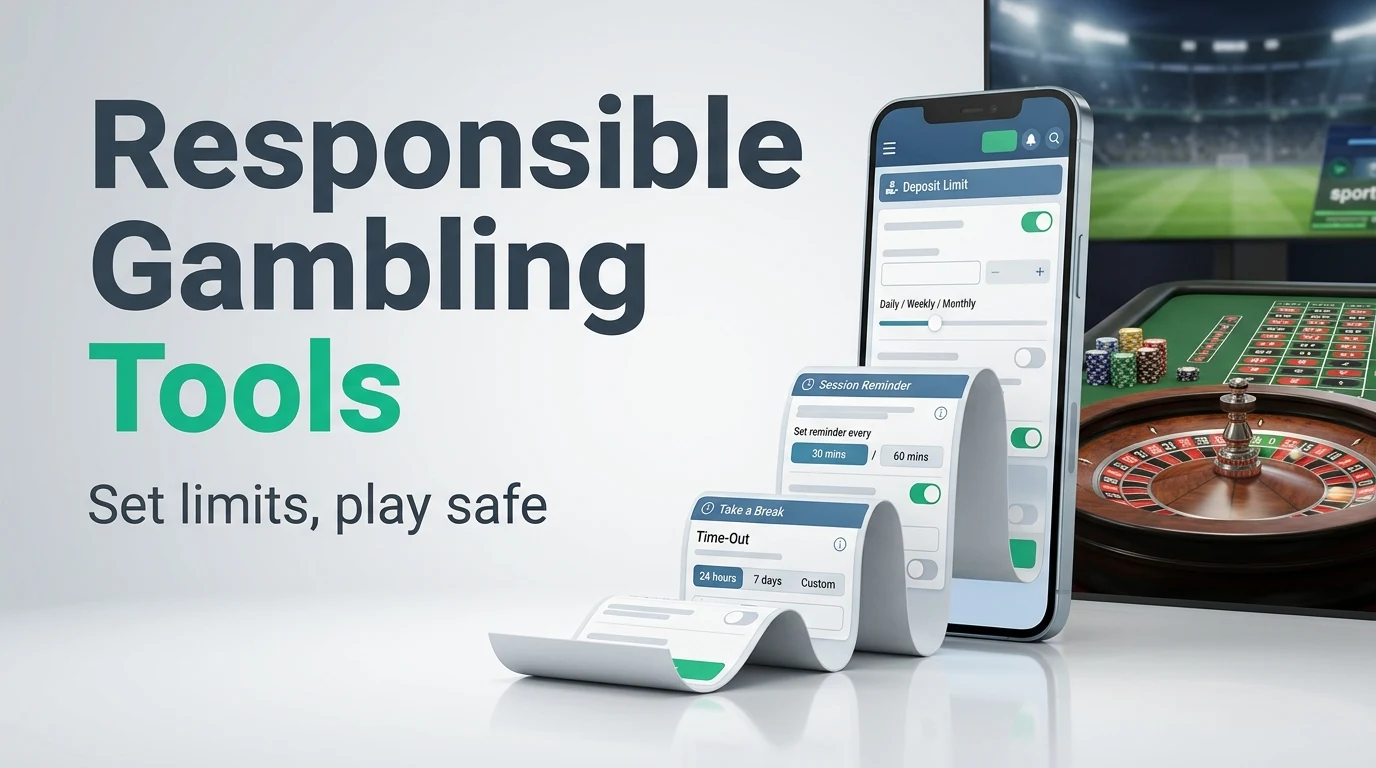
Responsible gambling tools are player-facing controls that let a customer limit, pause or exclude their own betting. A sportsbook needs four groups of them: deposit and loss limits, session reminders and time-outs, cool-off periods, and self-exclusion. This checklist sets out what each group must do, whatever market you operate in.
On this page
- What Are Responsible Gambling Tools for a Sportsbook?
- Which Deposit and Loss Limits Should a Sportsbook Offer?
- Why Do Session Reminders and Time-Outs Matter for Sportsbooks?
- When Should a Sportsbook Offer Cool-Off Periods and Self-Exclusion?
- How Should Responsible Gambling Tools Be Built into a Sportsbook Platform?
What Are Responsible Gambling Tools for a Sportsbook?
Responsible gambling tools are the controls a player can use on their own account to restrict, interrupt or end their betting. They are different from the monitoring an operator runs in the background. The player decides, the platform enforces. That split matters because a control the player cannot find, or one the platform cannot enforce reliably, protects nobody.
In a sportsbook these tools touch three layers of the product. The account layer holds the player’s profile, status and history. The wallet layer holds balances, deposits and withdrawals. The betting layer accepts or rejects each stake. A deposit limit has to be checked in the wallet. A self-exclusion has to block sign-in and stop bet placement. A session reminder has to read activity from the betting layer. Because the tools cut across all three, they are hard to retrofit. If the wallet, the account service and the bet engine were built without a shared place to store player restrictions, every new control means touching each of them separately.
The four groups this article covers are summarized below.
| Tool group | What the player controls | What the platform must do |
|---|---|---|
| Deposit, loss and stake limits | How much they can add, lose or stake over a period | Enforce across every payment method and apply decreases at once |
| Session reminders and time-outs | How long they play before being prompted, and when to pause | Show time spent and net result, and log each reminder |
| Cool-off periods | A short break from betting | Block betting immediately and restore access automatically at the end |
| Self-exclusion | A longer block, often not reversible on request | Block sign-in, hold the balance, stop marketing and control reinstatement |
Regulators set minimum requirements, and those minimums differ in detail. One jurisdiction may require operators to offer certain limit types, another may fix the available self-exclusion durations, and a third may run a national register that operators must check. The UK Gambling Commission is one example of a regulator that publishes requirements for licensed operators on customer protection, and other regulators publish their own. Treat the rules of your licensing jurisdiction as the floor and read them directly before you finalize any design.
The checklist that follows applies to any sportsbook. It does not depend on whether you serve one regulated market or several. What changes between markets is configuration: which limit types are mandatory, which durations are offered, which registers you connect to. What should not change is the underlying capability. If the platform can enforce a limit, hold a block and record the event, you can adjust the parameters per market without rebuilding anything. For a wider view of what a sportsbook needs beyond player protection, see our sportsbook platform features checklist.
Which Deposit and Loss Limits Should a Sportsbook Offer?
A sportsbook should offer daily, weekly and monthly deposit limits, plus loss and stake limits where the regulator allows them. Deposit limits are the baseline. Loss and stake limits add finer control for players who fund their account once but bet across many events.
Daily, weekly and monthly windows each serve a different purpose. A daily limit catches a bad evening. A weekly limit fits players who budget around pay cycles. A monthly limit gives a ceiling for the whole period. Let players set any combination of the three, and apply the strictest one that is reached first. Show the remaining allowance on the deposit screen, not buried in account settings, so the limit is visible at the moment the player decides to add funds.
Loss limits cap net losses over a window. Stake limits cap the amount placed on a single bet or across a period. Both depend on the betting layer reporting settled and open positions accurately. That is harder in sports than in a simple casino product. Cash-out, partial settlement, voided legs and bet builders all change the net result after a bet is placed, so the platform needs a clear rule for when a position counts toward a loss limit. Define that rule, document it, and apply it the same way everywhere. If a regulator does not permit or require a given limit type in your market, make the type configurable rather than removing it from the codebase.
Player-Set Limits and Operator-Imposed Limits
Keep the two types separate in your data model and in the interface. A player-set limit is a choice the customer makes about their own budget. An operator-imposed limit is applied by you, either because a regulation requires it or because your own risk team has decided to restrict an account. The player should be able to see both, with a plain explanation of who set each one. Mixing them leads to confusion and support tickets. It also causes compliance problems if you cannot show later which party set a limit and why.
Operator-imposed limits should carry a reason code and a review date. A restriction that sits on an account for years with no record of its purpose is a liability. Where your jurisdiction requires affordability or source-of-funds checks before higher limits are granted, the workflow should tie the check result to the limit change so the approval is traceable.
Decreases Take Effect Now, Increases Wait
The rule to build in is asymmetric. Lowering a limit takes effect immediately. Raising a limit, or removing it, takes effect only after a waiting period. The point is that an impulse change cannot undo protection. A player who has just lost a bet and wants to chase it should find that the limit they set last week still holds.
The length of the waiting period is often set by regulation, so keep it configurable. During the wait, the player should see the pending increase, the date it takes effect and an option to cancel it. If they cancel, the existing limit stays in force with no interruption. Do not let a support agent shorten the waiting period on request unless your compliance policy explicitly allows it and the override is logged.
One Limit Across Every Payment Method
Limits belong to the account, not to the payment instrument. If a player has a daily deposit limit and funds the account by card, bank transfer, e-wallet or a cashier top-up, all of those count against the same total. Otherwise a player who reaches the limit with one method can simply switch to another, and the control becomes decoration.
This is where a wallet layer built separately from the account layer causes trouble. Every deposit route, including any voucher, retail or cashier channel and any manual credit from support, must call the same limit check before funds are credited. Test for the gaps: a deposit that is initiated but settles later, a refunded deposit, a reversed payment, and a bonus credit that is not a deposit but still adds to the playable balance. Decide how each one counts and make sure the check runs on all of them.
Why Do Session Reminders and Time-Outs Matter for Sportsbooks?
Session reminders and time-outs show a player how long they have been betting and what their net position is, and they let the player pause play. They interrupt the momentum of a long session at the point where the player can act on it.
Sports betting suits these tools well, and also needs them. A slot session has an obvious rhythm of spins. A sportsbook session can stretch across a whole afternoon of fixtures. In-play markets reopen every few seconds, a live match offers a steady supply of new bets, and bet builders let a player assemble a new multi-leg wager in moments. A player can be active for hours without ever reaching a natural stopping point, because the next market is always about to open. A reminder gives that stopping point back.
How the Reminder Should Be Designed
The common design has three parts. First, a reminder fires at an interval the player chooses, within a range you set. Many regulators require reminders to be available, and some set the maximum interval, so make the range configurable. Second, the reminder shows two facts clearly: the time spent in the current session and the net result, meaning total won minus total staked since the session began. Third, the player can start a time-out with one action from the reminder itself, without going to a settings page.
Keep the language plain. A message such as “You have been betting for 2 hours and are down by this amount” is more useful than a generic prompt to gamble responsibly. Show the figures in the player’s currency, and update them at the moment the reminder appears rather than from a cached value. Define what a session is, since a player who moves between the web app and a mobile app, or who leaves a tab open, may confuse a naive timer. Tie the session to the account, not to the device, so the clock does not reset when the player switches.
Time-Outs as a Short, Easy Pause
A time-out is a brief break the player starts themselves, from minutes up to a day or so, depending on your configuration. It should be quick to start and should take effect at once. During the time-out the player cannot place new bets. Think carefully about open bets and live positions. In most designs, existing bets stay open and settle normally, while new bets and new deposits are blocked. State that clearly on the confirmation screen so the player knows what to expect.
This is different from a cool-off period, which the next section covers. A time-out is designed to be light and frequent, a way to step away for a meal or a night. A cool-off is a deliberate decision to stay away for longer.
The Dismissal Problem and Logging
The main weakness of reminders is that players learn to dismiss them without reading. A pop-up with a single close button becomes noise within a week. There are practical countermeasures. Require the player to take a visible action, such as choosing between continuing and pausing, rather than closing the window. Show the net result in a way that is hard to miss. Pause bet placement while the reminder is open so the player cannot tap through to another stake.
The platform should also log every reminder: when it was shown, what it displayed, and what the player did in response. That record serves two purposes. Compliance teams can demonstrate that the control operated as designed. Your player protection team can also see patterns, such as a player who dismisses every reminder within a second or who keeps betting through repeated prompts. Those signals can feed manual review or automated interventions, which we cover in our piece on AI for responsible gambling.
When Should a Sportsbook Offer Cool-Off Periods and Self-Exclusion?
A sportsbook should offer a cool-off period and self-exclusion from within the account at all times, with durations set by the jurisdiction it operates in. Neither should require the player to contact support or find a hidden page. If a player decides to stop, the option should be a few taps away.
“We license, regulate, advise and provide guidance to the individuals and businesses that offer gambling in Great Britain, including the National Lottery in the UK..”
The two tools differ in length and in how easily they can be undone. A cool-off is short and temporary. Typical designs run from a day to a few weeks, and access returns automatically when the period ends. Self-exclusion is longer, often months or years, and usually cannot be reversed quickly. In many markets a self-exclusion cannot be lifted at all until the chosen term has run out, and then only after a further step. Present the difference honestly in the interface. A player who thinks they are choosing a short break should not end up locked out for a year, and a player seeking a long exclusion should not be offered a short one by default.
What the Account Must Do During a Block
Once a cool-off or self-exclusion starts, the account needs to behave in specific ways. Build these as testable requirements.
- Block access: The player cannot sign in to betting products, and any active session ends when the block begins. Open bets may settle, but no new bets can be placed.
- Hold the balance: Remaining funds stay safely in the account and are returned or made available according to your terms and the regulator’s rules. Do not leave the player unsure where their money is.
- Stop marketing: Email, SMS, push notifications and retargeting audiences must exclude the account for the full period. This is among the most common failure points, because marketing systems often sit apart from the account service and keep their own lists.
- Block new accounts and deposits: Deposits must be refused, and where your jurisdiction and technology allow, the platform should flag attempts to open a duplicate account using the same identity details.
- Show support information: Confirm the block on screen and in a message, and give the player routes to independent help.
Where a national or shared exclusion register exists in your market, the platform should check it at registration and at sign-in, and should add the player to it when the player chooses a register-based exclusion. Treat that integration as part of the core build, not as an afterthought.
Reinstatement Belongs in the Workflow
Reinstatement procedures are regulated in many markets. They may require a minimum waiting time after the term ends, a confirmation from the player, a cooling interval before betting resumes, or a documented check by the operator. Build those steps into the product workflow with clear states: active block, term ended, reinstatement requested, reinstatement pending, reinstated. Each state should have defined rules about what the player can do and what staff can do.
Do not handle reinstatement by email. An email thread has no enforced waiting period, no reliable record, and no protection against an agent making a well-meant exception. When a player asks to return, the request should go through the same system that holds the exclusion, with the checks run automatically and the outcome written to the audit trail. Staff should not be able to remove an exclusion by editing a status field. That single design choice prevents a large share of the compliance failures that regulators find in practice.
Players who choose self-exclusion may also need support beyond the sportsbook itself. Link to independent organizations such as the National Council on Problem Gambling for players in the United States, and to the relevant national helpline for each market you serve. Keep the list of resources configurable by jurisdiction.
How Should Responsible Gambling Tools Be Built into a Sportsbook Platform?
Responsible gambling tools work best when they are built into the core account and betting layers at launch rather than attached afterward. A control that lives in the same service as the wallet and the bet engine can block a deposit or reject a stake in the same transaction. A control that sits in a separate add-on has to be synchronized, and any delay or failure in that synchronization is a gap a player can fall through. We cover the trade-offs in more detail in our piece on whether responsible gambling controls should be a platform feature or bolt-on.
Sourcecodelab is a B2B platform provider that builds sportsbook software for iGaming operators. Whichever provider you evaluate, ask the same question: when the platform is delivered, do limits, reminders and exclusion sit in the core account layer, or are they separate modules to be integrated later? Ask to see them working in a test environment. Ask how a limit change travels from the player interface to the wallet and to the bet engine. Ask what happens if one of those services is briefly unavailable. The answers show quickly whether protection is part of the architecture or a feature layered on top.
What Operators Need Behind the Player Tools
The player-facing screens are only half the work. Operators need a back-office view that proves the controls operate.
Audit log: Every limit change, exclusion, cool-off, time-out and reminder should be recorded with the account, the timestamp, the old and new values, and who or what made the change, whether the player, a staff member or an automated rule. The log should be append-only, so entries cannot be edited or deleted after the fact.
Reporting for compliance teams: Compliance staff should be able to pull reports without asking engineering. Useful reports include active limits by type, pending limit increases, current exclusions and their end dates, reminder responses, reinstatement requests and any staff overrides. Regulators may ask for this information on short notice, and a report you can generate on demand is far less costly than one assembled by hand.
Testing before launch: You need a way to test the controls end to end before real players use them. That means a staging environment where you can set a limit and attempt to breach it through every payment route, start an exclusion and try to sign in, trigger a reminder at a short interval and check the logged result. Scripted test cases that run on every release catch regressions that a one-time check would miss. A new payment method or a new bet type can quietly bypass a control that worked last month.
A Short Launch Checklist
Before you go live, confirm each of the following.
- Daily, weekly and monthly deposit limits work, and loss and stake limits are available where the regulator allows them.
- Limit decreases apply immediately and increases wait for the configured period, with a cancel option.
- Every payment method and cashier route checks the same account-level limits.
- Session reminders show time spent and net result, and require a visible player action.
- Time-outs start in one action and block new bets and deposits at once.
- Cool-off and self-exclusion are available from within the account, with durations matching your jurisdiction.
- Blocked accounts cannot sign in to betting, hold their balance safely and are removed from all marketing lists.
- Reinstatement runs through a defined workflow, not by email, and staff cannot remove an exclusion manually.
- The audit log records every limit change, exclusion and reminder and cannot be edited.
- Compliance reports run on demand, and the controls have passed end-to-end testing in staging.
- Support links and helpline details are correct for each market you serve.
Run the checklist per market, since durations, limit types and register requirements will differ. If every item passes with configuration changes only, the platform has the right foundation. If an item needs custom development for each new market, treat that as a warning about how the controls were built.