


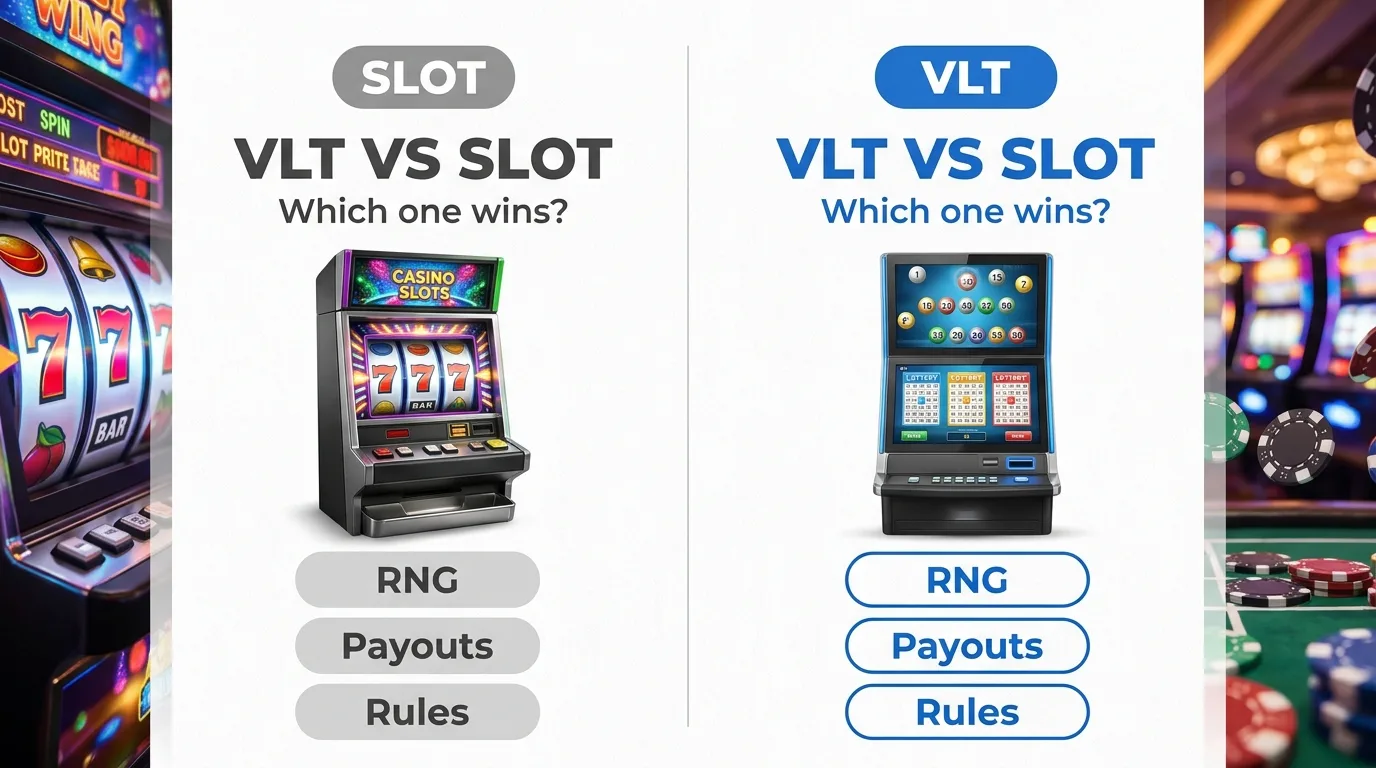
Video Lottery Terminal Vs Slot Machine: What Is a Video Lottery Terminal and How Does It Differ from a Slot Machine?
A video lottery terminal (VLT) is a lottery-run gaming machine linked to a central server, while a slot machine is a casino device with its own random number generator. On screen they can look almost identical. Underneath, they differ in who decides the outcome, who licenses the hardware and where the machine may stand.
A slot machine is a self-contained gaming device. It holds its game logic and RNG locally, and a casino operator runs it under a gaming license. If you want the mechanics of return-to-player and randomness on that side, see how slot machines use RTP and RNG.
A VLT is a lottery product. Lottery commissions regulate it, and the terminal acts as a front end for games whose results are produced centrally. That design is why VLTs sit in the lottery’s legal category rather than the casino’s. It is also why a bar, a truck stop or a retail outlet can host one in jurisdictions that allow it, while a slot generally cannot leave a licensed casino floor.
The model is not new. South Dakota became the first state to adopt VLTs, on October 16, 1989. Other jurisdictions followed with their own rules on wagers, payouts and venues, so the term covers a family of regulated products rather than one uniform machine. If the lottery vocabulary around draws and odds is unfamiliar, lottery terms explained covers the basics.
The rest of this post sets the two machines against each other on outcome generation, regulator, legal venue and payout, then looks at what happened to VLTs in Missouri in 2026.
How Do Video Lottery Terminals and Slot Machines Compare Side by Side?
The two machines differ most on where the outcome is decided, who regulates them and where they can legally operate. Payout is the weakest dividing line, because the ranges overlap.
| Feature | Video lottery terminal | Slot machine |
|---|---|---|
| Outcome generation | Central server operated for the lottery | RNG inside the machine or its game system |
| Regulator | State lottery commission | State gaming commission (in Missouri, the Missouri Gaming Commission) |
| Typical venue | Lottery-licensed retail locations where the state allows them | Licensed casinos |
| Typical return | Commonly cited at 85% to 92%, a general older figure that may not reflect current state rules | Set by game and jurisdiction, generally a little higher than VLTs on older figures |
| Legal status in Missouri | Not legal outside casinos, and the 2026 legalization push ended without a law | Legal in licensed casinos |
Treat the return row with care. The 85% to 92% VLT range comes from older national reporting, and each state sets its own floor. A slot’s return depends on the game’s configuration and on the minimums the local regulator imposes, so there is no single number to compare against.
The verdict is short. A VLT is a lottery product and a slot is a casino product. The return figures overlap enough that the legal setting, not payout, separates them. If you are comparing the two for a project, start with the licensing category and work backward to the technical design.
Why the Random Number Generator Location Matters for Players
The location of the random number generator is the technical line between the two machines, since a slot keeps it on the device while a VLT’s outcomes come from a central lottery server. Everything else about auditing and control follows from that placement.
As Las Vegas Advisor described the structure in late 2025, casino slots carry their own independent RNG, while VLTs connect to a central server run and regulated by lottery commissions. That is a design difference, not a cosmetic one.
Three practical consequences follow.
- Auditing: A lottery commission can inspect one central system instead of testing every cabinet’s RNG individually. A slot regulator certifies the device or its game software and checks the installed build.
- Game logic control: On a VLT, the lottery operator controls the logic that produces results. On a slot, the manufacturer and the casino operator work within the regulator’s approval process.
- Player verification: At the machine, you can verify very little in either case. You see a paytable and a result. Neither type lets you inspect the RNG, so trust rests on the regulator’s testing and the operator’s license.
For developers, the central link changes the architecture. A VLT terminal has to handle network latency, session integrity and server-side result delivery. A slot has to protect a local RNG and its seed handling. Our post on hardware versus software RNG covers the general mechanics for readers who want that background.
The central model also means a single fault or misconfiguration can affect every connected terminal at once. That is why lottery regulators tend to scrutinize server changes closely.
Are Video Lottery Terminals Legal Where Slot Machines Are?
Legality is where the two machines diverge most sharply, because Missouri law allows slot-style play only in casinos, and Torch Electronics agreed on November 17, 2026 to pay $13.5 million and stop operating its VLTs. Looking like a slot is the legal problem.
Missouri’s 2026 record runs in a clear order.
- February 18: The Missouri House passed a bill to legalize and regulate the machines by an 83-66 vote. It did not become law.
- Early March: The St. Louis County Prosecutor, Melissa Price Smith, warned that businesses that did not disable VLTs by June 1 could face criminal penalties.
- April 8: Torch’s removal from Missouri took effect under an agreement that suspended its operations in the state.
- May 6: A Missouri Senate committee vote effectively ended any 2026 legislative effort to legalize the machines.
- November 17: Torch settled state and federal investigations. It agreed with Missouri Attorney General Catherine Hanaway and federal prosecutors to pay $13.5 million and stop operating its machines.
Torch’s VLTs had been compared to virtual slot machines, which Missouri allows only in casinos. That comparison is the core of the enforcement logic. A machine that behaves like a slot but sits outside a licensed casino is treated as unlicensed gambling, whatever the operator calls it.
The current status is plain. The House bill is not the plan going forward, and no 2026 law legalizes VLTs in Missouri. For official positions, see the Missouri Attorney General’s office and the Missouri Gaming Commission, which oversees the licensed casino side.
Other states handle this differently, so a machine that is legal in one jurisdiction can be an enforcement target in another. Check the state’s own lottery and gaming statutes before deploying anything.
Choosing Between a Video Lottery Terminal and a Slot Machine
Neither machine is better in general, since a slot suits a casino operator who wants flexible game design and a VLT suits a state lottery running a controlled product. The choice usually follows from the license you hold, not from preference.
Use this checklist to narrow it down.
- Legal venue: Will the machine stand in a licensed casino or in lottery-authorized retail locations?
- Regulator: Is the approving body a gaming commission or a lottery commission?
- Outcome location: Must results come from a central server, or can the RNG sit on the device?
- Payout floor: What minimum return does the jurisdiction require, and how is it verified?
Several 2026 proposals show how much the rules vary. Missouri’s SB 850 would have required a minimum payout of 85% for each game. Indiana’s proposal would cap wagers at $2 per round, with a maximum possible win of $599. Mississippi’s HB 76 would set a maximum bet of $0.01 per play, with payouts capped at $750 per round. I could not confirm the final status of the Indiana and Mississippi bills, so treat them as proposals and check current legislative records. In Missouri, the 2026 legalization effort ended in the Senate committee.
On the build side, Sourcecodelab develops both custom slot games and lottery management systems. That is the vendor’s own description of its work, so weigh it as you would any provider’s claim and compare it against your own technical and licensing requirements. Other providers, including SoftSwiss and GammaStack, also operate in the wider iGaming platform space, and a fair evaluation looks at all of them against your jurisdiction’s rules.
Whichever route you take, settle the legal category first. The architecture, the certification path and the payout configuration all depend on it.