

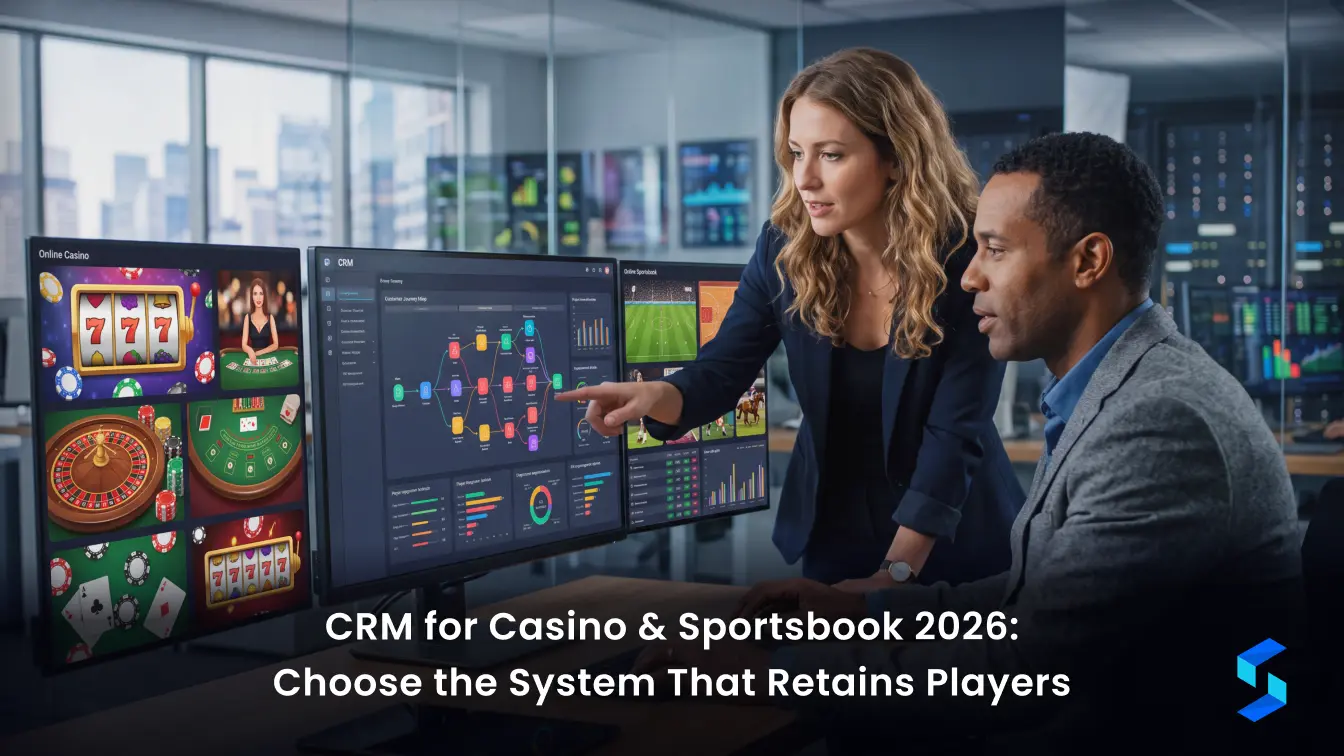
A gambling CRM solution is the system that turns player data into timed, targeted communication: welcome journeys, bonus campaigns, reactivation, VIP handling and responsible gambling interventions across casino and sportsbook. It runs on top of your PAM and does not replace it. This guide covers what an iGaming CRM must do, how casino and sportsbook logic differ, which routes you can buy or build, and how to test a vendor before you commit.
What a gambling CRM solution does for casino and sportsbook operators
An iGaming CRM ingests behavioral data from your PAM, game platform and sportsbook, then decides who hears what, when and through which channel. That decision layer is what separates a CRM from an email scheduler. A scheduler sends whatever you load into it. A CRM reacts to what players actually do.
In a combined operation, the CRM typically owns these jobs:
- Welcome journeys: Onboarding sequences, first-deposit follow-up and game or market recommendations.
- Bonus campaign management: Which segment gets which offer, in which channel, and at what moment.
- Reactivation workflows: Dormant-player sequences with escalating offers.
- VIP lifecycle management: Tier progression, exclusive offers and triggers for personal account managers.
- Cross-sell automation: Moving sportsbook players into casino and the reverse.
- Responsible gambling triggers: Messaging and suppression when players approach limits or enter a cooling-off period.
- Event-driven marketing: Tournament launches, major sporting events and seasonal promotions.
CRM vs. PAM
Operators evaluating iGaming technology confuse these two systems more often than any other pair. They are complementary.
| System | Role | Short version |
|---|---|---|
| PAM (Player Account Management) | Holds player records: identity, balance, session history, compliance status | The system of record |
| CRM | Uses that data to automate marketing, retention and lifecycle communication | The system of action |
A PAM without a CRM is a store of player data with no automated way to act on it. A CRM without a solid PAM feed is a campaign tool working from partial information. If your PAM vendor says CRM is included, find out whether that means real-time segmentation and multi-step journeys or a basic mailer with a template library.
Casino CRM vs. sportsbook CRM: where the signals differ
Casino CRM software and a sportsbook CRM read different behavior. A combined operation needs one system that understands both, because the signals that mark activity, churn and value are not the same.
| Signal | Casino CRM | Sportsbook CRM |
|---|---|---|
| Activity indicator | Game sessions, rounds played, slot type preference | Bet count, sports followed, in-play vs. pre-match ratio |
| Churn signal | No login in X days, shrinking session length | No bets in X days, narrowing sport range |
| Re-engagement trigger | Free spins on a preferred game type | Enhanced odds on an upcoming event in a preferred sport |
| VIP signal | High average bet per session, frequent deposits | High stake per bet, accumulator preference, same-day deposit and withdrawal |
| Cross-sell trigger | Casino player who has never placed a sports bet | Sportsbook player who has never played a slot |
A CRM that treats every player as one behavioral type will underperform. So will one tuned for a single vertical. Cross-sell between verticals is one of the strongest retention levers you have, and it only works if the CRM knows which vertical a player lives in and what a sensible next step looks like.
Casino CRM strategies that depend on the tooling
Several common strategies sound simple and fail without the right capabilities underneath:
- Lifecycle-stage journeys: Separate flows for new, active, declining and dormant players, each with its own offer logic and exit conditions.
- Preference-matched offers: Free spins on the game type the player actually uses, or enhanced odds in the sport they follow.
- Event calendars: Sportsbook campaigns built around fixtures, with casino follow-ups for the quiet days between them.
- Frequency control: Caps per player across channels, so a busy campaign calendar does not turn into noise.
If bonus mechanics are part of your plan, read how a free bet pays out and what its terms require before you design offers. Your CRM will trigger them, but the terms still need to make sense to players and compliance teams.
Features that separate an iGaming CRM from an email scheduler
Real-time segmentation
Segments should update as players act, not after last night’s batch job. Look for multi-dimensional criteria that combine game type, deposit frequency, VIP tier and days since last session, plus predictive churn scoring that flags at-risk players before they go quiet. Ask how fast a player moves from one segment to another and whether that speed holds at your peak traffic.
Multi-channel campaign management
Players respond through email, push, SMS, in-app messages and pop-ups, and they prefer different channels at different moments. Your CRM should run all of them from one workflow builder, support A/B testing with proper significance calculation, learn channel preference per player and apply frequency capping across channels. Excess messaging tends to push players away, so the cap matters as much as the send.
Bonus engine integration
The CRM should trigger bonuses that your platform’s bonus engine fulfills, with no manual handoff between teams. In practice, that means API integration with your PAM or bonus system so that:
- A CRM workflow can award free spins without a developer touching the bonus system.
- Bonus status (accepted, wagering in progress, completed) flows back into the CRM for follow-up sequencing.
- Abuse-prevention rules in the bonus engine do not conflict with campaign automation.
It also helps if the marketing team and the bonus team share vocabulary. Our casino term guide on money metrics and bonus rules is a useful reference for aligning definitions like wagering and bonus balance before you configure workflows.
Responsible gambling automation
A modern iGaming CRM needs responsible gambling workflows built in, not bolted on. Check for automatic communication to players approaching self-set deposit limits, cooling-off management tied to self-exclusion status in the PAM, and campaign suppression so a flagged player never receives a bonus offer during an intervention. Many licensed markets expect this, so confirm the requirements of your own jurisdictions. It also protects long-term value, since a well-timed intervention is better for the relationship than silence followed by churn.
Predictive and AI-driven personalization
Rule-based segmentation is the baseline. Beyond it, evaluate next-best-offer models, in-session personalization that adapts to current behavior and predictive lifetime value scoring for new players. Ask vendors to show which models are in production today and which are on a roadmap.
Gambling CRM options: purpose-built, integration partner, PAM-native and general
Most operators choose among five routes. They are listed here by type, not by quality, and the right one depends on your team, your PAM and your launch timeline.
- Purpose-built iGaming CRM platforms: Dedicated products built for casino and sportsbook. Optimove, Fast Track, Symplify and Smartico are names that regularly appear on shortlists. They differ in emphasis, such as segmentation depth, responsible gambling tooling, channel orchestration or gamification, so test each against your own use cases.
- Integration partner: Sourcecodelab is a B2B platform provider for iGaming whose team integrates CRM systems with casino and sportsbook platforms, from basic segmentation to real-time personalization. This route suits operators who want the CRM connected cleanly to their PAM and bonus engine without owning the integration work.
- Integrated PAM-CRM: Some PAM providers include CRM functions. Integration is simpler, but campaign flexibility can be narrower than in a dedicated tool.
- General CRM with iGaming integration: Platforms such as Salesforce or HubSpot can be adapted, but bonus triggering, responsible gambling suppression and betting-behavior segmentation all need custom development. This fits only teams with strong in-house engineering.
- Custom-built CRM: Maximum control, maximum cost and a long maintenance tail. Rarely justified before you have scale and a clear gap that no vendor fills.
What the cost looks like
Published prices vary widely and change often, so treat any figure you read without a quote as a rough guide. Purpose-built SaaS tools usually price by active player volume. PAM-native CRM is either bundled or sold as an add-on. General CRM and custom builds shift the cost into development and ongoing engineering. Ask every vendor for the full picture: license, implementation, channel send costs, data volume charges and support tiers.
Choosing a CRM for an online casino launch
If you are launching, resist buying the most complex tool first. Pick a CRM that connects cleanly to your PAM, covers welcome and reactivation journeys, and supports responsible gambling suppression from day one. Advanced predictive models matter once you have enough player data to train them. For sportsbook-led launches, the commercial planning in our guide to building a successful sports betting company gives useful context on where retention fits against acquisition.
How to evaluate a sports betting CRM or casino CRM before you sign
Demos are polished by design. Use this sequence to get past the surface:
- Demo with your data types: Ask for the segmentation builder to be shown using realistic casino and sportsbook behavior, not a generic retail example.
- Bonus trigger path: Have the vendor walk through how a campaign awards a bonus in your specific PAM, and how bonus status returns to the CRM.
- Responsible gambling configuration: Confirm that suppression and limit-based messaging can be changed by your team without developer involvement.
- Relevant references: Ask for case studies from operators with a similar product mix. A casino-only reference tells you little about sportsbook handling.
- API and timeline: Get the API documentation, check it against your PAM, and obtain a written integration timeline with named responsibilities.
- Data handling: Review where player data is stored, who can access it and how it moves between systems. Our guide to securing a betting platform covers the wider security picture.
- Operating model: Find out who builds journeys after launch. A powerful tool still stalls if only the vendor can configure it.
Budget CRM as a retention engine
Operators who treat CRM as an email tool leave retention to chance. Real-time segmentation, cross-sell automation and responsible gambling integration give you the means to act on churn signals while they still matter. We cannot quote a universal retention uplift, because results depend on your markets, product mix and data quality. What holds across operators is that CRM sits closest to the revenue you already paid to acquire. If your acquisition work is strong, the channel mix in our piece on lead generation strategies for sportsbooks shows where those players come from. Retention is what keeps them.