


Best Quality Assurance Companies In iGaming
A buyer's guide to the best quality assurance companies in iGaming, for operators and platform teams who need casino, sportsbook and payment flows tested before launch. It covers what to ask each vendor and how to compare them.
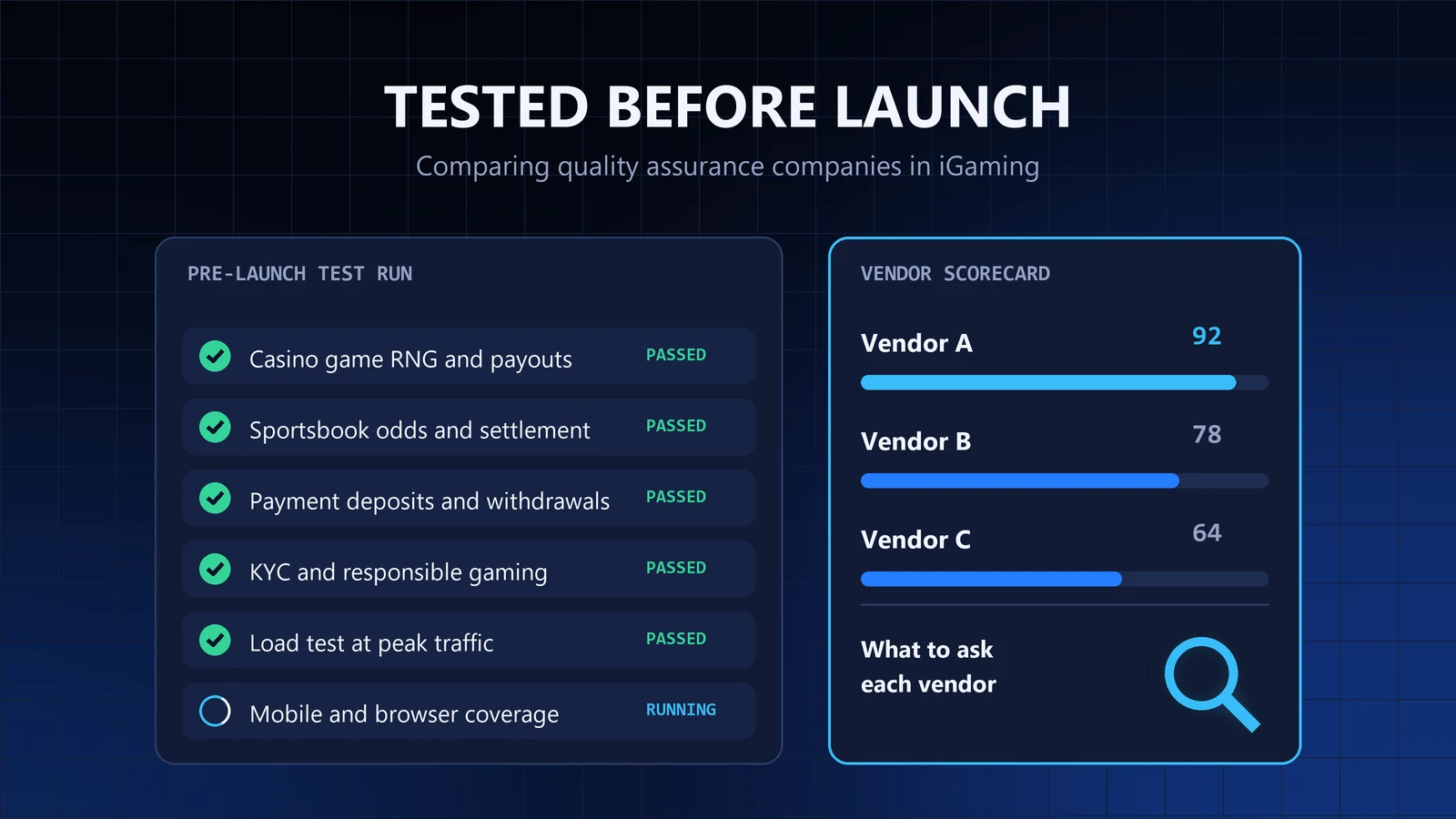
Why picking an iGaming QA partner goes wrong
Most QA vendor lists read the same, and few of them separate general software testers from teams that understand gambling products.
Generic testers miss gambling logic
A tester who has only worked on retail apps may not know how bonus wagering, jackpot contributions or bet settlement should behave. Those defects pass a standard test script and then show up as wrong payouts or player disputes.
Integrations break after launch
An iGaming platform depends on game providers, payment gateways, KYC checks and a back office all working together. Testing each one alone leaves gaps, and the failures appear where they connect, often under real player traffic.
Vendor claims are hard to compare
Every QA company says it is thorough and fast, but the pitches rarely show what is actually covered. Without a clear checklist for scope, reporting and regulatory test needs, you end up choosing on price or a sales call.
What an iGaming QA engagement hands over
Whichever company you pick, ask for these items in writing before testing starts.
Ways to work with a QA partner
Pick the model that matches how often you release and how much testing you already do in-house.
One-off test cycle
- Fixed scope agreed up front
- Testing of one build or one product
- Defect log and sign-off report at the end
- No ongoing commitment
QA inside your team
- Testers join your sprints and tools
- Test cases written as features are built
- Regression run before every release
- Bugs reported straight into your tracker
Ongoing release testing
- Regular regression runs on a set routine
- Checks after provider or payment updates
- Test pack kept current as the product changes
- Short report after each cycle
What the best QA companies in iGaming actually test
A strong iGaming QA partner covers money, game logic, load and regulation, not just screens and buttons.
Wallet and payment flows
Deposits, withdrawals, refunds and balance changes are checked end to end, including failed and repeated transactions.
Bonus and promo logic
Wagering rules, expiry, eligibility and stacking are tested so offers pay out exactly as configured.
Bet settlement checks
Sportsbook and casino results are verified against expected outcomes, including voids, cash-outs and edge cases.
Back office testing
Admin panels, player management, reporting and permission levels are tested the way operators use them daily.
Peak load testing
Traffic spikes from big matches and promotions are simulated to find slow points before players do.
Penetration testing
Login, payment and API layers are probed for weaknesses that could expose player data or funds.
Third-party integration tests
Game providers, payment gateways and KYC services are tested together with the core platform.
Regulator-ready test evidence
Test cases and reports are organised so they can support a licence application or an audit.
Cross-device regression
Each release is rechecked on the browsers, phones and operating systems your players really use.
Automated release checks
Repeatable test suites run on every build so regressions are caught before they reach production.
Tools and standards QA teams in iGaming work with
These are common choices for testing gaming platforms, not a claim about any one provider's setup.
Playwright
Automated browser tests for registration, lobby, cashier and betting flows.
Appium
Automated tests for native and hybrid mobile gaming apps.
Postman
Manual and scripted checks of wallet, bonus and game APIs.
Apache JMeter
Load and stress tests that mimic peak betting and casino traffic.
Jenkins
Runs automated test suites on every build in the release pipeline.
OWASP ZAP
Scans web applications for common security flaws before release.
GLI-19
Technical standard for interactive gaming systems used as a test reference.
ISO/IEC 27001
Information security standard used to frame data protection test checks.
Standards the best iGaming QA companies test against
A QA company in iGaming is only useful if its test cases map to the rules your licence and your payment partners expect.
Interactive gaming system rules
GLI-19 is a technical standard for interactive gaming systems, and test plans for platforms and game integrations can be built to meet it. Ask any QA company which of its checks trace back to a named requirement rather than a general checklist.
Game fairness and payout checks
Testing covers whether random number generation and return-to-player settings behave as the game specification says they should. Results need to be reproducible, so your regulator or lab can see what was run and on which build.
Payment flow testing
Deposit, withdrawal and refund journeys are tested with the requirements of PCI DSS in mind. The goal is to catch card data handling mistakes and broken payment states before real players meet them.
Player data and privacy
Registration, KYC and account closure flows are checked for how they collect, store and delete personal data, in line with GDPR principles. Test data should be anonymised so that real player records never sit in a test environment.
How an iGaming QA engagement runs, step by step
Whichever company you pick, the work should follow a clear sequence that you can inspect at every stage.
Scope and risk review
The QA team reads your product, jurisdictions and integrations, then lists what could hurt players or your licence first. Wallets, bonuses and game launches usually rank high.
Test planning
Each risk becomes test cases, environments and test data, with a clear split between manual and automated checks. You review the plan before any testing starts.
Execution and regression
Functional, integration, load and device testing run against your builds, and regression packs are repeated after each change. Bonus logic and payment edge cases get extra attention.
Defect reporting
Every defect is logged with steps to reproduce, severity and the build it was found on. Your developers can fix it without a back and forth to ask what was meant.
Release sign-off
Before launch, the team reports what was tested, what passed and what remains open. That record also gives you something to show a regulator, lab or partner.
At each stage you receive a written output you can check: a risk list, a test plan, run results, defect logs and a sign-off report.
Questions about choosing an iGaming QA company
Short answers to what operators tend to ask before they hire a testing partner.
What does a quality assurance company do for an iGaming operator?+
A QA company checks that your casino, sportsbook or other gaming product works as intended before and after launch. That usually means functional testing, payment and wallet flows, bonus logic, game behaviour and regression checks after each update. The scope depends on your product, so ask for a written test plan before you sign anything.
How do I pick the best QA company for iGaming?+
Choose the one whose experience matches your product and your markets. Check whether they have tested the kind of platform you run, such as casino, sportsbook or lottery. Ask to see a sample report, how they handle defects, and who on their team will work on your account. Past work in regulated markets is a useful signal.
Is QA testing the same as regulatory game certification?+
No. QA testing is the checking you do for product quality, while certification is a formal approval that some regulators require from an accredited test body. A QA partner can help you prepare for certification, but check your jurisdiction's rules to see which approvals you need and who is allowed to issue them.
Should QA be done by the platform provider or by a separate company?+
Both can work, and many operators use both. A provider tests its own software during development, while an independent team gives a second view without a stake in the build. If your platform is bought from a vendor, ask what testing they already do so you do not pay twice for the same checks.
What should a QA company test on an iGaming platform?+
At minimum, test registration and login, deposits and withdrawals, bonus and promotion rules, game launch and settlement, bet placement and results, and the admin tools. Add security checks, performance under load, and behaviour on different devices and browsers. Each area can break independently, so a good plan covers all of them.
When in the project should I bring in a QA partner?+
Bring them in early, ideally while requirements are still being written. Early involvement lets testers spot gaps in the specification and plan test cases ahead of the build. Starting only at the end tends to leave little time to fix what they find, which puts the launch date at risk.
Can Sourcecodelab help me with testing and platform questions?+
Sourcecodelab is a B2B platform provider for iGaming, covering products such as casino, sportsbook and lottery software. It is not an independent review body, so treat this page as one option among others. If you are comparing platforms, use the contact page to ask how testing is handled in your project.
Talk to Sourcecodelab about iGaming QA
Tell us about your platform, your markets and what you need tested, and we will tell you plainly whether we are the right fit. If you are comparing the best quality assurance companies in iGaming, we are glad to be on your shortlist.
Contact Sourcecodelab
