


Devops practices in iGaming that keep the platform live
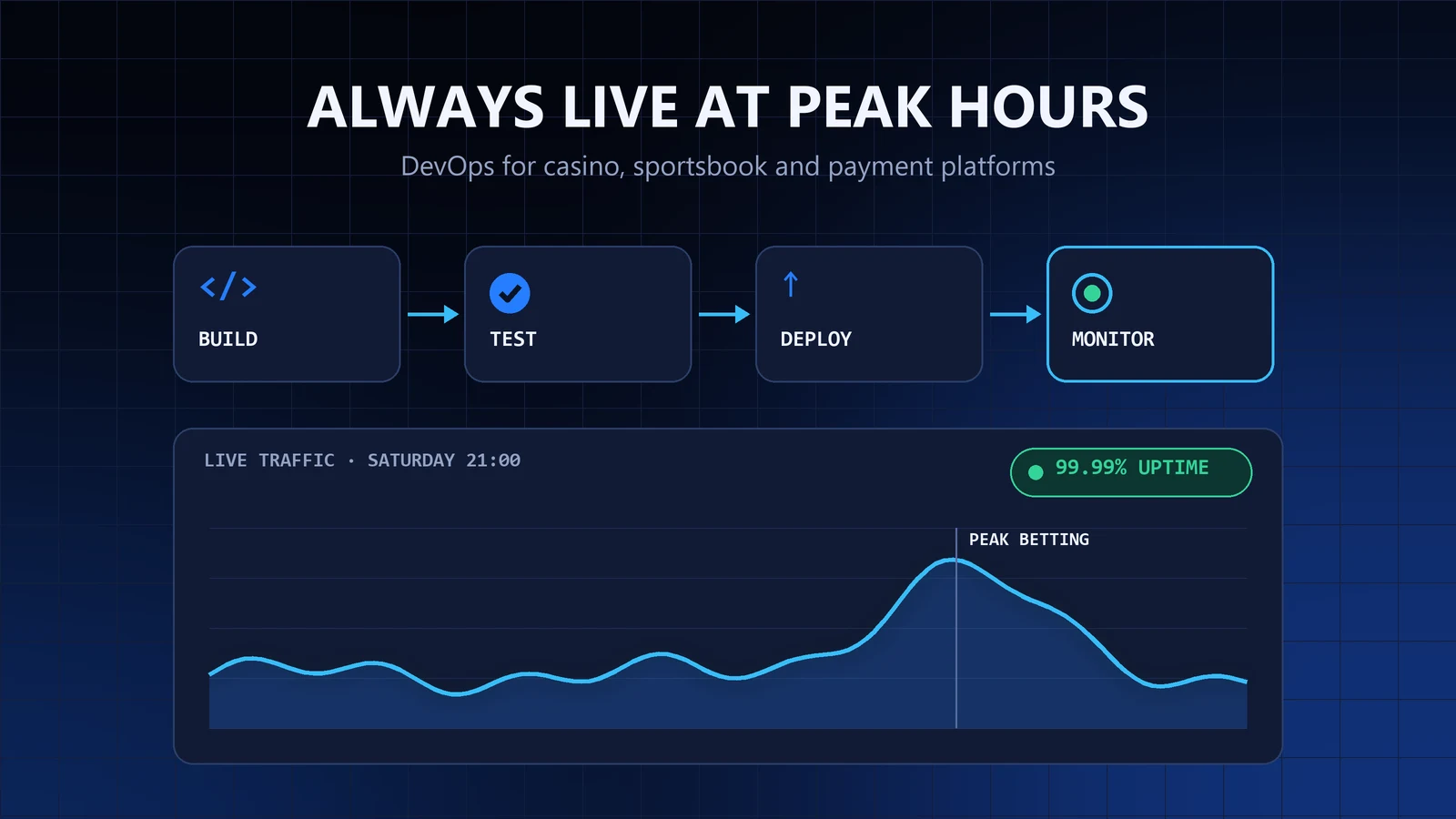
We set up release pipelines, infrastructure and monitoring for casino, sportsbook and payment platforms. Built for operators and platform teams who cannot afford downtime during peak betting hours.
Why iGaming releases and uptime go wrong
Most iGaming platforms grow by adding providers, markets and jurisdictions, and the delivery process rarely keeps up.
Releases that risk live traffic
A deploy lands during a major match or a busy evening and a wallet call starts timing out. The team has no quick way to roll back, so players and support feel it first.
Environments that do not match
Staging differs from production, so game integrations and payment flows pass tests and then fail live. Each fix is a manual change that nobody has written down.
Alerts that arrive after players complain
Monitoring covers servers but not bet placement, deposits or game launch. The first sign of a problem is a support ticket, and the on-call engineer starts from scratch.
What a DevOps engagement for an iGaming platform hands over
Each engagement ends with working pipelines, environments and runbooks that your own team can operate without us.
Ways to work with us on DevOps for your platform
Pick the model that matches how much of the platform you want us to touch.
Pipeline and infrastructure review
- We review your current release process and environments
- We check monitoring, backups and access controls
- You receive a written list of gaps in priority order
- No changes are made to your systems
Build and handover
- We design and set up the pipelines, environments and monitoring
- Work is done in your repositories and cloud accounts
- Your engineers join reviews along the way
- We finish with runbooks and a handover session
Ongoing DevOps support
- We act as an extension of your engineering team
- Help with releases, incidents and capacity planning
- Regular improvements to pipelines and alerts
- Scope agreed up front and reviewed as you grow
What DevOps covers on an iGaming platform
Betting and casino products have peak-hour traffic, many third-party integrations and strict change control, and the practices below are built around that.
Automated build and test
Every change to wallet, bonus or game-integration code runs through the same repeatable checks before it can merge.
Controlled releases
Canary and blue-green rollouts let a new version take a small share of players first, with a quick way back.
Release around events
Deployment windows are planned around major fixtures and promotions so risky changes do not land at peak load.
Infrastructure as code
Environments are defined in version-controlled files, so staging matches production and rebuilds are predictable.
Elastic scaling
Services such as odds feeds, session handling and game launch scale with player load instead of being sized for the worst day.
Multi-region resilience
Failover and backup routines are designed so a single zone problem does not stop bets or deposits.
Player-journey monitoring
Dashboards track login, deposit, bet placement and cashout as flows, not only server health.
Alerting and on-call
Alerts point to a specific service and owner, which cuts the time spent deciding who should respond.
Provider integration tracking
Latency and error rates from payment, game and data providers are watched so slow partners are spotted early.
Secrets management
Keys, tokens and database credentials are stored in a vault and rotated instead of sitting in code or config files.
Audit trails
Pipelines record who changed what and when, which helps when a regulator or auditor asks for evidence.
Dependency and image scanning
Container images and libraries are scanned in the pipeline so known vulnerabilities are caught before release.
Common tools behind iGaming DevOps
These are widely used, open standards and tools that fit this kind of platform, and the final choice depends on your existing setup.
Kubernetes
Runs and scales containerised platform services across environments.
Docker
Packages services so they behave the same in test and production.
Terraform
Defines cloud infrastructure as reviewable, version-controlled code.
GitLab CI
Runs build, test and scan stages on every code change.
Argo CD
Applies approved changes to clusters and tracks drift from the intended state.
Prometheus
Collects service metrics used for alerting on bets, deposits and latency.
Grafana
Shows operational dashboards for engineers and support teams.
HashiCorp Vault
Stores and rotates secrets such as API keys and database credentials.
DevOps practices in iGaming that stand up to regulators
Gaming platforms answer to licensing bodies, payment partners and players, so pipelines and infrastructure are built to make that scrutiny easy to pass.
Every change is recorded
Releases go through version control and a pipeline that logs who approved and deployed each change. When an auditor asks what changed and when, the answer is in the record rather than in someone's memory.
Least-privilege access to production
Access to live environments is limited by role and reviewed on a regular basis. Secrets and credentials are kept out of code and stored in managed vaults.
Player data handled with care
Environments are separated so test work never touches real player records. Encryption and logging are designed around the data protection rules that apply in each licensed market.
Built to the jurisdiction's requirements
Requirements differ between regulators, for example around game integrity, reporting and uptime. We set up deployment and monitoring so they can be adapted to the rules of the licence you hold or are applying for.
How a DevOps engagement runs from review to handover
The work moves in clear stages, so your team can see what has changed in the platform at each point.
Platform review
We look at how code currently moves from a developer to production, and where releases slow down or break. This covers your repositories, environments, hosting and on-call habits.
Priorities and plan
We agree which problems to fix first, based on release risk and the effect on live casino or sportsbook traffic. The plan lists what will change and who needs to be involved.
Pipeline build
We set up automated builds, tests and deployments, with infrastructure defined as code. Changes are tried in staging before they reach live players.
Monitoring and alerts
We add dashboards and alerts for the things that matter in gaming, such as game load, payment flows and error rates. Alerts are tuned so the team is not woken up by noise.
Handover and support
Your team gets runbooks and walkthroughs so they can operate the setup themselves. We stay available for improvements and incident support if you want it.
At each stage you receive written findings or working changes you can review, not just a status update.
DevOps in iGaming: common questions
Short answers to what operators and product teams ask before they change how they build and release.
What is iGaming?+
iGaming is online gambling and betting delivered over the internet. It covers online casinos, slots, sportsbooks, lotteries, poker, fantasy sports and similar products. The industry also includes the platforms, game content, payment systems and compliance tooling that operators use to run those products. For a wider glossary, see the iGaming FAQ page on this site.
What are DevOps practices in iGaming?+
They are the working methods that join development and operations so a gambling platform can be built, tested, released and run as one process. Typical examples are version control, automated testing, continuous integration, repeatable deployments, infrastructure defined as code and live monitoring. The aim is smaller, safer changes to a product that players use around the clock.
Why does an iGaming platform need DevOps?+
Because the product handles real money and runs without a quiet period. A bad release can block deposits, break a game session or disrupt a bet in play. DevOps practices make changes smaller and easier to test and reverse. They also give teams earlier warning when something starts to fail, which matters on a live casino or sportsbook.
How can an operator release updates without disturbing live players?+
The usual approach is to release in small steps and keep a quick way back. Teams use automated tests, staging environments that mirror production, and gradual rollouts to a share of traffic first. If monitoring shows a problem, the change is rolled back. The exact method depends on the platform architecture and on what your licence and game providers require.
What should be monitored on an iGaming platform?+
Monitor anything that affects a player's money or session. That includes login, deposit and withdrawal flows, game launch and round completion, bet placement and settlement, and third-party feeds and providers. Add server load, error rates and response times. Alerts should point to the failing service so the on-call team can act quickly, not just report that something is slow.
How does DevOps help with compliance and audit requirements?+
It gives you a clear record of what changed, who approved it and when it went live. Version control, pipeline logs and controlled access to production all support that record. Regulators and test labs may have their own rules on certified game builds and change control, so confirm those with your licensing and compliance advisers before you design the pipeline.
Can DevOps be applied to a white label or turnkey iGaming platform?+
Yes, though the split of responsibility changes. With a white label or turnkey product, the provider usually owns parts of the core code and hosting, while you own configuration, integrations, branding and front-end changes. Agree up front who handles releases, environments, monitoring and incident response, so each party's pipeline and escalation path are clear.
Talk through your DevOps setup with us
Tell us how your iGaming platform is built and released today, and we will go through where DevOps practices fit. You get a straight conversation with a B2B platform provider that works in iGaming.
Contact Sourcecodelab
