
Skill-Based Arcade Games vs Slots
A plain guide for operators on how skill-based arcade games differ from slots, and what to check in game design, platform and compliance before launching one.
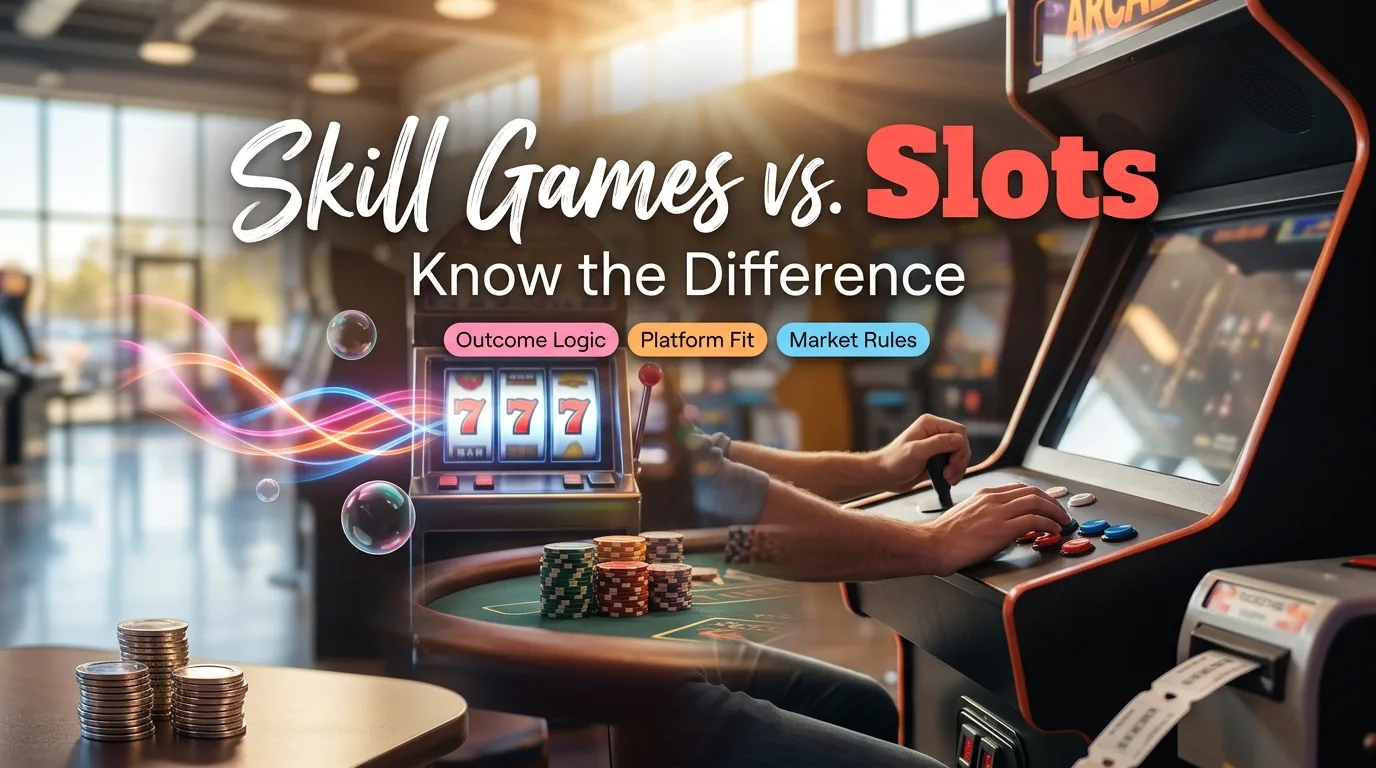
Why Skill-Based Games Do Not Behave Like Slots
Operators who treat an arcade title as a slot with a different skin tend to hit the same three problems.
The Player Changes the Outcome
A slot result is drawn by a random number generator, so the maths is fixed before the spin. In a skill-based game the player's input affects the result, so return and fairness cannot be described with a single figure the way slot teams are used to.
Classification Differs by Market
Whether a title counts as gambling can depend on the market and on how much skill decides the result. Operators often find this out after the game is built, when a change to the design is costly.
Slot Platforms Expect a Spin
Most slot integrations assume one request and one result. A skill game runs as a session with live player input, so wallet calls, session handling and reporting have to be planned for that flow from the start.
What an Operator Receives from a Skill-Based Arcade Games Review
Each item below is a written or working handover that your product, legal and operations teams can use directly.
Ways to Work with Sourcecodelab on Skill-Based Games
Pick the level of involvement that matches how far along your skill-game plans already are.
Review and Recommendations
- Skill versus chance assessment of your concept
- Comparison against your current slot lineup
- Written list of regulatory questions for counsel
- Clear recommendation on what to build or buy
Design and Integration
- Game design specification and scoring rules
- Integration with your platform and wallet
- Support through test lab preparation
- Handover pack for your internal team
Ongoing Partnership
- Regular review of game performance data
- Tuning of difficulty and player flow
- Help adding new titles to the lobby
What a Skill-Based Arcade Game Project Covers
A skill game is built differently from a slot, so each part of the project is scoped around how the player's input decides the result.
Skill-Driven Outcomes
The result depends on player input such as timing, accuracy or speed, not on a random draw alone.
Scoring and Difficulty
Scoring rules and difficulty curves are set so that better players can win more often over time.
Match and Prize Logic
Prize tiers, entry stakes and match formats are defined against the skill result.
Wallet and Session Link
Games connect to the operator's player balance and session handling through a documented API.
Back-Office Controls
Operators can configure stakes, limits and game availability without a code change.
Round Reporting
Each round is logged with its stake, score and payout so finance and support can trace it.
Classification Input
We document how the skill element works so your legal team can assess how a market may treat the game.
Responsible Play Tools
Limits, session reminders and self-exclusion hooks can be connected to the operator's own controls.
Technology Behind Skill-Based Arcade Games
These are standard tools for real-time games that must score a player's input and settle it against a wallet.
Unity
Game engine for arcade mechanics, physics and animation.
WebGL
Renders games in the browser on desktop and mobile without a plugin.
WebSockets
Carries live player input and match state between client and server.
REST API
Connects the game to operator wallets, accounts and reporting.
Redis
Holds session and leaderboard data that needs fast reads.
PostgreSQL
Stores rounds, scores and payouts in an auditable record.
Docker
Packages game services so they deploy the same way everywhere.
JWT
Signs player session tokens passed between operator and game.
Where Skill-Based Games Meet Gambling Rules
A skill-based arcade game is not exempt from gambling law just because the player's input matters, so the rules of each target market come first.
Skill or Chance Is Decided by the Regulator
Whether a title counts as a game of skill, a game of chance or a hybrid depends on the jurisdiction and on how much outcomes rely on the player. Operators should get the classification confirmed for each market before the game goes live.
Random Elements Still Need to Be Fair
Many skill games mix player input with random elements such as spawn patterns or matchmaking. Any random component should be built to meet the independent testing standard the licensing authority requires.
Responsible Gaming Applies to Skill Games Too
Spend limits, session reminders and self-exclusion tools matter just as much when the player believes skill reduces risk. The game is built to connect to the operator's responsible gaming controls.
Market Licence Terms Set the Limits
Each licence has its own conditions on age verification, stake handling and game approval. We build to the requirements the operator names for its markets and do not claim approval on the operator's behalf.
From First Brief to a Skill Game Live on Your Platform
The work moves in clear stages, so the operator knows what is decided and what is still open at each point.
Scope the Markets
We agree the target jurisdictions, the player type and how the game should be classified. This sets the limits for design and payout rules.
Define Skill Mechanics
We decide how player input affects results and which parts, if any, stay random. These choices are written down so they can be reviewed by the operator and any testing body.
Build and Integrate
The game is developed and connected to the operator's platform, including wallet, player accounts and reporting. Responsible gaming hooks are added at this stage, not afterwards.
Test and Review
We run functional checks and support the independent fairness testing the market requires. Issues found are fixed and rechecked before release.
Launch and Tune
After release we watch how players actually behave and adjust difficulty, rewards and limits within what the licence allows.
At every stage the operator gets a clear written record of what was decided, what was built and what still needs sign-off.
RNG in Games: Common Questions Answered
RNG is the main thing separating slots from skill-based arcade games, so these are the questions people ask most.
What is RNG in games?+
RNG in games is a random number generator, a system that produces unpredictable values the game uses to decide outcomes. Games use it for loot drops, card shuffles, enemy behaviour and slot results. In a slot, RNG alone decides each spin, while in a skill-based arcade game it usually shapes only part of the experience.
What is RNG in video games?+
In video games, RNG is the element of chance built into the code, such as which item drops or where an enemy appears. Designers add it to keep each session different. Players also use the word loosely for luck itself, as in a good or bad roll, and how much RNG a game uses varies a lot between genres.
How does RNG work in games?+
An RNG runs a mathematical formula from a starting value, called a seed, to produce a stream of numbers that look random. The game maps those numbers to outcomes, for example a number range that equals a rare item. Because the formula is deterministic, it is called pseudo-random, and operators in regulated markets should check what testing their jurisdiction requires.
What does RNG mean in video games?+
In video games, RNG means random number generator, and it is also slang for the luck factor that generator creates. When a player says a fight was RNG-heavy, they mean chance mattered more than their input. For operators, the useful question is how much of a result comes from the player and how much from the random element.
What does RNG stand for in games?+
RNG stands for random number generator. The term appears in game rules, technical documents and certification papers, so operators see it often when reviewing slot content. It describes the part of the software that picks outcomes, not the graphics, theme or bonus features wrapped around it.
What are RNG games?+
RNG games are games where a random number generator decides all or most of the outcome. Slots are the clearest example in iGaming, since each spin result comes from the generator and not from player ability. Skill-based arcade games sit differently, because player performance drives the result, though they may still use random elements such as layouts or spawn patterns.
Plan Your Skill-Based Arcade Games
Talk to Sourcecodelab about where skill-based arcade games fit next to your slots, and what your operation needs to know before you add them. You get a direct conversation with a B2B iGaming platform provider.
Talk to us