

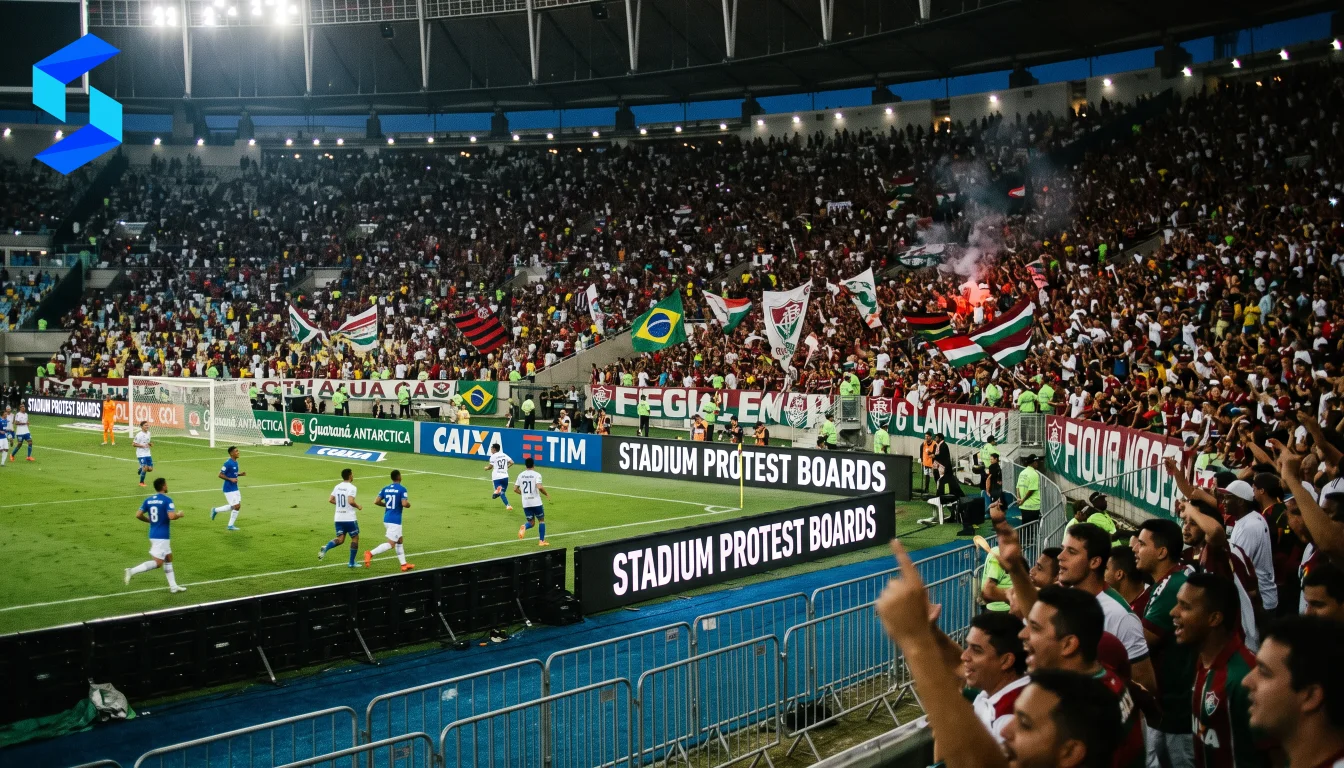
Licensed betting companies in Brazil have staged a coordinated protest against the government’s ban on online betting, using advertising hoardings at top-flight football matches to display messages warning of the consequences of prohibition. The action, organized by operators associated with the National Association of Games and Lotteries (ANJL) and the Brazilian Institute of Responsible Gaming (IBJR), saw companies give up their advertising space during matches on Friday and Saturday to display protest phrases.
The signs displayed messages reading “To prohibit is not to protect” and “The ban doesn’t end gambling” during matches between Sao Paulo and Santos on Friday, and Atletico-MG and Bragantino on Saturday. The protest is a direct response to Provisional Measure 1,394, which banned online betting in Brazil on 25 September.
Illegal Market Surge Following Ban
The manifesto signed by ANJL and IBJR alongside licensed operators argues that the ban does not end betting in the country, but rather eliminates protection for bettors. According to the Ministry of Finance, 31 million people were active on licensed platforms, with the vast majority betting recreationally and responsibly.
Since the enactment of the provisional measure, the illegal market has surged dramatically. According to data from Legitbet, the official monitoring platform of ANJL, 6,401 new illegal websites were observed between 22 and 28 September. In addition, 811 links to these platforms were identified on monitored channels. Before the ban, the illegal market already accounted for 41% of the volume wagered in the country. Organizations now project that this number will reach 100%.
Financial Impact on Sports and Revenue
The provisional measure affects not only existing commitments, but also the planning for upcoming seasons, the negotiation and renewal of sponsorships and the predictability of investment in sport. The consulting firm LCA estimates that up to BRL73 billion ($14 billion) in revenue would be at risk between 2027 and 2030 if all demand were to migrate to illegal operators.
“For ANJL and IBJR, maintaining a regulated environment with clear rules and legal certainty is fundamental so that clubs, companies and other agents in the sports chain can plan their long-term investments,” said Plinio Lemos Jorge, president of ANJL.
Industry Calls for Regulation Over Prohibition
Carlos Lima, president of IBJR, stressed that the discussion also involves the predictability of a market structured based on authorizations granted by the state itself. “For the entities, any changes must consider the effects on this chain and preserve the legal security necessary for companies, clubs, and other partners to plan investments and fulfill their commitments,” Lima stated.
ANJL and IBJR reiterated their concern about household debt and problematic gambling, arguing that a highly regulated market is best positioned to address the problem. The organizations expressed willingness to discuss deposit and time limits, stricter advertising rules, mental health care and more rigorous measures to combat illegal websites, measures that cannot be demanded of those operating clandestinely. The document warns about the growth of the black market, which is exploited by organized crime to scam the most vulnerable.

