


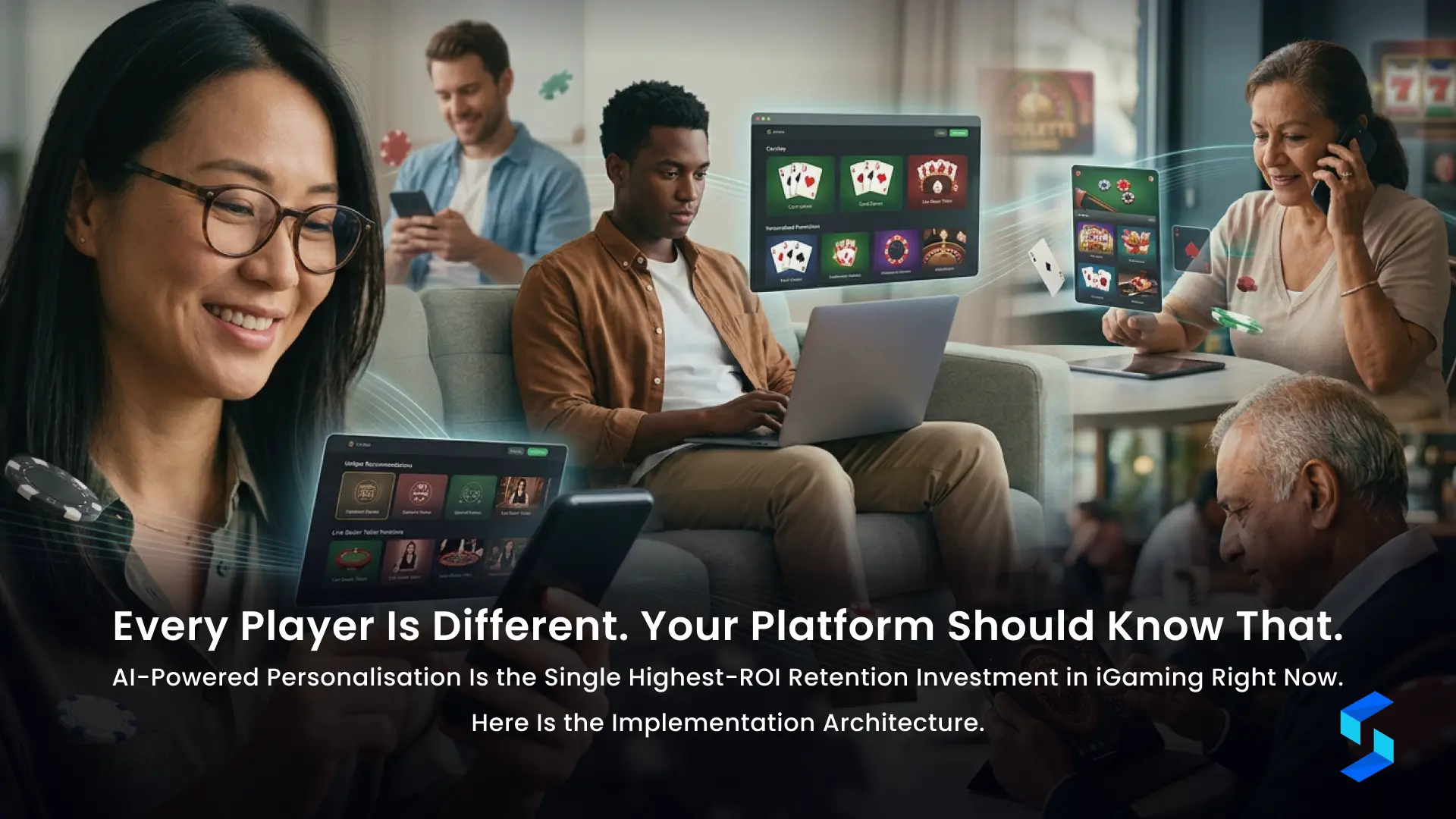
Player retention in online casinos and sportsbooks is a solved problem in theory and a difficult problem in practice. The theory: players who find games they enjoy, receive relevant promotions, and feel the platform understands their preferences stay longer and spend more. The practice: serving each of hundreds of thousands of players a genuinely personalised experience requires infrastructure, data, and models that most operators have not historically invested in.
The operators deploying production personalisation systems in 2026 are reporting 15–30% increases in active player days per month, 20–40% increases in average session length, and measurable LTV uplift for personalised player cohorts versus control groups. These are measured results from live deployments, not projections.
The Four Dimensions of iGaming Personalisation
| Dimension | What It Personalises | Player Impact | Operator Impact |
|---|---|---|---|
| Game Lobby Ranking | Which games appear first and most prominently | Higher session start rate from lobby | Increased GGR per session |
| Bonus and Offer Targeting | Which promotions a player sees and receives | Relevant offers drive acceptance; irrelevant ones are noise | Lower bonus cost per retained player |
| Communication Timing | When emails, push notifications, and messages are sent | Messages arrive when player is most likely to engage | Higher open and conversion rates |
| Game Discovery | Surfacing games a player has not tried that match their preference profile | Reduces genre saturation, extends session longevity | Extends game longevity and player LTV |
The Data Foundation: What You Need Before Any Model Is Built
Every personalisation failure starts with a data problem. Operators who jump to model development without establishing a clean, complete behavioural data foundation end up with models that cannot learn reliably and recommendations that feel random to players.
Essential Behavioural Events to Capture
- Game launch event: player ID, game ID, timestamp, device type, session ID
- Bet placement event: game ID, bet size, game mode, round ID
- Game exit event: session duration, game ID, exit trigger (voluntary, auto-timeout, session limit)
- Deposit event: amount, method, context (organic, bonus triggered, post-session-end prompt)
- Bonus acceptance/rejection: offer ID, offer type, player response
- Search and browse events: search terms, category filter selections, game hover time
Feature Engineering From Raw Events
- Game preference vectors: weighted affinity scores per game type, provider, and volatility level based on play history
- Session recency and frequency: leading indicator of engagement health
- Stake elasticity: how bet size responds to recent win/loss trajectory — a signal for bonus sizing
- Content novelty tolerance: does this player play the same games repeatedly, or regularly try new titles?
Model Architecture: From Data to Real-Time Recommendation
Retrieval Stage
The retrieval stage narrows the full game catalogue down to a manageable candidate set. Player preferences and game attributes are encoded as vectors in the same embedding space, and nearest-neighbour search retrieves the games closest to the player’s current preference vector as candidates.
Ranking Stage
The ranking stage scores and orders the candidate set incorporating additional context: time of day (player preferences differ between weekend afternoons and late-night sessions), device type, recent session history, and current promotional inventory.
Real-Time Inference
The ranking model must serve recommendations in under 100ms to avoid visible lobby load delay. This requires a pre-computed candidate set and a fast online ranking model served from in-memory infrastructure.
The biggest personalisation UX failure mode is a lobby that visibly changes layout between visits. Players find this disorienting. The personalisation system should update rankings gradually — new games can rise in prominence over multiple sessions, but the lobby should not look completely different every time a player opens the app.
Personalised Bonus Delivery: The Highest-Impact Use Case
Most casino bonus systems operate on segment logic: player is in segment ‘high-value slots player’ therefore receives the ‘slots free spins’ offer. AI-powered bonus personalisation replaces segment logic with individual-level predictions: what offer type, at what size, at what timing, and for which game is most likely to drive a positive session from this specific player today?
- Offer acceptance probability: likelihood this player will accept this offer type at this moment
- Offer-to-deposit conversion: likelihood accepting this offer leads to a real-money deposit
- Bonus cost efficiency: expected GGR generated per unit of bonus cost for this player
- Optimal offer timing: day of week and time of day when this player is most likely to respond
Our gamification and loyalty services for iGaming platforms provide the bonus orchestration layer that AI personalisation models connect to.
Measuring Personalisation: The Metrics That Matter
| Metric | What It Measures | Good Benchmark |
|---|---|---|
| Session start rate vs control | How often personalised lobby drives a session start vs generic | 10–25% lift |
| Average session length uplift | Whether personalised game selection extends time-on-platform | 15–35% increase |
| Game catalogue penetration | Whether players are trying more titles over time | 20–40% increase in unique games per month |
| Bonus acceptance rate | Whether personalised offers outperform generic segment offers | 30–60% improvement |
| 30-day retention | The ultimate retention test (personalised vs control) | 5–15% absolute improvement |
| LTV at 90 days | Does personalisation improve long-run revenue per player? | 15–30% uplift |
Related Resources
- AI Consulting Services for iGaming — AI personalisation architecture and implementation for casino platforms
- Predictive Analytics in Casino Games — Predictive modelling for player behaviour and retention
- Gamification Services for iGaming Platforms — Loyalty and bonus orchestration that AI personalisation connects to
- Player Account Management System — The player data platform that powers personalisation
- Casino Game Integration API — Unified game catalogue layer that personalisation models rank against
Build an AI Personalisation Engine for Your Casino
Source Code Lab designs and deploys AI personalisation systems for iGaming operators — from data pipeline to real-time recommendation serving. Talk to our AI team about your platform’s personalisation readiness.
Author: Source Code Lab Team | Category: iGaming Tech / AI Personalisation | Published: July 2026
External references: Industry research, AI modelling benchmarks, and live deployment metrics cited where applicable.