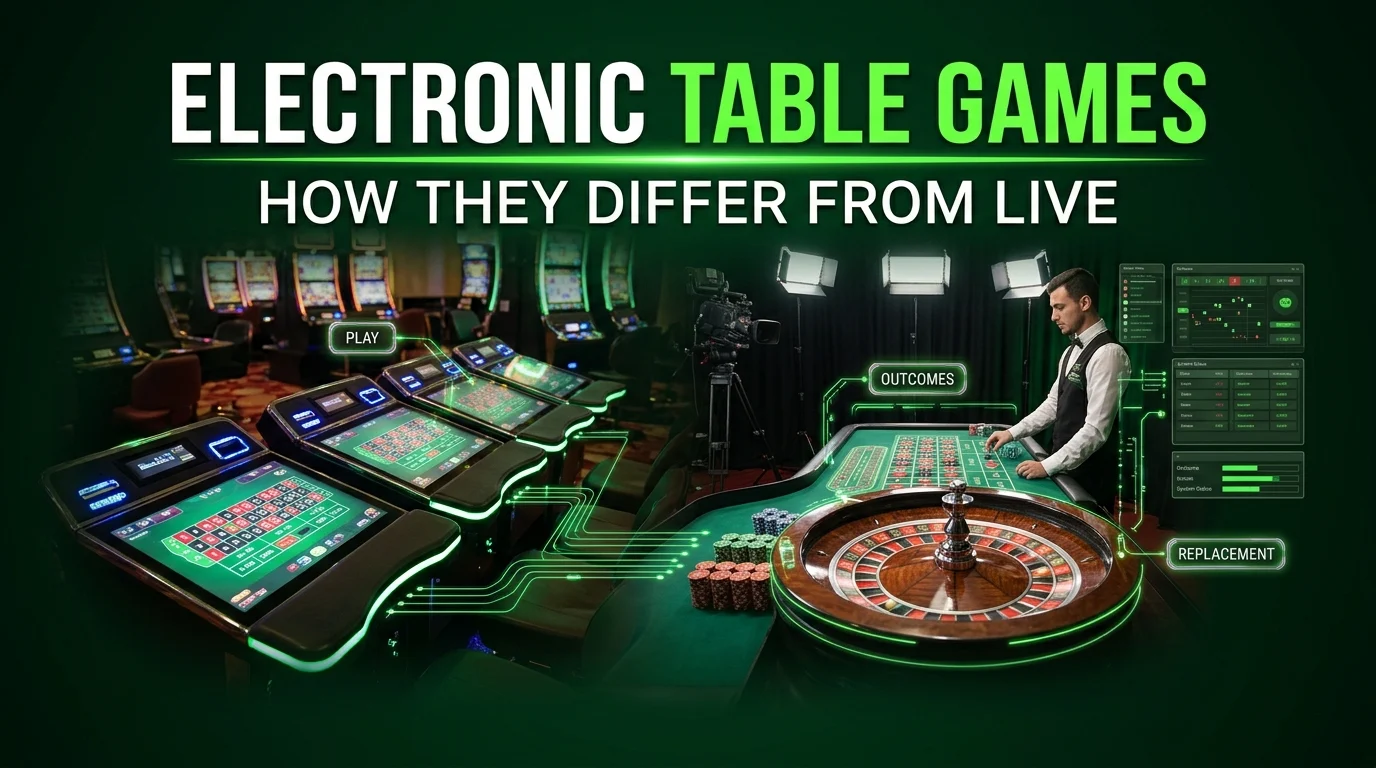
Electronic table games (ETGs) are casino table games played on terminals, with outcomes produced by software or by a dealer-assisted mechanism rather than a full live table. They differ from live tables in four practical ways: how results are generated, how many staff they need, what minimum bets the floor can offer, and which regulatory rules apply. A growing hybrid category now sits between the two formats.
What Are Electronic Table Games and How Do They Play?
Electronic table games are casino table games run on terminals, where no physical table sits behind the interface. Players place bets on a touchscreen, watch a high-resolution display of the wheel or cards, and collect winnings to their terminal credit. Roulette, blackjack, baccarat and craps all exist in this form.
The rhythm is the main difference you notice at the seat. Live tables run at the dealer’s pace, and betting windows follow the dealer’s handling of chips, cards and the wheel. On a terminal the betting window is fixed by the game, the animation runs on a schedule, and the next round starts when the timer says so. Nobody waits for a slow shuffle or a payout dispute at another seat.
A recent example is Oxford Casino Hotel & Sportsbook in Maine, which in June 2026 added Light & Wonder’s Roulette and RouletteX ETGs. The reported features are what you would expect from the format: high-resolution wheel displays, intuitive touchscreen controls and enhanced audio feedback. That is a presentation layer doing work a croupier and a felt layout used to do.
For players, the trade is clear. They give up the social friction and table talk of a live game, and in return they get a self-paced experience with no pressure to tip or keep up with a crowd. For operators, it means a table-game product that behaves more like a slot bank in how it is placed, supervised and counted.
How Do Electronic Table Games Differ from Live Tables in Outcomes?
Electronic table games generate results with a random number generator, while live tables use a dealer and physical equipment such as cards, wheels and dice. That is the clean definition, and most of the time it holds. It is also where the interesting exceptions start.
Random number generator (RNG) software produces each result according to the game’s programmed system. For a roulette ETG, the software selects a pocket, and the wheel animation is a visual rendering of a decision already made. For blackjack, the software draws cards from a modeled shuffle. Nothing physical determines the result, so the integrity of the outcome rests on the code, its certification and the controls around it.
Live tables carry their randomness in the equipment. A wheel is spun, a shoe is shuffled, dice are thrown. Live tables do not generally use RNGs to decide results, although a casino may use software for other things, such as displays, bet tracking or side-bet features. Operators who stream live tables to online players add a video layer on top, which is a different build again. Our notes on live roulette software development show how much of that work is about capture and synchronization rather than outcome generation.
Where Hybrid Games Blur the Line
On November 18, 2026, Snoqualmie Casino & Hotel announced a Washington-first crapless craps ETG with eight seats, built with Interblock, with installation already in progress. The game uses a live dealer and physical dice. It is an electronic table game in format, with terminals and touchscreen betting, but the outcome comes from dice a person throws.
So the dividing line is not always the presence of an RNG. A better test is to ask what decides the result: software, or physical equipment. Dealer-assisted ETGs answer “physical equipment” while keeping the terminal-based betting experience.
Why Are Casinos Replacing Live Tables with Electronic Table Games?
Casinos adopt electronic table games mainly to cut the personnel cost of dealers, supervisors and support staff. Reporting on the format consistently points to lower spend on staffing, security and related licensing, because one attendant can oversee a bank of terminals where a live pit needs a dealer per table plus supervision.
The Minimum-Bet Effect
Staffing economics change what a casino can sell. Action Network reported in March 2025 that Las Vegas casinos have stopped offering $5 and $10 minimum bets at live tables, because ETGs can provide those bets without a dealer to pay. A live table at those stakes has to cover a dealer’s cost out of small wagers, and the math rarely works. A terminal has no such constraint.
The practical result is a split on the floor. Live tables move up in minimums and lean on atmosphere and higher-stakes play. Low-limit players are steered toward terminals. If you run a property or an online lobby, expect your lowest-stakes table content to be the first to go electronic.
The Clearest Case of Full Conversion
Golden Gate Hotel Casino in Las Vegas is the example to watch. In September 2025 it held a launch event for its Interblock-powered ETG pit. The conversion was first reported in August 2025 as a plan to remove live dealer table games, and in January 2026 CBS News reported that the casino had removed all of its live dealers, making every table game electronic.
We would keep the claim to that. The reports describe what Golden Gate did, not how it performed afterward, and one downtown property is not a market trend by itself. It does show that a full switch is operationally possible, which a few years ago was a hypothetical.
Electronic Table Games Still Face Rules That Live Tables Often Avoid
Electronic table games carry extra regulatory requirements because their outcomes are software-controlled. A regulator who approves a live table is approving procedures, equipment and people. A regulator who approves an RNG-based ETG is also approving code, network exposure and the integrity of the random draw.
New York shows what that looks like in rule text. The New York State Gaming Commission listed a casino electronic table games systems rule, SGC-42-16-00004, in its April 2026 rule review. It covers firewalls, pre-approval of remote access and random number generation for ETGs, and the comment deadline was June 8, 2026. Read the three subjects together and the concern is plain: who can reach the system, from where, and whether the draw is sound.
Minnesota shows the opposite pressure, where the question is whether software-driven games are allowed at all. On January 23, 2026, the state Supreme Court upheld the Racing Commission’s approval of Interblock-based electronic tables at Running Aces. The court found the games were not prohibited gambling devices or video games of chance. It also found that a tribe had standing to challenge them, so the dispute was legitimate to bring even though the approval stood.
The background matters. Since 2017, Minnesota’s rules have allowed amendments only on the condition that games remain live, without random number generators. The Running Aces tables fit that definition because a dealer-run, physical-equipment mechanism still decides outcomes. For operators, the lesson is that format details, including whether an RNG is involved, can decide whether a product is lawful in a given state.
Choosing Between Electronic Table Games and Live Tables Depends on Staffing, Rules and Players
The choice depends mainly on local rules, staffing cost and the player base, not on which format is newer. A short decision frame helps you sort it out.
- Rules: Check whether your jurisdiction permits RNG-based table outcomes, or only games that remain live. Start with your own regulator, whether that is the Nevada Gaming Control Board, the New York body above or another authority.
- Economics: Compare dealer and supervisor cost against terminal capacity at your target minimum bets. Low stakes favor terminals. High stakes can still carry a live table.
- Players: Ask whether your customers expect a dealer. Table-game regulars often do, while casual and low-limit players may prefer the self-paced terminal.
- Delivery: If you stream live tables online, the work moves to video, latency and operations. Our guide on integrating live dealer games into a casino platform covers that side, and live casino uptime SLAs are worth reading before you sign with a studio.
A hybrid dealer-assisted game can sit in between. Snoqualmie’s crapless craps keeps the human and the physical dice while moving betting to terminals, which may satisfy regulators who want live outcomes and players who want a dealer, at a lower staffing load than a full live table. Treat it as a third option, not a compromise.
If you are planning digital table content, Sourcecodelab is a B2B platform provider that builds digital roulette and blackjack games.