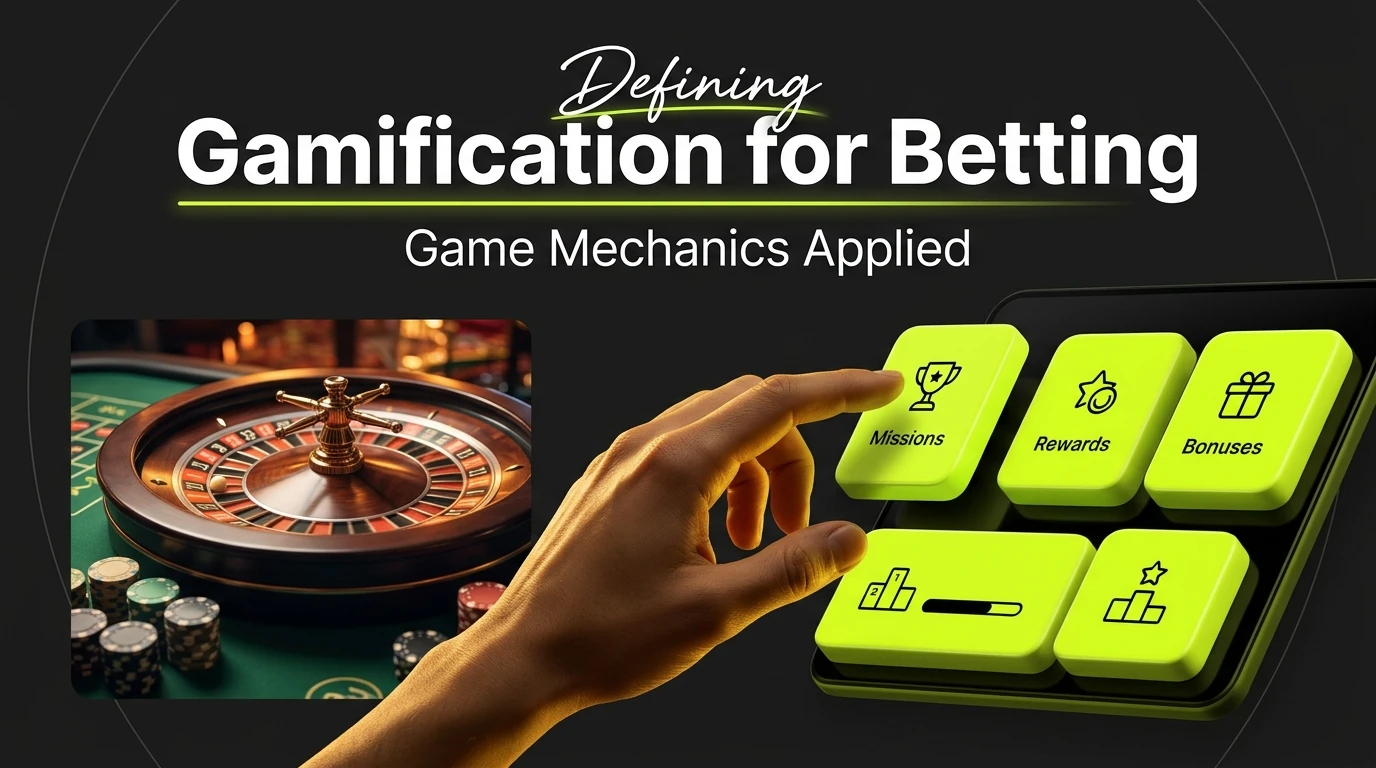
Gamification is the use of game mechanics such as points, levels, missions and badges to drive player actions on a betting or casino platform. The mechanics sit on top of real-money wagering. The platform itself, not a separate game, carries the reward logic. It watches events, updates a player’s progress and pays out when a rule is met.
Gamification Definition: Game Mechanics Applied to Betting and Casino Play
That placement is why buyers should treat gamification as a platform capability and not a marketing layer. A mission such as “place five bets on a live market this week” depends on the same bet feed, wallet and player profile that run your core product. A leaderboard depends on settled-round data. A level system needs a durable record of every qualifying action. If those pieces are bolted on from outside, you inherit sync delays, disputes over who earned what, and a second place where regulated data lives.
Buyers care for two reasons. First, gamification shapes how long and how often players wager, which puts it in front of regulators in a way a banner ad never was. Second, the rules around it are moving, and as of November 2026 they differ by market. A mechanic you define today has to be configurable tomorrow. For the commercial picture, see our iGaming gamification guide. For the failure modes, read gamification mistakes that make players quit. This post stays on the definition and the rules that now attach to it.
Which Gamification Formats Do Betting and Casino Platforms Use?
The most common formats are missions, XP and levels, badges, tournaments and leaderboards, tiered loyalty programs, daily rewards and personalized challenges. Each asks something different of the player and demands different tracking from the platform.
- Missions: The player completes a defined task, such as a set number of bets or spins inside a time window. The platform tracks qualifying events and progress per mission.
- XP and levels: Activity earns points that open up levels. You need a ledger of XP events and a clear rule for how stakes convert to points.
- Badges: One-time recognition for a milestone. The platform needs milestone triggers and a record of what was awarded and when.
- Tournaments and leaderboards: Players compete on a ranked metric over a fixed period. This requires settled-round data, tie-break rules and a hard cutoff. Our post on leaderboards and tournaments covers the retention side.
- Tiered loyalty programs: Players move up tiers through sustained activity. The platform keeps rolling totals, tier thresholds and downgrade logic.
- Daily rewards: A reward for logging in or playing on consecutive days. This needs streak counters and a reset rule.
- Personalized challenges: Tasks chosen per player from behavior. You need segmentation data and a record of why each player received each challenge.
Tiered loyalty and daily rewards are the formats most often tied to repeat play, because both reward return visits rather than a single session. Personalized challenges carry the most regulatory exposure, as the New York pre-proposal below shows.
Why Gamification Differs from a One-Off Bonus
Gamification rewards repeated play and progress over time, while a bonus usually pays once against a deposit or a wager. The difference is visible in how the platform is built.
A bonus is a credited balance with wagering conditions. The platform grants an amount, attaches a rollover requirement and releases funds when the requirement is met. State is simple: granted, in progress, completed or expired.
Gamification runs on progress states, event triggers and reward rules. A player sits at 60 percent of a mission, holds 1,200 XP, or is on day four of a streak. Every bet, spin or login is an event that may move that state. The reward is a result of accumulated progress, and it may be a spin, a cash credit, a tier upgrade or nothing monetary at all.
The two can be combined. A mission can pay a bonus, and a loyalty tier can raise a bonus cap. But they need separate tracking and separate compliance review. A bonus review asks whether terms are clear and wagering conditions are fair. A gamification review asks what behavior the mechanic encourages, whether the reward is random or fixed, who can see it, and whether it can be switched off. If both live in one undifferentiated rule engine, you cannot answer those questions for one without disturbing the other.
Platform buyers should ask how a vendor models each. If a mission reward is simply a bonus with a different label, audit and market-level control will be harder than they look.
What Rules Now Limit Gamification for Minors and Players at Risk
The European Commission published a draft Digital Fairness Act in November 2026 that would bar paid random rewards for minors and require odds disclosure and an opt-out tool for all users. The draft also scrutinizes creators who promote betting products. It is a proposal, not law. It still has to move through the legislative process, and its final text may change. Earlier reporting that expected the act in late 2025 or early 2026 is out of date.
For your platform, the practical reading is about design, not timing. Any mechanic that sells or awards a random outcome, such as a paid mystery reward, needs age gating and a disclosed probability. Any mechanic at all may need an opt-out switch the player can reach.
In the US, the New York State Gaming Commission issued a pre-proposal in March 2026. It would stop licensed operators from using AI-powered services to offer personalized promotions, suggested wagers or suggested wager amounts. It is a pre-proposal, so the wording could shift or not advance. Still, it points straight at personalized challenges and any recommendation engine feeding them.
Separately, Colorado, Massachusetts, New Jersey and North Carolina now require sportsbook operators to use algorithmic monitoring to flag problem gambling behavior. That has a direct consequence for gamification. A streak or mission system generates engagement data, and the same data can feed a risk signal. Your platform should be able to pause rewards for a flagged player rather than keep paying them out.
Operators in Great Britain should also check current guidance from the UK Gambling Commission against each mechanic they run.
Configuring Gamification per License Keeps Markets Separate
Regulated platforms now set gamification per license, and GiG Logic and Soft2Bet let operators configure, pause or disable specific missions for each license. That model fits a patchwork where one mechanic is acceptable in one market and restricted in the next.
A per-license control set should include four things:
- Mission catalog by market: Each license sees only the missions approved for it, with its own reward values and time windows.
- Age gating for paid random rewards: Any mechanic with a paid or random outcome checks verified age before it appears or pays.
- Opt-out handling: A player can switch gamification off, and the setting holds across missions, challenges and notifications.
- Audit logs of changes: Every edit to a mission, threshold or reward records who changed it, when and for which license.
These controls matter most when rules change faster than release cycles. If a regulator narrows what personalized offers may do, you want to switch a mission off in one jurisdiction the same day, without touching the others. Teams planning that architecture can look at our gamification services as a starting point for scoping.
Here is the practical check for buyers. Ask the vendor whether a mission can be switched off for one jurisdiction without a code release. If the answer involves a deployment, a ticket to engineering or a rebuild, the platform will be slow when the rules shift. If the answer is a setting in an admin panel with a logged change, you have per-license control in a form you can use.