

The Best Bingo Software: A Practical Buyer’s Guide
The best bingo software depends on who runs the game. For a hall, school or charity night, a free bingo caller with a projector flashboard is enough. For an operator taking real-money play online, you need a platform with certified RNG, wallet and CRM integration.
Short Answer: Best Bingo Software
“Bingo software” covers three different jobs, and most bad buying decisions come from mixing them up. The first job is calling numbers and showing them on a flashboard. The second is issuing and validating player cards. The third is running a licensed online bingo product with payments, player accounts, bonuses and reporting. Free tools handle the first job well, sometimes the second, and almost never the third.
If you host live or hybrid events, start with a free bingo caller. If you operate in a regulated or semi-regulated market and want bingo as a product line, skip the free tier and evaluate platforms. If you already run a casino or lottery platform and want bingo inside it, integration cost matters more than the feature list.
We judged each option on six criteria:
- Game variants: 75-ball (a 5×5 card, with B-I-N-G-O columns covering 1 to 15, 16 to 30, 31 to 45, 46 to 60 and 61 to 75), 90-ball (a strip of six tickets that covers every number from 1 to 90 once) and shorter formats.
- Flashboard quality: Real-time number tracking, readable output on a projector or TV, and layouts you can brand.
- Card handling: Paper cards only, or generated digital cards with automatic marking.
- Fairness and audit: A documented random number generator and an audit trail. Our comparison of hardware and software RNG explains what each approach proves.
- Integration: Wallet, CRM, player accounts and reporting.
- Cost model: Free, license fee, revenue share or custom build.
Variant support usually decides the shortlist before anything else. 75-ball is the common format in North America, while 90-ball is the staple in the UK and Australia. A room with a mixed crowd may need both, and a caller that supports only one forces you to run a second tool. Pattern support matters nearly as much. Check for lines, full house, four corners and letter shapes. Operators should also ask whether patterns can be configured per room without a code change, because that decides how fast your game schedule can adapt.
⚠️ Caveat: We did not run lab tests for this update, so the assessments describe what each category of product typically offers. Verify specifics with any vendor before you commit.
Editor’s Top 3 Picks
1. Sourcecodelab — for operators adding bingo to a platform
Sourcecodelab is a B2B platform provider for iGaming operators and offers bingo software deployment and integration services. It fits when you already run a casino, lottery or sportsbook stack and want bingo connected to your existing wallet, player accounts and CRM instead of bolted on as a separate product. Scope, game variants and commercial terms are agreed per project, so there is no public price list to quote.
Disclosure: Sourcecodelab publishes this page, so treat this entry as a vendor listing and not an independent review.
2. A free desktop caller with a projector flashboard — for event hosts
For a community hall, a fundraiser or a bar night, this is the right answer and the cheapest one. You install a caller on a laptop, connect a projector or TV, and the flashboard mirrors every called number. You supply paper cards. The trade-off is that you get no player accounts, no payments and no audit trail beyond what the host keeps.
Run a full mock session before the first real night. Set the display resolution, then walk to the back of the room and confirm the whole grid is readable. Keep a second laptop or a printed number sheet within reach in case the first machine fails. If the prizes are meaningful, write called numbers on paper as well, since the software log may be the only record otherwise.
3. An established operator bingo platform — for regulated online products
Providers such as Playtech and Dragonfish have long run bingo products for operators, and larger game studios have added bingo verticals in recent years. Buy from this tier when you need a ready-made lobby, chat rooms, jackpot mechanics and a track record in licensed markets. Commercial terms vary and are normally negotiated, so confirm them directly. If you are weighing this route against a wider stack, our turnkey provider comparison covers the trade-offs.
Put the same questions to every vendor in this tier. Which test laboratory certified the RNG, and for which jurisdictions? How are draw results stored, and for how long? What happens to a round if a server fails mid-draw? Which responsible gaming tools ship by default? Vague answers are an answer.
Comparison Table
The table compares the five option types side by side. Free tools are described by what the category typically offers, since individual apps differ.
| Option | Best For | Cost Model | Player Cards | RNG & Audit | Integration |
|---|---|---|---|---|---|
| Sourcecodelab bingo integration | Operators adding bingo to an existing platform | Quoted per project | Digital cards, scoped per project | Scoped per project, third-party certification is separate | Wallet, CRM and player accounts on your stack |
| Free desktop caller with flashboard | Halls, bars, fundraisers, projector setups | Free | Usually paper cards | Basic, no certification | None |
| Established operator bingo platform | Licensed online bingo products | License or revenue share, negotiated | Digital cards with automatic marking | Typically tested for licensed markets | Platform APIs, varies by vendor |
| Free browser-based caller | Quick one-off games, classrooms, remote groups | Free, sometimes ad-supported | Paper or printable cards | Basic, no certification | None |
| Paid hall and club software | Regular live events and larger halls | License fee | Paper and some digital | Session logs and reports | Limited, mostly standalone |
Read the table by use case, not by row order. A hall running a weekly game gains nothing from an operator platform, and an operator gains nothing from a browser caller.
Reviews
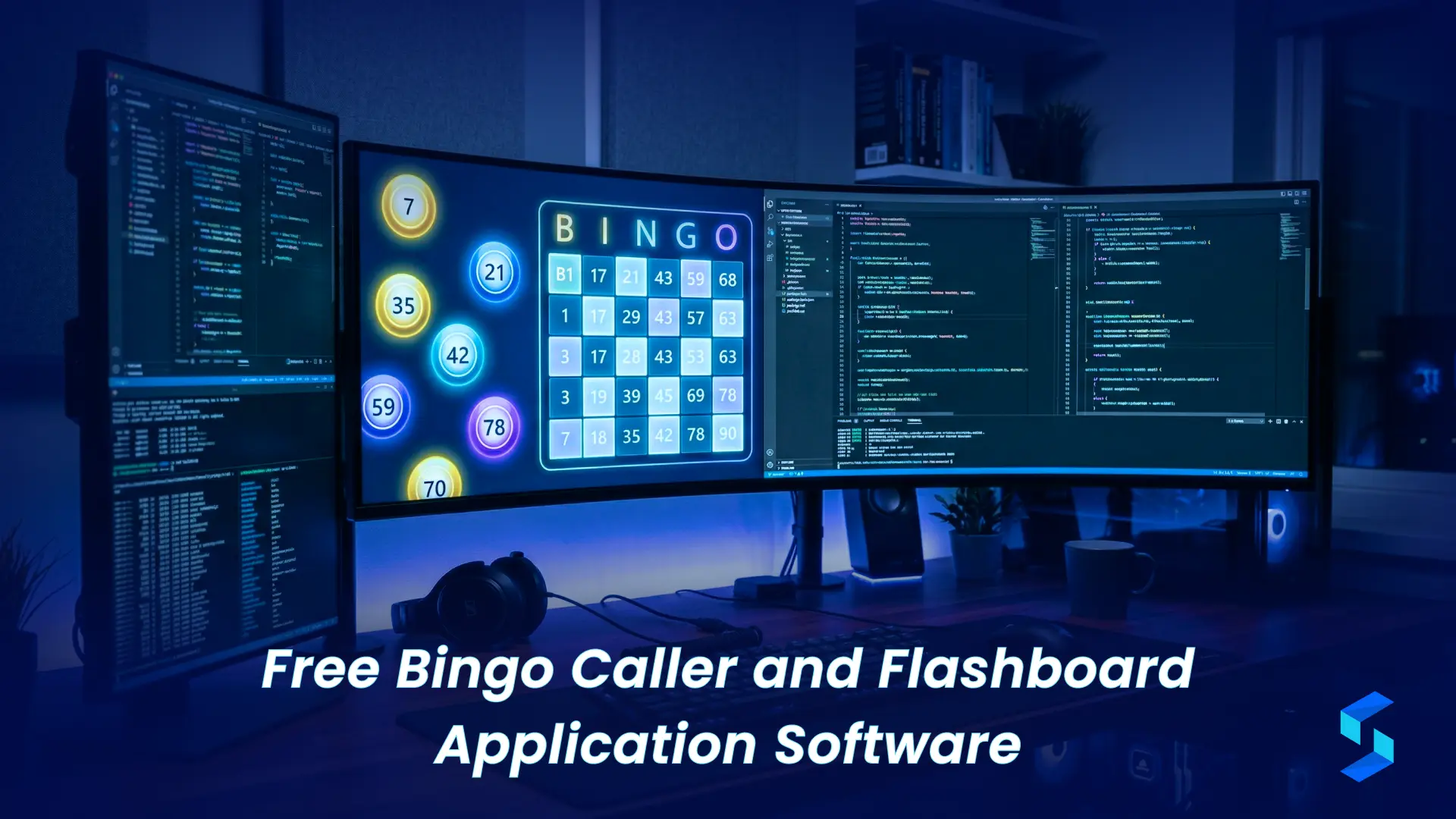
Free Bingo Caller and Flashboard Software
Free callers cover the core of a live game. Look for these caller features:
- Automated number calling: The software draws and announces numbers without manual input.
- Adjustable settings: Number range, calling speed and game pattern should be changeable between rounds.
- Voice options: Some tools let you pick a voice or upload your own recordings.
- Multilingual support: This matters for mixed audiences, for example Portuguese, Turkish, Filipino or Russian-language rooms.
The flashboard side matters just as much. A good flashboard shows every called number on a full grid, highlights the latest ball and stays legible from the back of the room. Layouts that you can recolor to match an event theme or a brand are a useful extra. The caller and flashboard should run from one session so the display never drifts from what was announced.
The limits are consistent. Free tools rarely offer support, rarely document how numbers are drawn, and rarely connect to anything. That is fine for a church hall and a problem for a business.
A quick sanity check is worth ten minutes before you rely on a free tool. Run a few full test games and confirm that no number repeats within a game, that every number in the range eventually appears, and that the flashboard matches the audio call each time. Also check your local rules. Charity and club bingo often needs a permit or has prize limits, and software cannot settle that for you.
Paid Hall and Club Software
Paid tools suit frequent events. They add session logs, multiple game modes, prize and pattern management, and reporting, which cuts disputes over whether a number was called. If you run several sessions a week, the logs pay for themselves the first time a player challenges a win.
When you compare products in this tier, test the close-out routine. A good tool calculates the prize pool from card sales, lets you export results at the end of a session, and keeps a history you can search by date. If a vendor cannot show you a sample report, assume the reporting is thin.
Operator-Grade Online Bingo Platforms
This tier is a different product. Beyond calling numbers, the platform handles player registration, deposits and withdrawals, bonus rules, chat moderation, responsible gaming limits and regulator reporting. Architecture matters here. A monolithic build is simpler and works for a small product with few game types. Microservices cost more to build but scale better and isolate faults, so a chat outage does not stop number draws. Real-time performance depends on low-latency messaging between the draw engine and every connected client, and on infrastructure that scales horizontally during peaks, such as a tournament start.
Whatever the architecture, load test before launch. Simulate the peak you expect at a scheduled game start, then push beyond it, and watch what degrades first. Chat and card rendering usually fail before the draw engine does, and you want to know that while the room is still empty.
Regional fit also changes the build. Mobile-first design is the baseline in the Philippines and Brazil, and Turkey mixes traditional and modern play styles. In parts of Eastern Europe, desktop use stays common, so you need both layouts to hold up. Social features such as live chat, leaderboards and avatars tend to carry weight in social-gaming markets, but they can backfire if overdone, which our piece on gamification mistakes that make players quit covers. For market context in Brazil and neighboring countries, see our Latin America operator map. Check the legal minimum age per market too, using our gambling age by country reference.
Sourcecodelab Integration Services
Operators who already run a platform often prefer integration over a separate bingo product. The work is mostly plumbing, and it needs planning before launch. Our guide to white label iGaming integration lists what to settle first, from wallet flows to reporting feeds. The same logic applies to adjacent products. Poker rooms face a similar build-or-buy choice, covered in poker tournament software features.
When to Move from Free to Paid
Move up when any of these happen:
- Concurrency: Thousands of simultaneous players need load balancing and low latency, which free desktop tools cannot provide.
- Branding: You need the interface, sounds and flashboard to carry your brand fully.
- Support: A failed draw during a paid event needs a vendor who answers.
- Reporting: You need game logs, player statistics and result histories you can defend.
- Payments: Real-money play needs integrated payment processing and security controls.
Tools Featured in This List
- Sourcecodelab: B2B platform provider offering bingo software deployment and integration for iGaming operators.
- Free desktop bingo callers: Installable apps that call numbers and drive a projector flashboard. Specific titles change often, so check current reviews and licensing before you install one.
- Free browser-based bingo callers: Web tools for quick games with no installation.
- Paid hall and club bingo software: Licensed tools for frequent live sessions with logging and reporting.
- Playtech: Operator-focused gaming supplier with a bingo offering.
- Dragonfish: Bingo platform provider for operators.
We name Playtech and Dragonfish as examples of the established-platform tier and do not link to them. Product ranges and terms change, so confirm current offerings on their own sites.
Funding Behind This Study
No third party paid for this article or for any placement in it. Sourcecodelab published it and appears as an option, so the ranking is not independent. We placed Sourcecodelab first for a specific reason: operators adding bingo to an existing iGaming platform are the buyers this site serves. A hall host should pick the second option, and we say so.
We cite no market-size forecast here. The earlier version of this page quoted one without a verifiable source, and we removed it instead of repeating it. Where we describe what a category of software does, we describe it generally and tell you to verify with the vendor.
Not on This List? Let’s Fix That.
The bingo software market is wide, and this list is short on purpose. If you build or sell a bingo caller, flashboard or operator platform and think it belongs in one of these categories, tell us which buyers it serves, what it costs to start, and how its RNG is documented. We will add it where the facts support it. If you are a buyer and a tool you rely on is missing, tell us that too.
If you are weighing a build against a purchase, our casino software modules and providers overview shows where bingo sits among the other modules you may need.