


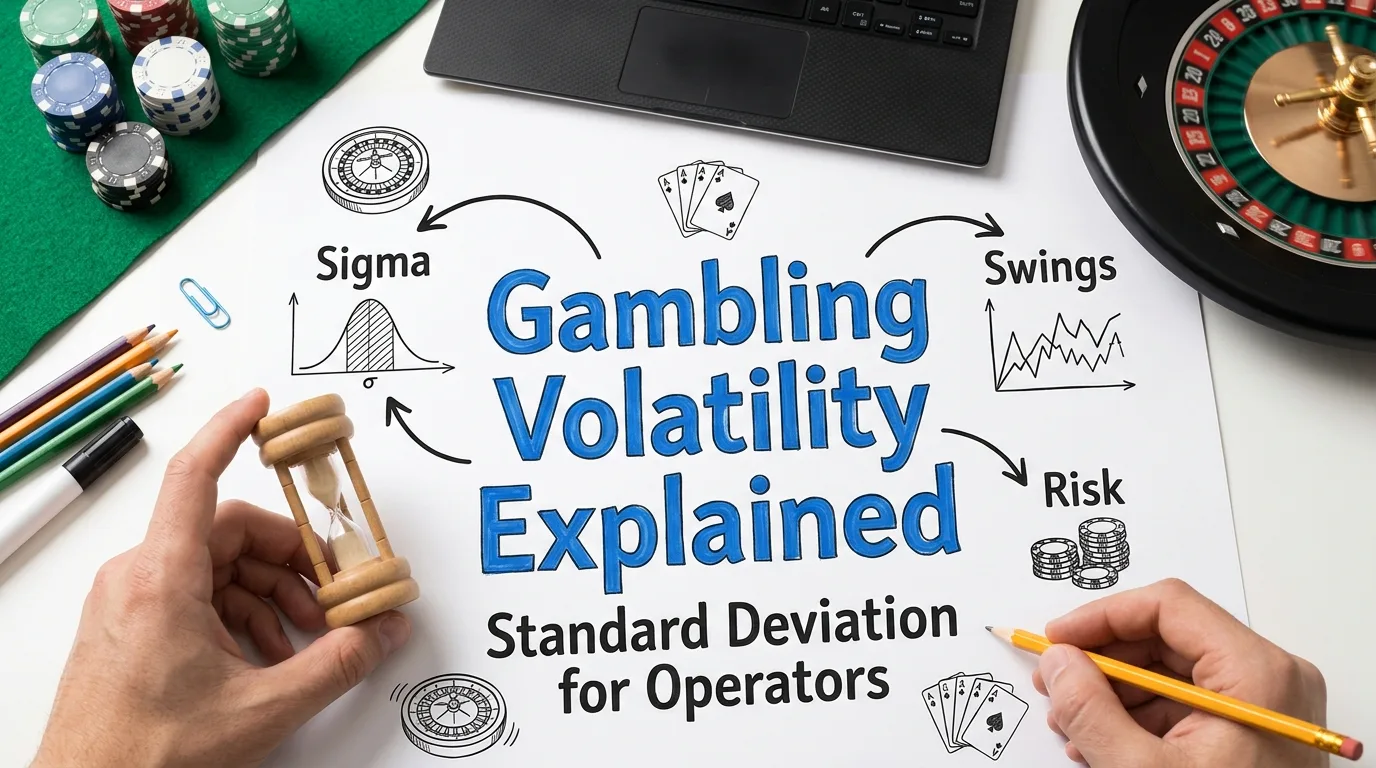
Sigma is the Greek letter for standard deviation, and in gambling it measures how far individual results spread around the expected value. For an operator, it describes the size of the swings behind a given RTP, which sets how much money can move against you before the math settles in your favor.
Sigma Meaning in Gambling: What It Is and Why Operators Track It
The sigma meaning in gambling is the same as in statistics: the typical distance between a single outcome and the mean. A game with a 3.5% house edge tells you what the operator keeps on average. Sigma tells you how rough the road to that average is.
The two numbers are independent. As one recent guide for bettors puts it, standard deviation tells you how wild the swings are regardless of whether you are winning or losing overall. The same holds on the operator side. A slot and a roulette table can carry an identical house edge and still produce very different daily results, because their sigma differs by a wide margin.
That is why operators track sigma separately from return. RTP drives long-run revenue forecasts. Sigma drives everything that happens before the long run arrives: cash reserves, bonus exposure, jackpot funding, limits on single wins and how you read a bad week. If you only monitor RTP, a normal variance event and a configuration fault look identical. Sigma gives you the band that separates them. For the basics of reading theoretical return, see how RTP is read and checked in casino games.
How Standard Deviation Measures the Size of Each Swing
Standard deviation is the square root of the average squared distance between each outcome and the mean. In practice, read it as the typical size of a single result’s miss from expectation. A larger sigma means each round is more likely to land far from the average, in either direction.
Two levers raise it. The first is bet size. Sigma scales linearly with stake, so doubling the bet doubles the standard deviation while the house edge percentage stays put. The second is the payout multiplier. For a bet that wins with probability p and pays b to 1, the per-unit standard deviation is (b + 1) multiplied by the square root of p(1 − p). Longer odds push that figure up fast.
Roulette shows the effect cleanly. An even-money bet on American roulette has a standard deviation just under 1 per unit staked. A straight-up number bet paying 35 to 1 has a standard deviation of about 5.76 per unit. Both carry the same 5.26% house edge. The number bet simply delivers its return in rare, large pieces.
Parlays and multi-leg bets follow the same logic by design. Most tickets lose, and a few pay large. At fair odds, a three-leg parlay of even-money legs wins with probability 0.125 and pays 7 to 1, which gives a standard deviation of about 2.65 per unit. That is more than double a single even-money bet. Bookmaker margin changes the exact figures, but the direction does not change. Each added leg stretches the payout distribution and lengthens the tail you have to fund.
The Volatility Index Is Standard Deviation for One Round at One Unit
Wikipedia defines the volatility index (VI) as the standard deviation for one round, betting one unit. It normalizes the measure so you can compare games on one scale, without stake size getting in the way.
Work it through for an even-money bet on American roulette, such as red or black. The wheel has 38 pockets and 18 of them win, so the win probability is 18/38, or about 0.4737. The loss probability is 20/38. A win pays +1 and a loss pays −1.
- Mean: (18 − 20) / 38 = −0.0526 per unit, which is the player’s expected loss and your 5.26% edge.
- Variance: The expected value of the squared outcome is 1, so variance is 1 − (0.0526)², which is about 0.9972.
- Standard deviation: The square root of 0.9972, or roughly 0.9986.
A VI near 1 means every round ends close to one unit away from zero, either up or down. There is no rare large win stretching the distribution. In the table-game sense, that makes this bet low-variance. Results move in steady, predictable steps, and the house edge is a small drift laid under a much larger swing.
The comparison point is useful. The 35-to-1 number bet above has a VI of about 5.76 on the same wheel with the same edge. When you compare games, VI is the number that separates them.
How Slot Volatility Changes Payout Dispersion Around RTP
In slots, volatility describes the dispersion of payouts. Low-volatility games pay small amounts often. High-volatility games pay less often but in larger amounts. Both can return the same percentage over a long run, and they feel and behave very differently over a day.
Two 2026 releases show how the parameters combine. Pragmatic Play’s Fury of Anubis (June 2026) is rated medium volatility with a 96.52% RTP and a 10,000x maximum win, which implies a 3.48% house edge. Caleta Gaming’s Cluster Cup (April 2026) is classed as high volatility with a 93.42% RTP. These are separate design choices. Volatility does not alter RTP. It shapes how that return is distributed across spins, and a low RTP number tells you nothing about how swingy the game is. Teams working on these trade-offs can start with slot RTP and volatility design choices.
You usually cannot derive a slot’s volatility yourself. The number depends on the full reel model, feature frequency and prize distribution, and a paytable alone does not expose it. Few developers publish volatility figures at all, with NetEnt being one that does. So request the figure, or the underlying simulation data, from every supplier as a condition of integration.
Regulators treat volatility as the measurable form of spread. The UK Gambling Commission guidance on calculating and monitoring RTP says volatility affects the acceptable tolerance around theoretical RTP, and that the range narrows as play volume increases. A high-volatility title needs far more spins before observed RTP can be judged against theory. Low play volume leaves a wide band, and high volume tightens it.
Using Sigma and Volatility in Operator Game Decisions
Three decisions follow from the numbers.
“The standard deviation we obtain by sampling a distribution is itself not absolutely accurate, both for mathematical reasons (explained here by the confidence interval) and for practical reasons of measurement (measurement error).”
Match volatility to player base and reserves. High-volatility games produce longer dry spells and rarer large wins. A smaller operator with thin reserves feels a single large hit more than a large operator does, so the portfolio mix should reflect what your bankroll can absorb. A balanced catalog spreads sigma across games instead of concentrating it.
Size liability for the tail, not the average. RTP tells you the mean cost of a game. The maximum win tells you the worst single event. A 10,000x cap on a stake means exposure scales with bet limits, so set stake ceilings, jackpot funding and per-player payout limits against the tail. If you commission your own titles, this belongs in the brief for custom slot game development, along with the target volatility profile. The slot game development features and process overview covers where those parameters get fixed.
Read short-term results against the expected band. Use standard error, which is sigma divided by the square root of the number of rounds. Take even-money roulette at 1 unit per round. Over 100 rounds, the expected house win is 5.26 units and the standard deviation of the total is about 10, so a losing stretch for the house is unremarkable. Over 10,000 rounds, the expected win is about 526 units against a standard deviation near 100. At that point a shortfall is a signal worth investigating.
Scale tightens this further. The UKGC’s final operator-data release reported 25.1 billion slot spins from the largest online operators in January to March 2026. At that volume, the standard error shrinks to a tiny fraction of turnover. Even with a hypothetical per-spin sigma of 10 units, the standard error is roughly 0.006% of stake. That figure pools many games and operators, so treat it as a sense of scale. Still, it shows why RTP tolerance becomes tight at high volume and why a deviation at that level deserves attention, while the same deviation on a few thousand spins does not.
A high sigma is not a fault in itself. It is a property to price, fund and monitor.