



“How long will this take?” is the first real question every iGaming founder asks — and the one most vendors dodge with vague timelines. This guide gives you specific, phase-by-phase numbers based on real operator journeys, not marketing brochures.
The honest answer is: anywhere from 3 weeks to 24 months, depending entirely on your build model, jurisdiction, and scope. If you’re still exploring opportunities and strategies for starting an online casino business, that context matters before you lock down a timeline — the market you’re targeting and the vertical you lead with will shape every phase of your launch schedule.
This guide breaks down every phase — planning, licensing, development, game integration, payment setup, compliance, QA, and go-live — with honest timelines for each build model. No fluff. No padding. Just the numbers you need to plan a realistic launch.
What This Guide Covers
Phase-by-phase launch timelines for white-label, hybrid, and custom iGaming platforms. Includes licensing duration by jurisdiction, the most common causes of delay, and actionable ways to compress your go-live date without cutting corners.
1. The Three Launch Paths — And Why Timeline Varies So Much
No two operators launch the same way. A white-label operator in Curaçao and a custom-built Tier-1 casino targeting the UK are both ‘launching an iGaming platform’ — but they’re running fundamentally different projects with entirely different timelines.
Understanding which path you’re on is the first decision that determines every date on your roadmap.
2. Phase-by-Phase Launch Timeline
Here is every phase a new operator goes through — in order — from the first strategic decision to the moment real players deposit real money.
PHASE 1 :- 2–6 weeks
Strategic Planning & Market Research
This phase is often skipped or rushed — which is why so many operators launch into the wrong market with the wrong product. The decisions made here determine licensing strategy, development scope, and go-to-market channel.
- Define your vertical: Casino-only, sportsbook-only, or combined? Each has different licensing, tech, and content requirements.
- Select target markets: Jurisdiction determines licensing path, payment methods, game content restrictions, and responsible gambling obligations.
- Choose build model: White-label, hybrid, or custom — this single choice sets your timeline ceiling and your capital requirement.
- Select technology partner: Your vendor or development agency must be shortlisted before licensing begins, as some regulators require this.
Operators who skip this phase typically spend 3–6 months in development before realising their target market requires a different license, different payment stack, or different game content. That’s a very expensive shortcut.
PHASE 2:- 6 weeks – 12 months (jurisdiction-dependent)
Licensing & Legal Setup
Licensing is the most unpredictable timeline variable. The same legal team can take 6 weeks for Curaçao and 12 months for a UK Gambling Commission license. Plan conservatively and run this track in parallel with development wherever possible.
Licensing runs concurrently with development in most jurisdictions. However, the UKGC and US state regulators will want to inspect your live compliance systems — which means your AML monitoring, KYC workflows, and responsible gambling tools must be operational before approval is granted.
PHASE 3:- 4 weeks – 18 months
Platform Development or Integration
This is the most variable phase of all. A white-label integration takes 4–8 weeks. A fully custom platform takes 12–18 months. Your timeline here is entirely determined by your build model choice in Phase 0.
- White-Label Integration: 4–8 weeks. Your provider configures the platform to your brand; you set up the back-office, bonus rules, and payment integrations.
- Hybrid Build: 3–6 months. You own your PAM and wallet layer; game aggregator and payment modules are integrated via APIs.
- Custom Build: 12–18 months. Every component — PAM, wallet, sportsbook engine, CRM, bonus engine — is built from scratch or assembled from best-of-breed modules.
Operators choosing a turnkey path — where you receive full source code ownership from a platform specialist — can get your own casino and sportsbook platform live in as little as 8–16 weeks while retaining 100% IP and code ownership. This is now the preferred path for serious operators who want speed without sacrificing long-term equity.
PHASE 4:- 2–8 weeks (parallel with development)
Game Content Integration
Game content is typically your most enjoyable phase — but it carries real timeline dependencies. Game providers require KYC checks on your business, legal agreements, and in many cases, proof of your license before enabling access.
- Via Game Aggregator (recommended): 2–4 weeks. One API integration unlocks 3,000–10,000+ titles from 100+ studios. Content goes live as soon as agreements are signed.
- Direct Studio Integrations: 4–12 weeks per studio. Each provider is a separate contract, technical integration, and compliance review.
- Game Certification: 2–6 weeks per game type in regulated jurisdictions. RNG certification through labs like BMM, GLI, or eCOGRA is mandatory before live deployment.
Before finalising your content strategy, study the guide to casino game types — understanding the categories, player demographics, and regulatory requirements of each game format helps you prioritise which verticals to launch first and which to phase in. Separately, use the casino games portfolio checklist for your development roadmap to ensure your game library is complete before go-live.
PHASE 5:- 4–10 weeks (often the biggest surprise)
Payment Infrastructure & Merchant Setup
Payment setup is consistently the phase that surprises founders the most. Getting approved as a high-risk merchant takes longer than most platforms take to build. Start this phase immediately after company formation — not after development is complete.
- High-Risk Merchant Account Approval: 4–8 weeks per processor. iGaming is classified high-risk; underwriting is thorough and approval is not guaranteed.
- E-Wallet Provider Agreements (Skrill, NETELLER): 2–4 weeks, but requires a live or near-live platform for review.
- Open Banking / Local Payment Methods: 1–3 weeks via aggregators like PaymentIQ or Trustly — faster than direct integrations.
- Crypto Payment Setup: 1–2 weeks via processors like NOWPayments or CoinGate. Fastest payment track available.
Pro tip: Apply to 3–4 merchant processors simultaneously. Approval from one covers your launch; others provide resilience and routing options post-launch.
PHASE 6:- 2–6 weeks (run parallel with development)
Compliance, KYC & AML Infrastructure
Compliance infrastructure is not optional — and in Tier-1 jurisdictions, regulators must see it live and functioning before issuing your license. This phase runs in parallel with development, not after it.
- KYC Provider Integration (Onfido, Jumio, Sumsub): 1–3 weeks. API integration with configurable verification flows for each jurisdiction.
- AML Monitoring Setup (ComplyAdvantage, NICE Actimize): 2–4 weeks. Transaction monitoring rules, PEP screening, and SAR workflows.
- Responsible Gambling Tools: 1–3 weeks. Deposit limits, self-exclusion, reality checks — most are configurable in your PAM layer.
- Self-Exclusion Registry Integration (GAMSTOP, SPELPAUS): 1–2 weeks per registry — mandatory in UK and Sweden.
UKGC applicants: your compliance systems must be demonstrably operational at the time of inspection. ‘We’ll build it after we get the license’ is not accepted.
PHASE 7:- 3–8 weeks
QA, Testing & Pre-Launch Certification
QA is the phase most operators compress under schedule pressure — and the one most likely to create post-launch crises. A casino platform handles real money in real time; a bug in the wallet or payment flow is a regulatory and reputational event, not just a software issue.
- Functional QA (full platform): 1–3 weeks. Registration, deposit, game launch, withdrawal, bonus application, responsible gambling tools.
- Security & Penetration Testing: 1–2 weeks. Mandatory in most Tier-1 jurisdictions; conducted by accredited third-party labs.
- Load Testing: 1 week. Simulate concurrent user sessions to verify infrastructure holds under traffic spikes.
- Payment Flow End-to-End Testing: 1 week minimum. Every deposit/withdrawal method must be tested with real transactions in staging.
- Soft Launch (Controlled): 1–2 weeks with limited player cohort before full go-live.
3. Full Timeline at a Glance: All Phases by Build Model
Note: Phases 1–5 run in parallel in well-managed projects. The critical path — the sequence that cannot be parallelised — is typically: Licensing → Merchant Approval → Game Certification → QA → Go-Live. Everything else can run concurrently.
4. What Actually Causes Launch Delays
Most operators do not miss their launch date because of bad development. They miss it because of administrative and third-party dependencies no one budgeted time for. These are the eight most common timeline killers.
Merchant Account Rejection or Delays:
Processors reject high-risk applications regularly. If you applied to only one processor and get rejected, you’ve lost 4–8 weeks. Apply to three simultaneously.
Incomplete Licensing Documentation:
Regulators reject applications for missing or incorrect documents. A single request for additional information adds 4–8 weeks to the Curaçao process; more for MGA and UKGC.
Game Provider Due Diligence:
Top studios (Evolution, Pragmatic Play, NetEnt) will not activate your account until your license is live or near-live. If you assumed game access was automatic, you’ve just added 4–8 weeks.
KYC Provider Onboarding Delays:
Onfido and Jumio have their own due diligence processes. Plan 2–3 weeks for contract execution and API credential setup.
Scope Creep in Phase 2:
Every feature added to the platform mid-sprint pushes the go-live date. A bonus mechanic added in Week 6 costs you 2–4 weeks of timeline.
Regulatory Pre-Launch Inspection (UKGC / EU):
Some jurisdictions require a site inspection before issuing a license. You must have a near-complete, functioning platform ready for this review.
SSL, CDN, and Infrastructure Configuration:
Cloudflare, DDoS protection, and SSL certificate setup seems trivial — but misconfiguration delays go-live by days or weeks. Often underestimated.
Responsible Gambling Registry Integration:
GAMSTOP (UK) and SPELPAUS (Sweden) integrations require documentation and validation. Operators often treat this as a post-launch task — regulators do not.
The Pattern
Every single delay above is predictable and preventable. Operators who work backwards from a fixed go-live date — building a reverse timeline for every third-party dependency — launch on time. Operators who sequence tasks linearly always run late.
5. How to Compress Your Launch Timeline Without Cutting Corners
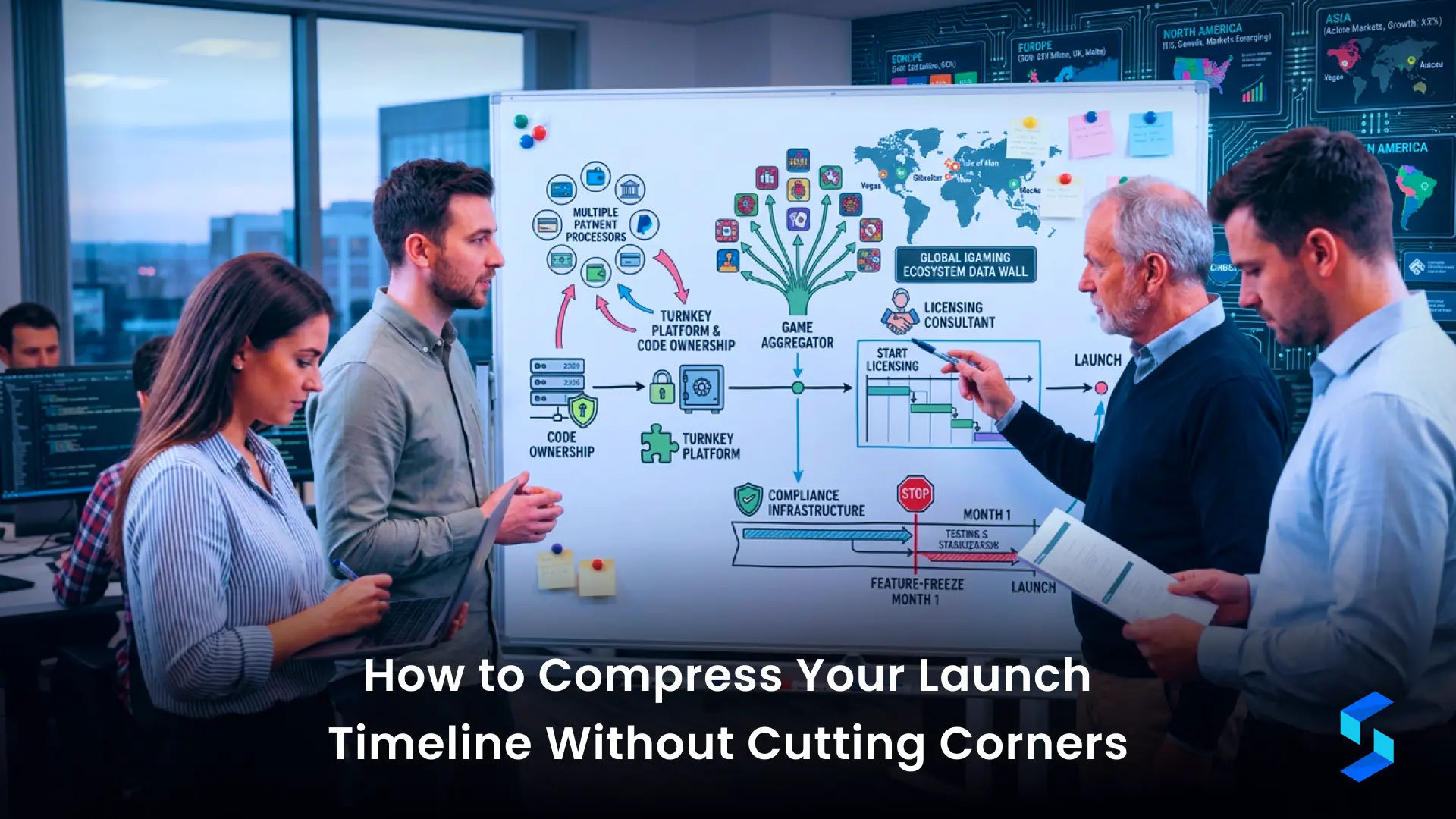
Speed to market matters enormously in iGaming — every week of delay is revenue not earned and CAC burning with no conversion. Here’s how experienced operators shave weeks off their timeline legally and safely.
- Start Licensing on Day 1: The moment your company is incorporated, begin your license application. Do not wait until development starts. In well-run projects, licensing and development run fully in parallel.
- Apply to Multiple Payment Processors Simultaneously: File 3–4 merchant account applications at the same time. You’ll accept the first approval and let the others serve as backup infrastructure post-launch.
- Choose a Turnkey Platform with Code Ownership: Source Code Lab’s iGaming platform and sportsbook solutions offer turnkey delivery in 8–16 weeks with full source code ownership — dramatically faster than custom builds, with none of the long-term revenue share of white-label.
- Use a Game Aggregator from Day One: Aggregators unlock 3,000–10,000+ titles in 2–4 weeks. Direct studio integrations can add 8–12 weeks per provider. Save direct deals for post-launch when your volume justifies negotiating power.
- Hire a Licensing Consultant: A specialist consultant who has successfully completed applications in your target jurisdiction will cut licensing time by 30–50%. The fee pays for itself in weeks of saved timeline.
- Build Compliance Infrastructure Before You Need It: Configure AML monitoring, KYC, and responsible gambling tools during development — not after. Regulators in some jurisdictions require operational compliance systems as a condition of approval.
- Feature-Freeze at Month 1: Agree your MVP feature set in Week 1 and freeze it. No new features after kickoff unless replacing something existing. Every addition to scope is timeline added.
6. Building Your Game Portfolio: What Needs to Be Ready at Launch
Your game content is what players actually come for. Having the right mix of content ready on Day 1 — not Day 30 — is critical for conversion and retention. Use the casino games portfolio checklist for your development roadmap to audit your launch library against what players in your target market actually expect.
Understanding the full landscape of available game formats before you go to your aggregator is equally important. The guide to casino game types covers the full spectrum — from RNG slots and live dealer tables to crash games and virtual sports — helping you make informed decisions about which verticals to prioritise in your launch library.
7. Ready to Launch? What Comes Next
The operators who launch fastest — and who build the most durable businesses — are the ones who start planning the right way, from the right foundation. Whether you’re targeting a white-label entry or a fully owned platform, the technical decisions made before a single line of code is written determine your trajectory.
Source Code Lab has helped operators across Europe, Asia, and Latin America go from concept to live platform. Their turnkey and custom development teams specialise in building iGaming platforms that operators own outright — source code included. Explore Source Code Lab’s casino and sportsbook platform solutions to see how your launch timeline can look.
Timeline Summary
White-label: 3–6 months. Hybrid: 6–12 months. Custom: 12–24 months. Turnkey with source code ownership: 8–16 weeks to soft launch. Start licensing on Day 1. Apply to multiple payment processors simultaneously. Freeze your feature scope early. Everything else is execution.