


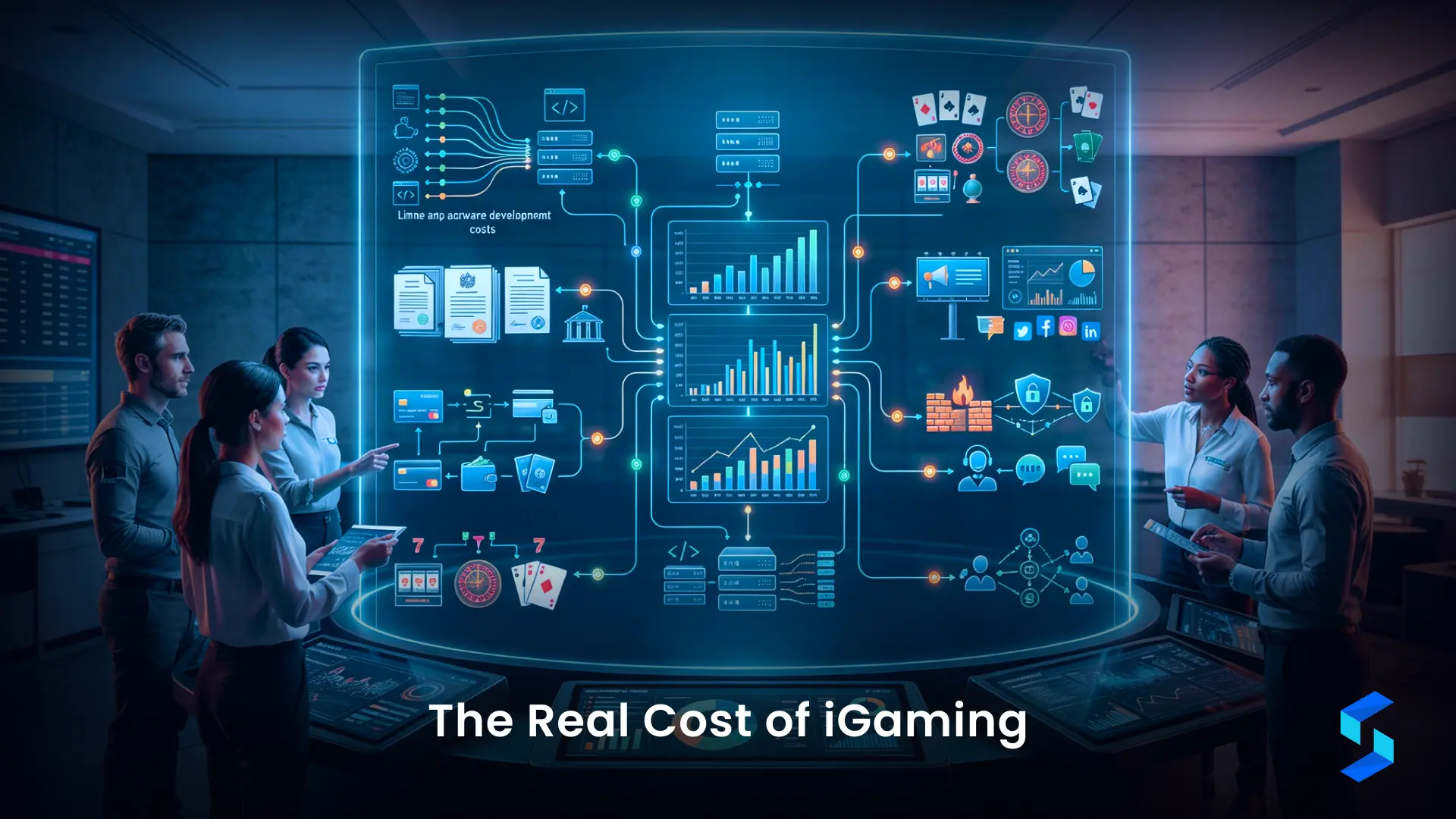
Every founder who enters iGaming asks the same question early: “How much does it actually cost to build this platform?” The honest answer is — it depends on dozens of variables. But it depends is not a budget. This guide is.
We break down every cost category — from development and licensing to compliance, payments, game content, and ongoing operations — so you can build a realistic financial model before you commit a single dollar. If you’re looking for an overview perspective first, the comprehensive guide to setting up an iGaming platform with online casino software is worth reading alongside this deep-dive.
Who This Guide Is For
Founders building their first iGaming business, CTOs scoping development budgets, CFOs stress-testing pro-forma models, and product leaders who need to prioritize features against capital constraints.
What Drives the Cost of an iGaming Platform?
Before looking at numbers, understand the variables that cause costs to swing by 10x between operators. Two founders can both want to ‘build an iGaming platform’ — and end up with budgets of $200,000 and $4,000,000. Here’s why.
The Seven Primary Cost Drivers
- Build Model: White-label, hybrid, or fully custom. This single decision has the highest impact on upfront cost and ongoing revenue share.
- Target Jurisdiction(s): A Curaçao license costs under $50K. An Italian concession now requires €7M. Your jurisdiction determines compliance infrastructure cost entirely.
- Vertical Mix: Sports betting requires real-time odds feeds and risk management. Casino needs game aggregator integration. Adding both doubles complexity and budget.
- Geographic Scope: One market requires one language, one payment stack, one compliance layer. Multi-market launch multiplies each of these.
- Team Model: In-house engineering at Western rates ($120–$200/hr), offshore development ($25–$60/hr), or a hybrid model — cost ranges vary by 300–400%.
- Timeline Pressure: Rushing a build requires more parallel resources. A 24-month runway builds smarter and cheaper than a 6-month sprint.
- Customization Level: A branded white-label UI costs $10K. A fully custom UI/UX with proprietary design language costs $150K+.
Build Model Cost Comparison: White-Label vs. Custom vs. Hybrid
The 20–40% ongoing GGR revenue share on white-label is often the detail founders underestimate. On a platform generating $500K GGR per month, that’s $100K–$200K leaving your P&L every single month — indefinitely. At scale, the custom build pays back its investment within 18–30 months.
Platform Development Cost by Component
If you’re building a custom or hybrid platform, each module carries its own development cost. The table below reflects realistic ranges using a mid-shore development team (Eastern Europe, India, Southeast Asia) in 2026.
Note on Development Rates
Mid-shore rates assume $25–$40/hr. Western agencies bill $120–$200/hr, making the same scope cost $1M–$3.2M. Senior-level specialists (security architects, blockchain engineers) command a premium regardless of location.
iGaming Licensing Costs: What You Actually Pay
Licensing is consistently the most misunderstood cost area. Founders see the headline application fee and budget accordingly — then get blindsided by ongoing compliance costs, legal fees, annual renewals, and jurisdiction-specific capital requirements. For a rigorous jurisdiction-by-jurisdiction analysis with ROI modelling, read the full breakdown of the real cost of iGaming licensing — including Italy’s new €7M concession framework and Curaçao’s updated LOK structure.
The headline fee is only 15–25% of total licensing cost in Year 1. Legal advisory, compliance infrastructure (AML software, KYC integration), staff training, and regulatory reporting systems collectively exceed the application fee in most jurisdictions.
Smart Licensing Strategy
Most early-stage operators start with Curaçao for speed and cost efficiency (6–8 weeks, $45K–$95K Year 1), then layer in MGA or UKGC licenses as revenue scales and market expansion demands it. Premature premium licensing burns capital before you have the revenue to justify it.
Game Content & Integration Costs
Your game library is your product — it’s what players actually spend time and money on. But sourcing and integrating game content carries both upfront and ongoing costs that vary dramatically based on your approach.
Game Aggregator vs. Direct Studio Deals
- Game Aggregator (Recommended for most operators): One API integration gives access to 3,000–10,000+ titles from 100+ studios. Setup cost: $10K–$30K integration + 3–8% of GGR in revenue share. Operators like Relax Gaming, EveryMatrix, and SoftSwiss offer this model.
- Direct Studio Integration: Negotiate directly with NetEnt, Pragmatic Play, Evolution. Better commercial terms at scale, but each integration is $10K–$50K in engineering plus legal. Only viable for operators with $5M+ monthly GGR.
- Proprietary Game Development: Building your own slot games, crash games, or table games. Higher long-term margin, full differentiation — but significant upfront cost.
Cost to Develop Individual Games
If proprietary game development is part of your roadmap, costs vary significantly by game type and complexity. For skill-based and casual formats, the Ludo game development cost guide provides a detailed breakdown covering design, engineering, platform compatibility, and multiplayer architecture — useful benchmarking for any social or casual gaming vertical.
For real-money gaming specifically — where transaction security, RNG certification, and regulatory compliance add significant development overhead — the cost to develop a real money game is a comprehensive reference that covers casino games, skill games, and hybrid formats with realistic cost ranges by feature set.
Payment Infrastructure Costs
Payment setup is one of the most underbudgeted line items. iGaming is classified as high-risk by most payment processors, which means higher fees, stricter terms, and more complex integration requirements.
Setup & Integration Costs
- High-Risk Merchant Account Setup: $2K–$10K per processor, plus rolling reserves of 5–10% of monthly processing volume held for 90–180 days
- Payment Gateway Integration (per method): $3K–$15K engineering per payment type; aggregators like PaymentIQ reduce this to one integration
- KYC-Linked Payment Verification: 3DS2 implementation, bank verification, and Open Banking setup: $5K–$20K
- Crypto Payment Integration: $5K–$25K depending on number of currencies and whether on-chain or via processor (NOWPayments, CoinGate)
Ongoing Payment Processing Fees
Compliance, KYC & AML Infrastructure Costs
Compliance is not a one-time cost — it’s a recurring operational expense that grows proportionally with your player base and transaction volume. Budget it as a percentage of NGR, not a fixed number.
KYC Verification Costs
- Per-Verification Cost: $1.50–$8.00 per identity check depending on provider and verification depth (Onfido, Jumio, Sumsub)
- Liveness Check (Video/Selfie): $3–$10 additional per check, required in many Tier-1 jurisdictions
- Document Verification: $2–$6 per document — passport, driving licence, proof of address
- Enhanced Due Diligence (EDD): $50–$200 per high-risk player requiring deeper background checks
AML Monitoring Infrastructure
- AML Software Licensing: $2K–$15K/month depending on transaction volume and provider (ComplyAdvantage, Refinitiv, NICE Actimize)
- PEP & Sanctions Screening: $500–$3K/month for continuous screening of player database
- Suspicious Activity Reporting (SAR) System: $1K–$5K/month for automated filing and case management
- Compliance Officer (FTE or Outsourced): $60K–$120K/year for in-house; $3K–$8K/month outsourced
Compliance Cost Benchmark
Budget 3–6% of NGR for compliance in Tier-1 markets (UK, Sweden, Germany). In lighter-touch jurisdictions (Curaçao, Kahnawake), 1–2% of NGR is more typical. Non-compliance penalties dwarf these costs — UKGC fines routinely run £5M–£20M+.
Technology Infrastructure & Hosting Costs
Cloud infrastructure costs scale with player volume and traffic. The figures below represent a mid-scale operator — 5,000–20,000 monthly active players across 2–3 regulated markets.
Player Acquisition & Marketing Budget
Marketing is your single largest variable cost — and the one most founders chronically underestimate. In competitive iGaming markets, you cannot build without it. You will not acquire players organically in Year 1 without a significant paid strategy.
Customer Acquisition Cost (CAC) Benchmarks by Channel
Rule of thumb: In a competitive regulated market (UK, Germany), budget $1M–$3M for Year 1 player acquisition. Emerging markets (LatAm, Africa) can run on $300K–$800K. Pure SEO-first strategies take 12–18 months to mature but deliver the lowest long-term CAC.
Hidden Costs Most Operators Miss
These budget lines don’t always appear in vendor quotes or initial scoping documents — but they show up in your bank account.
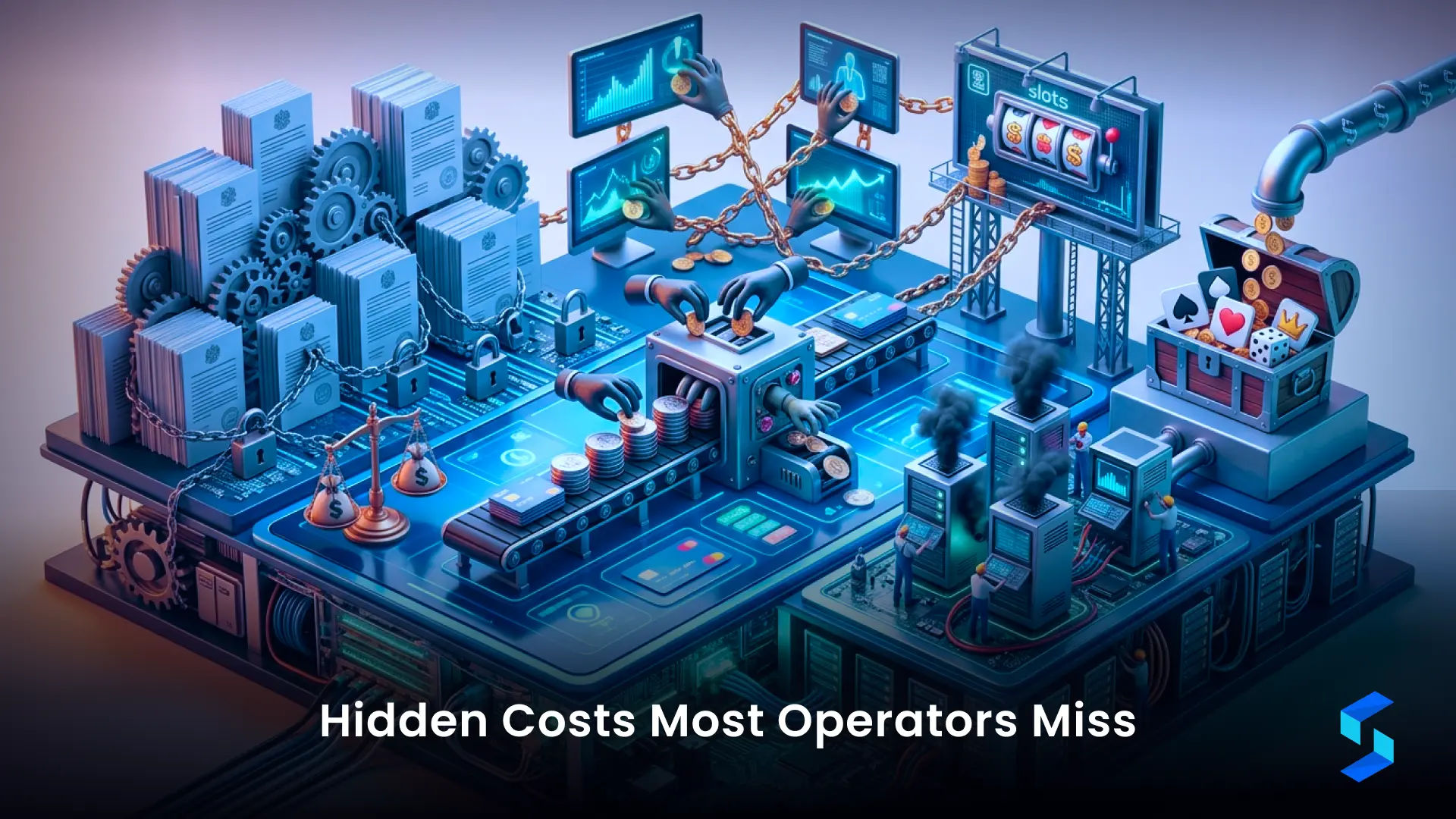
The 8 Costs That Surprise Founders
RNG Certification & Game Testing:
$5K–$20K per game type, per jurisdiction. Mandatory before any game goes live under a regulated license.
Penetration Testing & Security Audits:
$15K–$50K annually. Required by MGA, UKGC, and increasingly Curaçao regulators.
Payment Rolling Reserves:
Processors hold 5–10% of your monthly volume for 90–180 days. On $500K/month processing, that’s $25K–$50K tied up indefinitely.
Player Dispute Resolution Costs:
ADR (Alternative Dispute Resolution) provider fees, chargeback management, and internal dispute resolution staff: $2K–$10K/month at scale.
Affiliate Commission Liability:
Revenue share affiliates earn 25–40% of NGR on referred players — for life. On $1M NGR, that’s $250K–$400K/month leaving your P&L in perpetuity.
Bonus Liability & Abuse Management:
Welcome bonuses cost 10–20% of initial deposits in real terms after wagering. Bonus abuse (gnoming, matched betting) can spike this to 30%+ without proper controls.
Responsible Gambling Tool Implementation:
Self-exclusion registry integration, behavioral monitoring, affordability check systems: $20K–$80K to build; $2K–$10K/month to operate.
Annual Software Licensing Renewals:
CRM, analytics, fraud, AML, and monitoring tools collectively run $5K–$25K/month in SaaS fees that multiply as you grow.
Total First-Year Budget: Scenario Planning
Below are three realistic operator profiles — from lean MVP to full-scale launch — with total first-year budget estimates.
Fundraising Benchmark
Most seed-stage iGaming founders raise $1M–$3M for an MVP launch in a single regulated market. Series A rounds for meaningful scale typically target $5M–$15M. If your model requires a custom platform AND a Tier-1 license from Day 1, you need institutional capital — not bootstrapping.
How to Reduce Your iGaming Platform Build Cost
Smart founders reduce cost not by cutting corners — but by sequencing their investment intelligently.
- Start White-Label, Plan Custom: Use white-label to validate market fit and generate early revenue. Use that revenue and operational data to fund a custom rebuild at Month 18–24.
- Choose Mid-Shore Development: Eastern European and South Asian development teams deliver senior-level engineering at $25–$50/hr vs. $150–$200/hr in Western markets. Source Code Lab’s development teams operate in this model — see their iGaming platform solutions.
- License Curaçao First: Get to market in 6–8 weeks at $45K–$95K Year 1 cost. Apply for MGA or UKGC once monthly GGR exceeds $200K+.
- Use a Game Aggregator: A single aggregator integration replaces 50+ direct studio deals. Saves $200K–$500K in Year 1 integration engineering alone.
- Outsource Non-Core Functions: Customer support, compliance officer, affiliate management — outsource these until you hit operational scale. Saves $200K–$400K in Year 1 headcount.
- Modular Phase 2 Features: Defer advanced CRM, custom reporting, and loyalty programs to Phase 2. Launch with core P&W (payment and wallet), PAM, and game integration. Every deferred feature is cash preserved for player acquisition.