


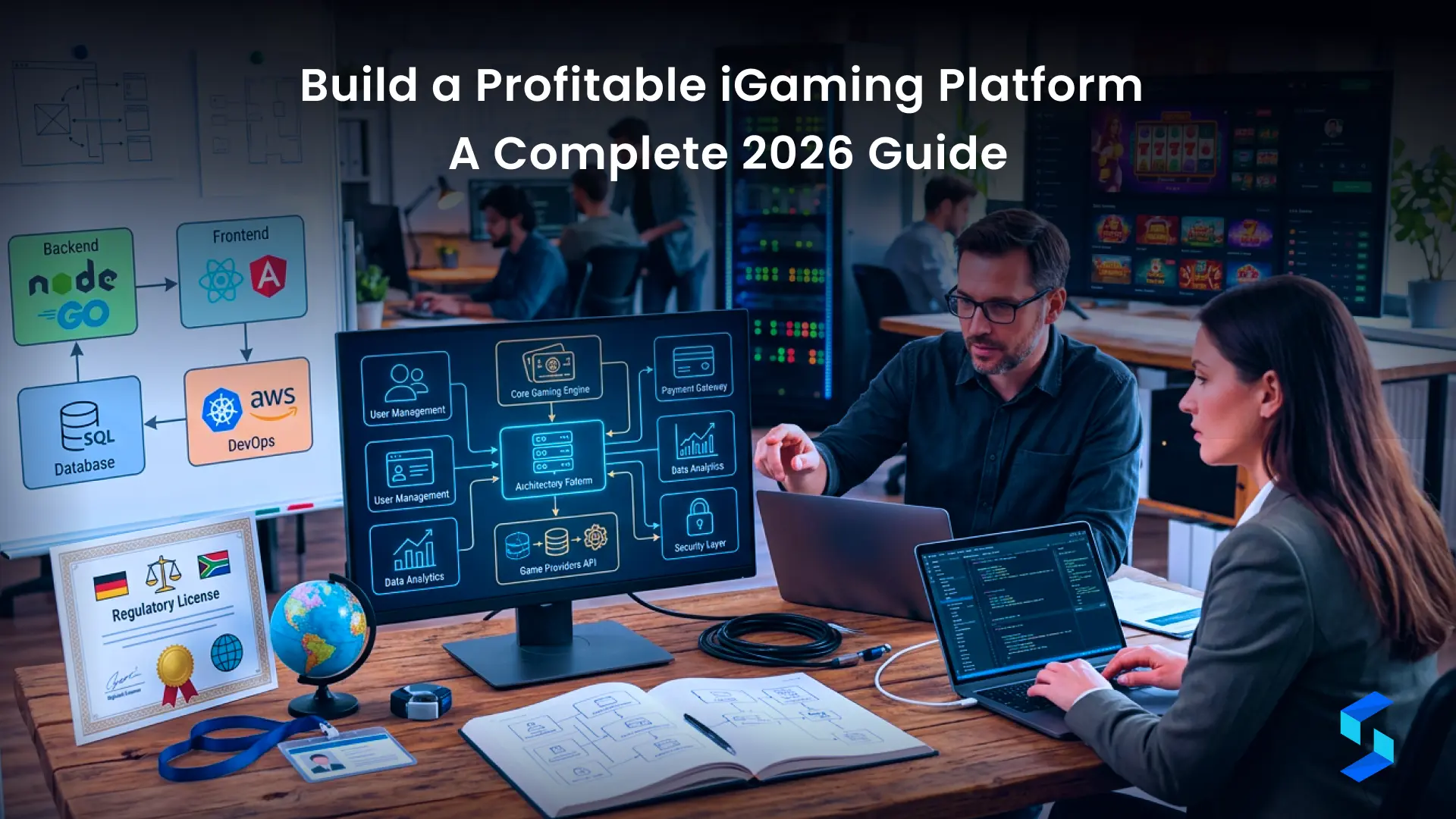
Building an iGaming platform is one of the most complex — and most rewarding — ventures a tech-forward entrepreneur can pursue. You’re not just launching a website. You’re engineering a real-time financial system, a regulated gaming environment, a fraud-resistant transaction layer, and a high-engagement user experience — all simultaneously. Before diving into architecture decisions, it helps to start with a foundational understanding of the iGaming industry and its key dynamics.
This guide is written for decision-makers: founders evaluating their first entry into online gambling, CTOs scoping architecture decisions, and product leaders who need to translate business goals into a technical roadmap. We cut through the noise and give you the frameworks, numbers, and strategic clarity to make the right calls.
Limited slots available for Q2 2026 projects. Book your strategy call today.
What You’ll Learn
This guide covers the full development lifecycle — from market validation and licensing strategy to platform architecture, vendor selection, and launch execution. It reflects current (2026) market conditions, regulatory landscapes, and development best practices.
The iGaming Market Opportunity in 2026
The global online gambling market is on a steep upward trajectory. Driven by mobile penetration, regulatory liberalization in key markets, and growing appetite for digital entertainment, the sector is projected to exceed $153 billion by 2030, with a CAGR hovering around 11–13%.
North America remains one of the most exciting growth frontiers, with U.S. sports betting now legal in 38+ states following the 2018 PASPA repeal. Latin America is rapidly opening up, with Brazil and Colombia leading regulated frameworks. Meanwhile, European markets — traditionally the most mature — continue to evolve with stricter compliance demands that reward operators who build right from the start.
Where the Real Growth Is
- Sports Betting: The fastest-growing vertical, fueled by live in-play wagering and mobile-first behavior
- Online Casino & Slots: Consistent revenue generator with high margins and strong player lifetime value
- Live Dealer Gaming: Premium segment with rapidly growing demand — players want the casino floor experience from home
- Crash Games & Provably Fair: Gen-Z-oriented formats disrupting traditional casino verticals
- Crypto & Web3 Gaming: Still niche, but growing — particularly in unregulated or lightly regulated jurisdictions
Founder Insight
Market opportunity does not guarantee success. The iGaming space has extremely high marketing costs (CAC ranges from $150–$800+ per depositing player), fierce competition, and regulatory complexity. The operators who win build defensible technology and brands — not just ‘another casino.’
Key Market Entry Questions for Decision-Makers
- Which vertical(s) will you lead with — sports, casino, or both?
- Which jurisdiction will you obtain your primary operating license from?
- What is your target player demographic and geography?
- Will you compete on product, brand, odds, or all three?
- What is your realistic 18-month player acquisition budget?
Choosing Your Build Model: White-Label vs. Custom vs. Hybrid
This is the single most important strategic decision you’ll make before writing a line of code or signing a vendor contract. Your build model determines your time to market, your cost structure, your differentiation ceiling, and your long-term scalability.
| Factor | White-Label | Custom Build | Hybrid |
|---|---|---|---|
| Time to Market | 3–6 months | 12–24 months | 6–12 months |
| Initial Investment | $50K–$200K | $500K–$5M+ | $200K–$1.5M |
| Ongoing Rev Share | 20–40% of GGR | Minimal (infra) | 10–20% on modules |
| Differentiation | Low | High | Medium |
| Regulatory Complexity | Lower (managed) | Full ownership | Shared |
| Scalability | Limited | Unlimited | Strong |
| Best For | First-time operators | Funded startups / tech leaders | Growth-stage operators |
White-Label: The Fast-Entry Path
A white-label iGaming solution lets you launch under your own brand using a third-party provider’s infrastructure, game content, payment processing, and compliance layer. You essentially rent the engine and customize the exterior. Before committing to this model, it’s worth reading a detailed comparison of white-label casino pros and cons so you understand exactly what you’re trading off for speed to market.
Best for: First-time operators who need to validate a market, regional operators testing a new vertical, or affiliates transitioning into direct operation. Not ideal if you intend to compete on product innovation or build long-term tech defensibility.
Custom Build: The Ownership Play
A fully custom iGaming platform gives you complete control over the product experience, data architecture, compliance tooling, and integration ecosystem. You’re building a proprietary technology asset — not licensing one.
Best for: Well-funded founders with technical teams, operators targeting multiple regulated markets simultaneously, or businesses that see technology differentiation as a core competitive advantage.
Hybrid: The Pragmatic Middle Ground
Most sophisticated operators end up here. You own your core platform — player management, wallet, CRM, and frontend — while licensing best-of-breed modules for games, payments, and risk management. You control the customer relationship; vendors power the specialist components.
KEY TAKEAWAY
If you’re pre-revenue or in market validation mode, start with white-label. If you’re serious about building a long-term iGaming business with genuine competitive differentiation, plan for a hybrid or custom architecture from day one — even if you launch with white-label as a bridge.
iGaming Platform Architecture & Tech Stack
Your architecture must handle three non-negotiable realities: millisecond-level transaction processing, real-time game state synchronization, and an unbroken audit trail for regulatory compliance. These requirements shape every technology decision you make. For a broader overview of what modern iGaming software solutions look like today, it’s useful context before scoping your own stack.
Recommended Platform Architecture Overview
Player-Facing Layer: Web App (React/Next.js) · Mobile (React Native / Flutter) · Native iOS / Android
API & Edge Layer: API Gateway (Kong / AWS) · CDN & WAF · WebSocket Server (Game Feed)
Core Platform Services (Microservices): Player Management (PAM) · Wallet & Ledger · Bonus Engine · Risk & Fraud · Sportsbook Engine · Casino Aggregator · Payment Gateway · Compliance/AML
Data & Infrastructure Layer: PostgreSQL / CockroachDB · Redis (Cache / Sessions) · Kafka (Event Stream) · Elasticsearch (Analytics)
| Layer | Recommended Technology | Why it Works for iGaming |
|---|---|---|
| Frontend Web | React + Next.js | SSR for SEO, fast hydration, large ecosystem |
| Mobile | React Native or Flutter | Single codebase, native performance, push notifications |
| Backend Services | Node.js / Go / Java (Spring) | Node for real-time, Go for high-throughput, Java for enterprise |
| Real-Time Communication | WebSockets + Socket.io / gRPC | Live scores, live dealer, in-play odds streaming |
| Primary Database | PostgreSQL / CockroachDB | ACID compliance critical for financial transactions |
| Caching | Redis | Session management, odds caching, leaderboards |
| Message Queue | Apache Kafka | Decoupled event streams for wallet, bets, notifications |
| Cloud Infrastructure | AWS / GCP with multi-region | 99.99% uptime SLA, geo-compliance, autoscaling |
| Security | Vault, OAuth 2.0, WAF | Secrets management, MFA, DDoS protection |
Critical Architecture Principles
- Event Sourcing for the Wallet: Every credit and debit must be an immutable event — not an UPDATE statement. This is non-negotiable for audit trails and dispute resolution.
- Idempotency Everywhere: Payment and bet settlement requests must be safely retried without double-processing. Use idempotency keys on all financial endpoints.
- Jurisdiction-Aware Routing: Your API layer needs to enforce geo-restrictions and route players to compliant game content based on their jurisdiction.
- Multi-Tenancy from Day One: If you plan to operate multiple brands or white-label your platform to third parties, architect for tenancy isolation from the start.
- Separation of Gaming Logic from Business Logic: Game results (RNG outcomes) must be isolated from promotional and bonus logic to prevent manipulation vectors.
Core Platform Components Every Operator Needs
An iGaming platform is not one system — it’s an ecosystem of interconnected modules. Understanding what each component does and how they interact is essential for CTOs and product managers scoping a development roadmap.
Player Account Management (PAM)
The PAM is the operational heart of your platform. It handles player registration, KYC verification, session management, preference storage, communication consent, and player segmentation. Every downstream system — wallet, bonuses, CRM — relies on the PAM.
A well-built PAM must support GDPR-compliant data management, configurable KYC workflows per jurisdiction, and robust API access for CRM and affiliate systems.
Wallet & Transaction Ledger
The wallet system manages real-money balances, bonus balances, pending withdrawals, and cashback. It must be ACID-compliant, support multi-currency, and maintain a complete ledger of every financial event with timestamps and audit metadata.
Bonus balance management — tracking wagering requirements, expiry dates, eligible games — adds significant complexity. Budget accordingly.
Sportsbook Engine
If you’re running a sportsbook, this is your most complex component. It includes odds management, bet acceptance, in-play data feeds, settlement logic, liability management, and result verification. Most operators integrate with a third-party odds feed provider rather than building odds calculation from scratch — our in-depth guide on how sports betting odds are calculated explains the mathematics and business logic behind pricing markets, which is essential reading before selecting an odds feed vendor.
Casino Game Aggregator
A game aggregator connects your platform to hundreds of game studios via a single API integration. Rather than integrating each provider separately, you plug into aggregators like Relax Gaming, SoftSwiss, or EveryMatrix to access content from NetEnt, Pragmatic Play, Evolution, and thousands of others at once.
Bonus & Promotions Engine
This is a frequently underestimated module. A sophisticated bonus engine handles welcome bonuses, reload offers, free spins, cashback schemes, tournament mechanics, referral bonuses, and VIP loyalty programs — each with configurable wagering requirements, game weights, time limits, and eligibility rules.
Risk Management & Fraud Prevention
- Real-time bet pattern analysis and liability exposure monitoring
- Payment fraud detection (velocity checks, BIN analysis, device fingerprinting)
- Bonus abuse identification (multi-accounting, gnoming, matched betting detection)
- Responsible gambling triggers and player behavioral profiling
CRM & Marketing Automation
Player lifecycle management is your primary retention tool. A CRM layer should enable segmentation-driven campaigns, triggered communications (email, SMS, push), churn prediction, personalized offers, and A/B testing — all connected to real-time player behavior data.
Reporting & Analytics
Operators need dashboards covering GGR, NGR, player lifetime value, game performance, bonus cost, and RTP by provider. Regulatory reporting — generating required submissions to licensing bodies — must also be built into or adjacent to your analytics layer.
Product Manager’s Note
Don’t try to build everything in Phase 1. Prioritize PAM, Wallet, Game Integration, and Payments. Layer in CRM sophistication, advanced bonus mechanics, and custom reporting in Phase 2. This phased approach controls scope and gets you to revenue faster.
Licensing, Compliance & Regulatory Framework
Licensing is not an afterthought — it’s a foundational business decision that shapes which markets you can enter, which payment providers will work with you, which game studios will supply content, and how much it will cost to operate.
There is no such thing as a ‘global’ iGaming license. Every jurisdiction has its own regulatory authority, licensing criteria, and ongoing compliance requirements. Your licensing strategy must align with your target markets.
Major Licensing Jurisdictions Compared
| Jurisdiction | Regulator | Time to License | Cost Estimate | Reputation |
|---|---|---|---|---|
| Malta (MGA) | Malta Gaming Authority | 4–6 months | €25K–€35K/year | Tier 1 — Widely Recognized |
| Gibraltar | Gibraltar Regulatory Authority | 3–6 months | £85K initial | Tier 1 |
| UK (UKGC) | UK Gambling Commission | 6–12 months | £25K–£100K+/year | Tier 1 — Most Stringent |
| Isle of Man | GSC Isle of Man | 4–6 months | £5K–£35K/year | Tier 1 |
| Curaçao | Curaçao Gaming Authority | 1–3 months | $30K–$50K/year | Entry-Level |
| Kahnawake | Kahnawake Gaming Commission | 2–4 months | $10K–$25K/year | Mid-Tier |
| New Jersey (US) | NJ Division of Gaming Enforcement | 12–18 months | $400K–$1M+ setup | Tier 1 US — High Barrier |
Key Compliance Requirements You Must Engineer For
- KYC (Know Your Customer): Identity verification, document upload, liveness checks — typically powered by providers like Onfido, Jumio, or Sumsub
- AML (Anti-Money Laundering): Transaction monitoring, suspicious activity reporting, politically exposed persons (PEP) screening
- Responsible Gambling Tools: Deposit limits, loss limits, cooling-off periods, self-exclusion, reality checks — many jurisdictions mandate specific implementations
- Data Protection (GDPR / CCPA): Data minimization, consent management, right to erasure, breach notification
- RTP Certification: Games must be certified by accredited testing labs (BMM, GLI, eCOGRA) before going live
- Audit Trails: Complete immutable logging of all transactions, bets, and administrative actions for regulatory inspection
CTO Alert
Compliance must be built into the platform, not bolted on after launch. Retroactively engineering AML monitoring, responsible gambling controls, or audit-safe logging into a live production system is extremely costly and risky. Design for compliance from Sprint 1.
Payment Infrastructure & Financial Integrations
Payments are the lifeblood of your operation. A frictionless deposit experience drives conversion; a fast withdrawal experience drives retention and trust. But iGaming is a high-risk category for payment providers — which means you’ll need to build relationships carefully and engineer resilience into your payment stack.
Building a Multi-Layer Payment Strategy
No single payment provider should be your single point of failure. Top operators run 3–5 simultaneous providers with intelligent routing logic that maximizes approval rates, minimizes fees, and provides failover when a processor has issues.
- Acquire a Primary High-Risk Merchant Account: Work with processors specializing in iGaming: Nuvei, Payroc, PaySafe, or Trustly. Expect higher interchange fees (2–4%) and reserve requirements.
- Integrate Open Banking & Local Payment Methods: In markets like the UK and Sweden, bank transfers via Trustly or open banking APIs have become dominant deposit methods — often outperforming cards.
- Add E-Wallets for Player Preference & Chargeback Protection: Skrill and NETELLER are iGaming staples in Europe. PayPal has selective iGaming relationships. E-wallet transactions typically have lower chargeback rates.
- Implement Crypto as an Optional Channel: For certain markets and player segments, cryptocurrency deposits (BTC, ETH, USDT) offer lower fees and instant settlement.
- Build Intelligent Payment Routing: Route transactions dynamically based on player geography, method type, transaction value, and processor uptime. A 5% improvement in approval rate can materially impact monthly revenue.
Payment Technologies to Evaluate
- Nuvei · Trustly · Paysafe / Paysafecard
- Skrill / NETELLER · Worldpay · PaymentIQ
- Stripe (select markets) · Volt (Open Banking) · Zimpler
Responsible Gambling & Player Protection
Responsible gambling (RG) is no longer a regulatory checkbox — it’s a business imperative and a reputational pillar. Regulators in the UK, Sweden, Germany, and the Netherlands have significantly raised the bar, and player protection requirements are tightening globally.
Beyond compliance, operators who invest in responsible gambling tools actually see long-term improvements in player retention. Players who feel in control and treated fairly stay longer, deposit more responsibly, and become advocates.
Mandatory RG Features by Major Jurisdictions
- Deposit Limits: Daily, weekly, and monthly limits — player-set, with mandatory cooling-off periods before increases take effect
- Loss Limits: Maximum loss thresholds over defined periods
- Session Time Limits: Automatic session expiry with reality check notifications
- Self-Exclusion: Integration with national self-exclusion registries (GAMSTOP in the UK, SPELPAUS in Sweden)
- Cooling-Off Periods: Mandatory break options before returning to play
- Reality Check Notifications: Pop-up reminders showing time spent and money spent
- Affordability Checks: Increasingly mandated, especially in the UK — triggered at defined deposit thresholds
Best Practice
Build a behavioral analytics layer that proactively identifies at-risk players before they self-exclude. Patterns like increased session frequency, chasing losses, or rapid deposit escalation are detectable signals. Proactive outreach is better regulation — and better business.
Cost Breakdown & Budget Planning
Budgeting for an iGaming platform startup is where many founders get surprised. The numbers below reflect real-world 2026 market rates. Treat them as informed ranges, not fixed quotes.
Development Cost Ranges by Build Model
| Cost Category | Range | Notes |
|---|---|---|
| White-Label Setup | $50K–$200K | One-time setup + 20–40% GGR revenue share ongoing |
| Custom Platform Build | $500K–$3M+ | 18–24 month engagement with a dedicated team |
| Hybrid Approach | $200K–$1.5M | Own the core; license specialist modules |
| Licensing (MGA) | €25K–€60K | Initial application + first-year fees + legal |
| KYC & AML Tools | $2–$8 per verification | Volume-dependent; plan for 100% of new registrations |
| Ongoing Infrastructure | $15K–$80K/month | Cloud, CDN, data, monitoring — scales with traffic |
| Marketing (Year 1) | $500K–$5M+ | Your single largest line item; depends on market |
| Customer Support | $20K–$100K/month | 24/7 multi-lingual support; often outsourced initially |
Common Budget Mistake
Most founders underbudget marketing by 50–70%. Building the platform is only half the battle. In competitive iGaming markets, customer acquisition is the dominant cost driver. Plan for a marketing budget at least equal to — and often 2–3x larger than — your technology budget.
Revenue Model: How iGaming Operators Make Money
- Gross Gaming Revenue (GGR): Total bets placed minus winnings paid out
- Net Gaming Revenue (NGR): GGR minus bonuses, affiliate commissions, and payment processing fees
- House Edge: Ranges from 2–5% in sports betting to 3–15% in casino, depending on game and configuration
- Affiliate Revenue Share: Typically 25–40% of NGR for referred players, ongoing
- B2B Revenue: If you white-label your platform — license fees plus revenue share from sub-operators
Choosing the Right Vendor or Development Partner
Whether you’re engaging a white-label provider, a technology platform vendor, or a custom development agency, your partner selection will make or break your launch. For those building B2B-first or white-label-first, our guide on B2B iGaming platform development covers vendor structure, API contract expectations, and revenue-share negotiation in detail.
Evaluation Framework for iGaming Technology Vendors
Licensing & Compliance Credentials: Does the vendor hold relevant B2B licenses (e.g., MGA B2B license)? Are they approved suppliers in your target regulated markets? This is a hard requirement.
Reference Operators & Track Record: Ask for references from live, operating clients — not just logos on a website. Speak directly to a CTO or Product Lead at a reference client about real problems they’ve encountered.
API Documentation & Technical Depth: A mature platform vendor should have comprehensive API documentation, versioning policies, sandbox environments, and clear SLA commitments. Sloppy documentation is a red flag for engineering quality.
Data Ownership & Portability: Confirm that you own your player data and can export it in standard formats. Never sign a contract that traps you in a vendor’s ecosystem by restricting data portability.
Uptime SLA & Incident Response: iGaming platforms require 99.95%+ uptime SLAs. Ask for historical uptime records and review their incident response process. Downtime during peak events is catastrophically expensive.
Roadmap Transparency & Contractual Flexibility: Understand the vendor’s product roadmap and how your feature requests are prioritized. Avoid long lock-in contracts (5+ years) before you’ve proven the platform fits your needs.
Key iGaming Platform Vendors to Evaluate
- EveryMatrix · SoftSwiss · Digitain · BetConstruct
- Kambi (Sportsbook) · Altenar · NuxGame · GR8 Tech
- Pragmatic Solutions · Paysign
Go-to-Market Strategy for New iGaming Operators
Launching your platform is a milestone. Acquiring your first 1,000 depositing players is the real test. Here’s how sophisticated operators approach their go-to-market strategy.
Define Your Player Persona First
Before allocating a single marketing dollar, know exactly who you’re targeting. A recreational slots player in Germany requires a completely different acquisition channel, deposit method, bonus structure, and communication style than a high-volume sports bettor in Latin America.
Acquisition Channel Mix
| Channel | Best For | Avg. CAC | Scalability |
|---|---|---|---|
| Affiliate Marketing | SEO-driven, performance-based acquisition | $200–$600 per FTD | High |
| SEO / Content Marketing | Long-term organic player acquisition | $50–$200 (mature) | High (long-term) |
| Paid Social (Meta, TikTok) | Brand awareness in new markets | $300–$800+ | Regulated |
| Sports Sponsorships | Brand visibility, trust signals | High CPPM | Brand Play |
| Influencer / Streamer | Younger demographics, crypto operators | Variable | Niche |
| Email / CRM Lifecycle | Retention, reactivation of existing players | Near-zero marginal | High ROI |
Your First 90 Days Post-Launch: A Prioritized Roadmap
- Days 1–30: Soft launch to a controlled audience. QA the full deposit-play-withdrawal loop. Fix conversion funnel friction points.
- Days 31–60: Activate affiliate partnerships. Launch SEO content strategy. Test welcome bonus offers with controlled cohorts.
- Days 61–90: Analyze first cohort LTV vs. CAC. Double down on channels with positive unit economics. Begin email lifecycle campaigns for early depositors.
KEY TAKEAWAY
The operators who survive their first year aren’t always the ones with the best product — they’re the ones who understand their unit economics. Know your cost-per-FTD, your 30/60/90-day retention rates, and your average player GGR before you scale spend. Grow before you know your numbers and you’ll scale losses, not profits.
Internal Resources & Further Reading
Explore these in-depth resources from SourceCodeLab to go deeper on the topics covered in this guide:
| Resource | Where to Use It in Your Journey |
|---|---|
| Sports Betting Odds Calculation Explained | Essential before selecting an odds feed vendor or building your sportsbook pricing engine |
| White-Label Casino: Pros & Cons | Compare tradeoffs before committing to your build model in Section 2 |
| iGaming Software Solutions | Overview of the software landscape for operators scoping their tech stack |
| Understanding iGaming | Foundational primer for founders new to the online gambling industry |
| B2B iGaming Platform Development | Deep dive into vendor structures, API contracts, and revenue-share negotiation |
Ready to Build Your Winning iGaming Platform?
Whether you need a fast white-label launch, a hybrid solution, or a fully custom platform engineered for long-term dominance — our team has delivered 40+ successful iGaming projects in 2025–2026.
Get Your Free Architecture Roadmap →
Limited slots available for Q2 2026 projects. Book your strategy call today.