


The UNODC estimates that 2% to 5% of global GDP is laundered each year, or roughly USD 800 billion to USD 2 trillion annually, a scale referenced in earlier FINRA AML guidance. For iGaming operators, that risk shows up in a digital environment built for speed, high transaction volume, and constant cross-border movement of funds.
An AML program for an online casino or sportsbook has to reflect the way the business runs. Players can register, deposit, place bets, and request withdrawals in a short window. Acquisition often comes through affiliates. Payment activity is split across cards, wallets, open banking flows, prepaid instruments, and crypto in some markets. Those conditions create abuse patterns that generic AML advice does not address well.
Effective prevention starts with controls that match the operating model. That means risk-based onboarding, payment and gameplay monitoring tied to customer behavior, clear escalation rules for suspicious activity, documented ownership checks where required, and independent testing that measures whether controls work under production pressure.
For operators active in several jurisdictions, AML also has to fit the wider iGaming legal compliance and regulations around the world requirements. In practice, that includes licensing conditions, local reporting thresholds, vendor oversight, and AI systems that help investigators sort real alerts from routine player activity without burying the team in false positives.
Table of Contents
- The High Stakes of AML Compliance in iGaming
- Building Your AML Compliance Framework
- Implementing Robust Customer Due Diligence
- Mastering Transaction Monitoring and Red Flags
- Managing Third-Party and Affiliate Risk
- Leveraging Technology and AI for AML
- Maintaining Compliance Through Training and Audits
The High Stakes of AML Compliance in iGaming
Financial crime teams are dealing with faster payment rails, higher account turnover, and more cross-border user activity than legacy gambling controls were built for. In iGaming, that pressure shows up immediately. A player can register, deposit through an e-wallet or card, place low-risk bets, trigger bonus logic, and cash out before a manual reviewer has a clear picture of what happened.
That is why AML failures in this sector are expensive. The risk is not limited to fines. Operators also face license friction, delayed market entry, payment partner scrutiny, frozen merchant relationships, and expensive remediation projects that pull product, fraud, and compliance teams off core work. If you operate across multiple regions, the burden gets heavier because your controls must reflect the iGaming legal and regulatory requirements across global markets, not a single-country rulebook.
Why the sector attracts abuse
iGaming offers exactly the conditions a launderer wants. Fast account creation. High transaction velocity. Large volumes of legitimate user behavior to hide inside. A weak program will treat those patterns as growth signals when they are AML exposure.
The operational problem is not just customer identity. It is the mismatch between how digital gambling products work and how basic AML programs are often designed. Players switch devices, test payment methods, use affiliates, react to promotions, and move between jurisdictions. Some of that is normal. Some of it is structuring, account linking, or attempts to move funds through gameplay with minimal loss.
A common failure point is treating KYC as the control and gameplay as a product issue. That split does not hold up in practice. On a high-velocity platform, AML risk forms across the full account journey: registration, first deposit, bonus use, betting pattern, withdrawal timing, payment instrument changes, and reactivation after dormancy.
Practical rule: If compliance only checks documents at onboarding, the operator is blind to where the real laundering risk develops.
What actually matters in practice
Strong iGaming AML performance depends on controls that match how the platform really runs, not how a policy document describes it.
- Lifecycle monitoring. Review customer risk across deposits, bets, bonuses, withdrawals, device changes, and linked account behavior.
- Payment and gameplay analysis together. A withdrawal may look ordinary on its own and still be suspicious when paired with low-value wagering or circular payment activity.
- Fast escalation paths. Analysts need clear triggers for source-of-funds review, manual investigation, account restriction, and reporting.
- Affiliate and acquisition oversight. Traffic sources influence AML exposure. Poor-quality affiliates can drive synthetic, bonus-abuse, or mule-linked accounts into the funnel.
- Independent challenge. Compliance, fraud, payments, and VIP teams need defined ownership, but the AML decisioning logic cannot be set by commercial teams alone.
For digital-first operators, technology choices matter here. Static rules still have a place, but they miss too much in environments with heavy promotion use, multi-account behavior, and rapid transaction cycles. Teams improve outcomes by combining rules, case management, graph analysis, and AI models for detecting fraud and managing risk, especially where affiliates, devices, and payment methods create hard-to-spot connections.
A good AML program does not remove risk. It makes suspicious behavior visible early enough to stop funds from moving, defend regulatory decisions, and keep the business operating.
Building Your AML Compliance Framework
Financial institutions spent an estimated USD 206 billion globally on AML compliance in 2023 (Basel Governance on AML success). That figure matters because it shows what operators often learn the hard way: AML isn't an admin task. It's an operating function with staffing, process, technology, governance, and audit costs.
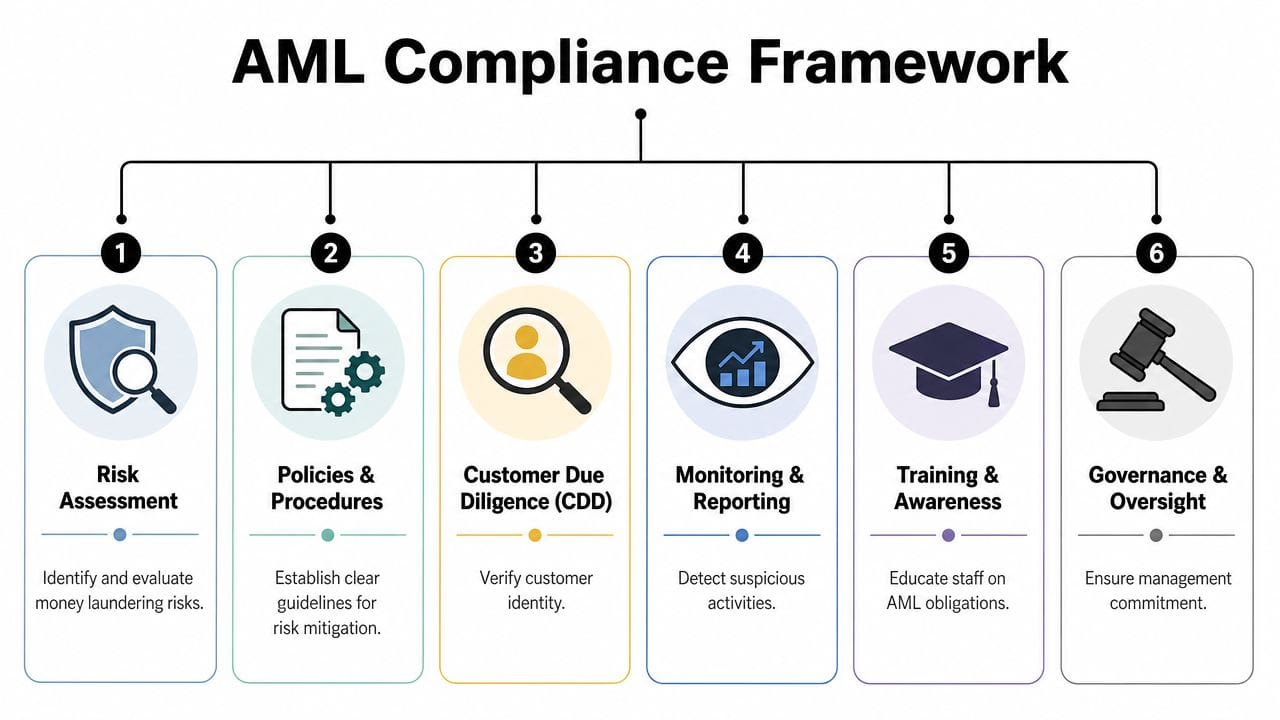
If you're building an iGaming platform or cleaning up a weak legacy setup, start with the framework, not the tools. Teams that buy software before defining risk usually end up with too many alerts, unclear ownership, and policies nobody follows.
For operators putting launch readiness in order, this sits alongside the broader casino platform compliance checklist for launching iGaming.
Start with a real enterprise risk assessment
Your risk assessment should be written, current, and tied to how your business operates in practice. In iGaming, three categories usually shape the first draft.
Customer risk
Look at who you allow onto the platform. High-spend players, users with complex payment behavior, politically exposed persons, and customers whose activity doesn't align with their profile deserve more scrutiny.Geographic risk
Review where players register, fund accounts, and access the platform. Jurisdiction mismatches matter. A player living in one place, funding from another, and logging in from a third changes the risk picture fast.Product and channel risk
Not every payment flow carries the same exposure. Fast deposits, quick withdrawals, wallet-based rails, multi-account behavior, and any feature that allows movement with limited economic friction should sit higher in the risk model.
Good AML controls are specific to the business model. A sportsbook with live betting, affiliate traffic, and multiple payment processors needs a different control design than a single-market casino brand with slower payment flows.
Write the policy your team can actually run
A formal AML policy has to do more than satisfy a regulator on paper. It should tell operations, payments, fraud, and support teams what happens when risk appears. If the document reads like a legal memo and nobody can follow it, it will fail during an incident.
At minimum, the policy should cover:
- Governance and approval with senior management sign-off and clear accountability.
- Named compliance ownership so there's a designated officer responsible for oversight.
- Internal controls for onboarding, screening, monitoring, investigations, reporting, and recordkeeping.
- Training requirements designed for the teams that touch customers and payments.
- Independent review procedures that test whether the program works in live conditions.
This is also where outside expertise helps. Teams that need a practical view of detecting fraud and managing risk often benefit from comparing AML controls with broader financial-crime operating models, especially where fraud and laundering signals overlap.
A weak framework creates two predictable failures. First, the business pushes too much risk into manual review and burns out analysts. Second, product and growth teams bypass controls because they don't understand them. Good governance prevents both.
Implementing Robust Customer Due Diligence
Customer due diligence breaks down when an iGaming operator treats it as a document check at onboarding. Fast payments, remote onboarding, affiliate-driven acquisition, and multi-account abuse create risk long before a case reaches transaction monitoring. A CDD model for gaming has to decide who can enter the platform, who needs limits, and who should never reach first deposit.
Teams tightening these controls should align operations, licensing, and product decisions against a practical iGaming KYC and AML compliance checklist, especially when each group defines customer risk differently.
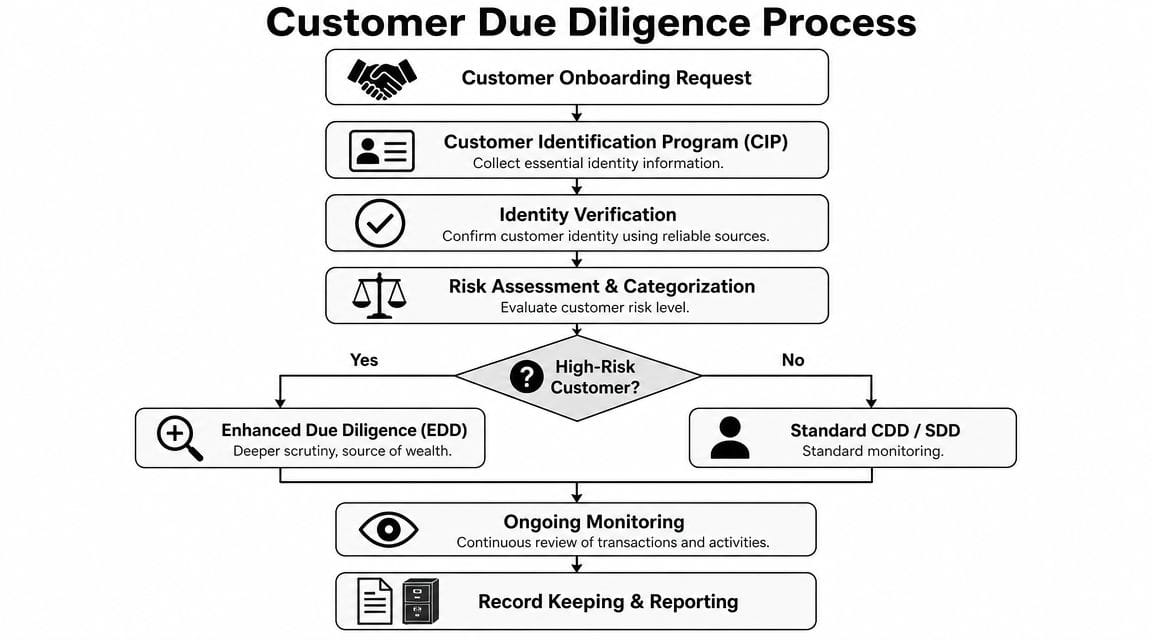
Build a tiered CDD model
Start with a baseline that is strict enough to stop obvious abuse without driving unnecessary abandonment. For most operators, that means collecting core identity data, verifying documents, screening against sanctions and watchlists, and testing whether the account details match the device, location, and payment setup presented at signup.
The first review should answer four questions:
- Is the player a real person
- Can the identity be verified from reliable sources
- Is there a sanctions, watchlist, or PEP concern
- Does the registration pattern fit normal customer behavior
Verification alone is not a risk rating. Once the account passes initial checks, classify it. A low-stakes recreational player using a local card from a matched device should not enter the same review path as a customer referred by an aggressive affiliate, using a VPN, registering from one country, funding from another, and requesting rapid withdrawal access.
Common escalation triggers include:
- Funding patterns that do not fit the stated profile
- Country mismatch across registration, device, IP, and payment instrument
- Early withdrawal requests with little or no meaningful gameplay
- Shared cards, wallets, devices, or identifiers that suggest third-party use
- Affiliate traffic patterns linked to duplicate, synthetic, or bonus-abuse accounts
For higher-risk customers, Enhanced Due Diligence should produce a defensible file, not just more uploads. Ask for source of funds where the risk justifies it. Review linked payment methods, ownership indicators, gameplay purpose, account connections, and prior internal cases. Record why the account was approved, restricted, or exited. If an investigator cannot explain that decision six months later to an auditor or regulator, the review was incomplete.
Here's a useful primer for teams that want to compare internal workflows with a broader industry explanation of CDD and onboarding controls:
Use behavior before funding as a control
High-velocity platforms cannot wait for deposits and withdrawals before assessing laundering risk. Signup behavior, device use, and session patterns often show the account's real purpose earlier than KYC documents do.
BioCatch reports that behavioral biometrics detected mule accounts in 92% of cases before traditional AML and transaction-monitoring systems alerted the bank, and that some banks saw up to 1,000 mule accounts identified per month using this approach (BioCatch on behavioral biometrics and mule account detection). That matters in iGaming because mule and synthetic-account behavior often appears before the first deposit.
Review the session, not just the ID:
- Navigation patterns that suggest scripted, coached, or automated onboarding
- Device and browser reuse across clusters of new accounts
- Typing, swiping, and interaction signals that differ from normal player behavior
- Repeated signup traits tied to affiliate campaigns, promo abuse, or account farming
AI helps here if it is trained on gaming-specific abuse patterns. Generic fraud scores are rarely enough. Models should weigh signals such as account velocity, payment instrument reuse, bonus sequencing, device graph links, and affiliate source quality. They also need controls around explainability, threshold testing, and human review, because a model that blocks good players without a clear rationale creates both regulatory and commercial problems.
The practical rule is simple. Stop suspicious accounts before they become operational. Once a bad actor has deposited, wagered just enough to create cover, and pushed a withdrawal request into queue, the case is harder to investigate and more expensive to contain.
Mastering Transaction Monitoring and Red Flags
A lot of AML failures in iGaming come from one bad assumption: if onboarding was clean, transactions will explain themselves. They won't. The same account can pass verification and still be used for suspicious movement once funding starts.
Transaction monitoring is where how to prevent money laundering becomes operational. This is the part that has to work every day, with live deposits, bonus activity, gameplay patterns, and withdrawals arriving in sequence.
Why generic rules fail in iGaming
A bank rule that flags “large deposit followed by withdrawal” is too crude for gaming. Plenty of legitimate players deposit, bet lightly, change their mind, and cash out. The issue is context. Was there meaningful gameplay? Did the account receive promotional abuse signals? Are there links to other wallets, devices, or player accounts? Did the withdrawal destination change?
Industry guidance gets one point exactly right: poorly tuned thresholds break the system. If thresholds are too strict, false positives overwhelm investigators. If they're too loose, suspicious activity slips through. Effective programs map monitoring scenarios to actual laundering typologies and track metrics such as alert-resolution time and SAR filing rates to keep tuning the rules (transaction monitoring playbook from Sanctions.io).
A monitoring rule is only useful if an analyst can investigate it quickly and consistently.
In iGaming, I'd rather run fewer rules tied to clear behaviors than dozens of vague alerts nobody trusts.
iGaming AML Red Flag Indicators
The most useful red flags are pattern-based, not isolated. One event might be harmless. A sequence often isn't.
| Red Flag Indicator | Description | Typical Risk Level |
|---|---|---|
| Large deposit with minimal gameplay | The player funds the account, places little or low-risk activity, then requests withdrawal | High |
| Rapid deposit and withdrawal cycling | Funds move in and out repeatedly without a credible entertainment pattern | High |
| Multi-account behavior | Several accounts appear linked by device, payment instrument, IP pattern, or behavioral traits | High |
| Bonus abuse tied to cash-out attempts | The player uses promotional mechanics in a way that appears designed to legitimize withdrawals | Medium to High |
| Payment method changes before withdrawal | The account uses one method to fund and another to withdraw, or introduces third-party indicators | High |
| Cross-border inconsistency | Registration, login activity, and funding geography don't align with the stated customer profile | Medium to High |
| Peer-to-peer collusive play signals | Gameplay suggests intentional transfer of value between accounts, including deliberate losses | High |
| Structuring around internal limits | The player repeatedly transacts just below review thresholds or operational controls | Medium to High |
| Dormant account activation with immediate high-value activity | An inactive account suddenly resumes with aggressive funding or cash-out behavior | Medium |
| Repeated failed onboarding followed by successful account creation | Multiple identity or device attempts precede a funded account | Medium to High |
The trade-off is always the same. Broad rules catch more activity but create analyst drag. Narrow rules reduce noise but miss emerging methods. The solution isn't choosing one side. It's tuning rules around player purpose, expected activity, and linked behavior over time.
Managing Third-Party and Affiliate Risk
An operator's AML program is only as strong as the data and controls flowing through its partners. That includes payment processors, wallet providers, KYC vendors, fraud tools, game suppliers that influence transaction patterns, and affiliates that shape who arrives at your front door.
FinCEN's prevention guidance emphasizes that effective AML programs must adapt controls to the products and services offered and identify high-risk geographies and customers. In a digital business, that extends naturally to the third parties bringing in funds, traffic, and account activity (FinCEN AML prevention guide).
Treat vendors as part of your AML perimeter
A processor can create AML exposure even when your internal team is doing solid work. If the processor obscures payment metadata, slows investigative cooperation, or permits weak ownership transparency, your analysts lose context exactly when they need it.
Vendor due diligence should cover more than commercials and uptime. Ask operational questions:
- What screening and monitoring controls does the vendor run
- What data fields are shared back to your team
- How quickly can they support an investigation
- What jurisdictions, customer types, or payment flows create higher risk
- Can they demonstrate independent testing or control assurance
Contract language matters here. Include obligations for timely data sharing, audit cooperation, escalation support, and notice of control changes. If a partner won't agree to that, assume you'll have blind spots later.
Affiliates need compliance controls too
Affiliates are often treated as a marketing issue. In AML terms, they're a risk-distribution channel. They influence user acquisition, jurisdiction exposure, onboarding quality, and traffic intent. That means they belong in your risk model.
The practical problem isn't just bad actors. It's opaque traffic. An affiliate might send users who churn quickly, create clusters of linked accounts, or arrive through channels that increase identity risk. Without monitoring affiliate-level quality signals, the compliance team ends up investigating symptoms one account at a time.
Use an affiliate control framework that includes:
- Pre-approval review of ownership, geography, business model, and traffic sources
- Ongoing quality monitoring for suspicious signup patterns, payment anomalies, and linked-account activity
- Restrictions in contract terms around prohibited acquisition methods and sub-affiliate use
- Cross-team reviews involving compliance, fraud, payments, and affiliate management
If an affiliate manager is compensated only on deposits or first-time depositors, expect tension. That's normal. AML governance exists to resolve that tension before it turns into regulatory exposure.
Leveraging Technology and AI for AML
Manual AML operations don't scale in a high-velocity platform. They create queues, inconsistent decisions, and late interventions. Technology should remove repetitive work, centralize risk signals, and help investigators focus on the accounts that require judgment.
Automate the controls that should never be manual
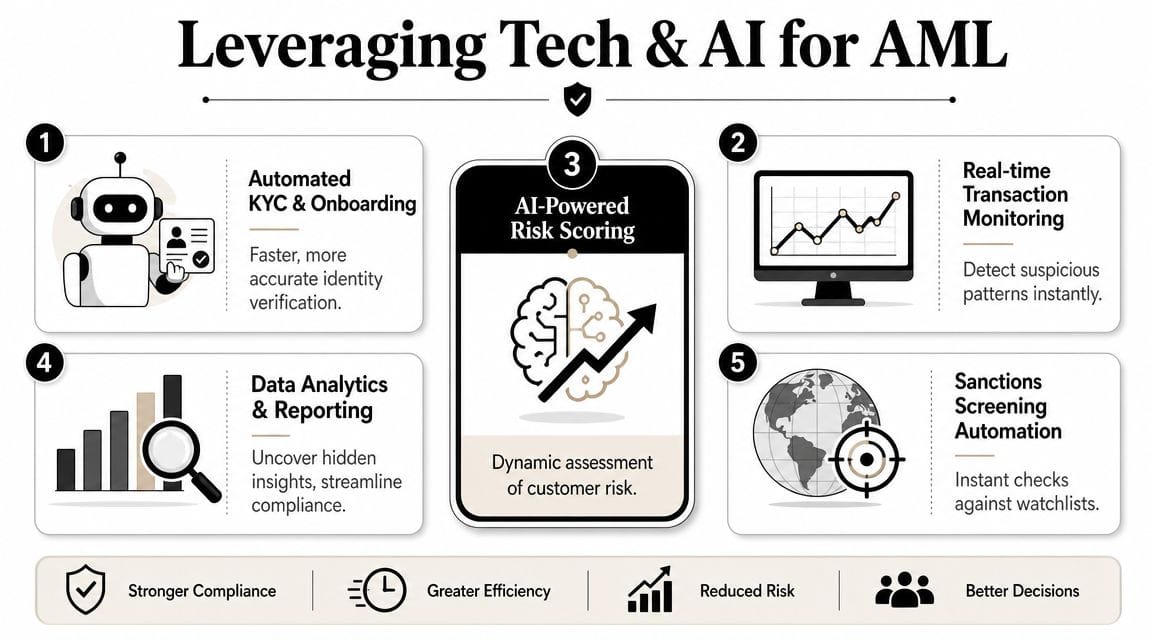
Some checks shouldn't depend on human memory or spreadsheet discipline. Automate them.
That includes:
- Sanctions and watchlist screening at onboarding and on an ongoing basis
- Identity verification workflows that route exceptions for manual review
- Case management so alerts, evidence, decisions, and escalations live in one audit trail
- Record retention tied to due diligence and investigation activity
- Risk scoring updates whenever customer behavior changes
A solid stack usually combines an identity provider, watchlist screening, transaction monitoring engine, case management layer, and data warehouse or analytics environment. If you run crypto-adjacent payment options, intelligence on wallet exposure and counterparties becomes part of the picture too. Teams dealing with that overlap may find this architecture-focused piece on threat intelligence for crypto payments useful when designing cross-channel controls.
Use AI where static rules break down
Rules are good at catching known patterns. They're weaker when the behavior is subtle, distributed across accounts, or constantly shifting. That's where AI and machine learning can help, especially in iGaming environments with dense event streams.
Useful applications include:
Dynamic player risk scoring
Instead of assigning a fixed risk level at onboarding, the model updates risk as deposits, session behavior, device changes, and withdrawal patterns evolve.Network analysis
AI can help surface clusters of related accounts through device overlap, shared payment traits, behavioral similarity, or collusive gameplay patterns that individual rules might miss.Alert prioritization
When dozens of rules trigger, models can rank cases by likely severity so investigators start with the most meaningful work.Anomaly detection
Some suspicious activity doesn't match a prewritten rule. It looks wrong relative to the account's prior behavior or the platform's normal patterns.
Technology should reduce analyst noise, not create a prettier version of the same queue.
AI also needs guardrails. Don't buy a black-box system that can't explain why it scored an account as risky. Compliance teams need traceable inputs, documented models, human review points, and change control. If you can't defend the output to an auditor or regulator, the sophistication doesn't matter.
One practical option in the iGaming stack is a platform that already includes AML rule support and fraud-monitoring layers alongside payment operations. Source Code Lab, for example, offers platform features that include AML rules and integrated fraud detection relevant to suspicious transaction monitoring. That kind of integration can reduce handoff gaps, provided the operator still defines the policy logic, thresholds, and escalation standards internally.
Maintaining Compliance Through Training and Audits
A written policy won't protect you if the support team doesn't escalate a suspicious withdrawal request, the VIP team waives review for a valuable player, or the payments team can't reconstruct why a transaction was approved. AML breaks at the handoff points.
Banking guidance consistently treats customer due diligence as one of the most effective tools against misuse of financial services, but it only works when paired with continuous monitoring and suspicious activity reporting across the customer lifecycle (Alessa on the three stages of money laundering and controls). That lifecycle view is what keeps a program alive after launch.
Train by role, not by generic policy deck
Most annual AML training is too broad to be useful. Teams need role-based examples tied to the decisions they make.
A workable training program includes:
- Support teams learning when customer explanations don't match account behavior
- Payments teams recognizing risky funding and withdrawal patterns
- Affiliate and marketing teams understanding traffic-quality risk and prohibited acquisition practices
- VIP and retention teams knowing when commercial pressure must stop and compliance must lead
- Analysts and investigators practicing escalation, documentation, and reporting standards
Use live scenarios from your own environment. If staff can't recognize suspicious behavior in the products they handle every day, training hasn't landed.
Audit the system before a regulator does
Independent review is essential. Internal testing matters, but it isn't enough on its own. You need periodic challenge from someone who can assess whether controls work, whether alerts are investigated consistently, and whether documentation supports the decisions made.
A practical audit cycle should test:
- CDD files for completeness and consistency
- Monitoring scenarios for relevance, threshold tuning, and investigation quality
- Case handling from alert to closure
- Recordkeeping so files can be reconstructed quickly
- Reporting procedures for suspicious activity escalation and filing readiness
Keep records in a form your team can retrieve without scrambling across email, chat logs, and vendor dashboards. When a regulator or auditor asks why an account stayed open, the answer has to be immediate and documented.
Strong AML programs don't rely on memory. They rely on evidence.
AML is never finished. Payment methods change, affiliates shift, player behavior evolves, and criminals test whatever friction you leave exposed. The operators that stay in control are the ones that review, retrain, retune, and re-audit before a problem becomes a finding.
If you're building or upgrading an iGaming platform and need AML controls embedded into onboarding, payments, fraud monitoring, and case workflows from the start, Source Code Lab can help you design a platform setup that matches real compliance operations rather than generic policy language.
Prepared with Outrank tool