


U.S. commercial gaming revenue hit a record $78.72 billion in 2025, and all 38 commercial gaming states posted annual revenue growth, according to MoEngage's casino marketing overview. That number matters less as a bragging point than as a warning. More revenue attracts more operators, more aggressive acquisition spend, and more pressure on every team to prove that marketing is producing durable player value instead of expensive first deposits.
That's why marketing for casinos has changed. The old approach treated channels as isolated tactics. Run paid media. Send offers. Sponsor events. Hope players return. That playbook breaks fast when privacy rules tighten, attribution gets messy, and media costs rise faster than player value.
A stronger approach is to build a marketing engine. It runs on first-party data, measures performance against LTV and CAC, and uses AI where it helps: personalization, audience modeling, and testing. It also respects a basic operational truth. Acquisition without retention burns cash. Retention without measurement turns into guesswork. Measurement without compliant data collection collapses under regulation.
Operators that win don't just market harder. They market with cleaner data, tighter control, and better judgment about where each dollar belongs.
Table of Contents
- Introduction Winning in a High-Stakes Market
- The Modern Casino Marketing Engine
- Mastering Player Acquisition Channels
- Building a High-LTV Retention Strategy
- Navigating Regulations and Advertising Constraints
- Measuring What Matters KPIs and Attribution Models
- The Future AI Personalization and Privacy-First Growth
- Conclusion Building Your Casino's Marketing Playbook
Introduction Winning in a High-Stakes Market
The casino category doesn't reward generic marketing. It punishes it.
Operators are competing in an environment where demand is large, competition is intense, and every acquisition source is under more scrutiny than it was a few years ago. Players move across devices, compare offers before they click, and respond to promotions differently depending on spend level, game preference, and timing. A broad campaign might still create awareness, but awareness alone won't protect CAC.
Three changes define the market now.
- Competition is rising: Record industry revenue has made the category more attractive, which pushes more brands into the same acquisition spaces.
- Tracking is getting harder: Privacy rules and weaker identity signals make lazy retargeting and third-party dependency less reliable.
- Boards want proof: Marketing leaders are expected to explain not just traffic and registrations, but deposit quality, retention, and long-term value.
Practical rule: If a casino marketing tactic can't be connected to player value, it belongs in the test budget, not the core budget.
That changes how a new operator should build the function. Start with owned data. Connect CRM, acquisition reporting, and product behavior. Make channel decisions based on contribution to lifetime value, not noise at the top of the funnel. Use AI to improve matching, timing, and recommendation logic, not to generate more campaign clutter.
Marketing for casinos works best when it acts like a disciplined operating system. Every campaign should answer four questions. Who is this for? Why now? How will we measure value? What happens after the first conversion?
The Modern Casino Marketing Engine
Most weak casino marketing programs don't fail because the team lacks channels. They fail because the channels don't share a system.
A paid team chases registrations. CRM pushes bonuses. Affiliates bring traffic that nobody scores properly after first deposit. Brand work runs on a separate calendar. Then leadership asks a simple question, which channels bring profitable players, and nobody can answer with confidence.
Why channel-first thinking fails
Channel-first planning sounds practical. It usually isn't. Teams end up optimizing local metrics inside each platform instead of business outcomes across the full player lifecycle.
That creates familiar problems:
- Paid media overvalues easy conversions: Branded search and retargeting can look efficient while adding limited incremental lift.
- CRM becomes a discount machine: If segmentation is weak, retention turns into repetitive offers that train players to wait for incentives.
- Affiliate programs scale unevenly: Without proper tracking and quality controls, operators reward volume instead of valuable intent.
- Branding gets ignored: Then the same operator wonders why conversion rates depend entirely on bonus aggressiveness.
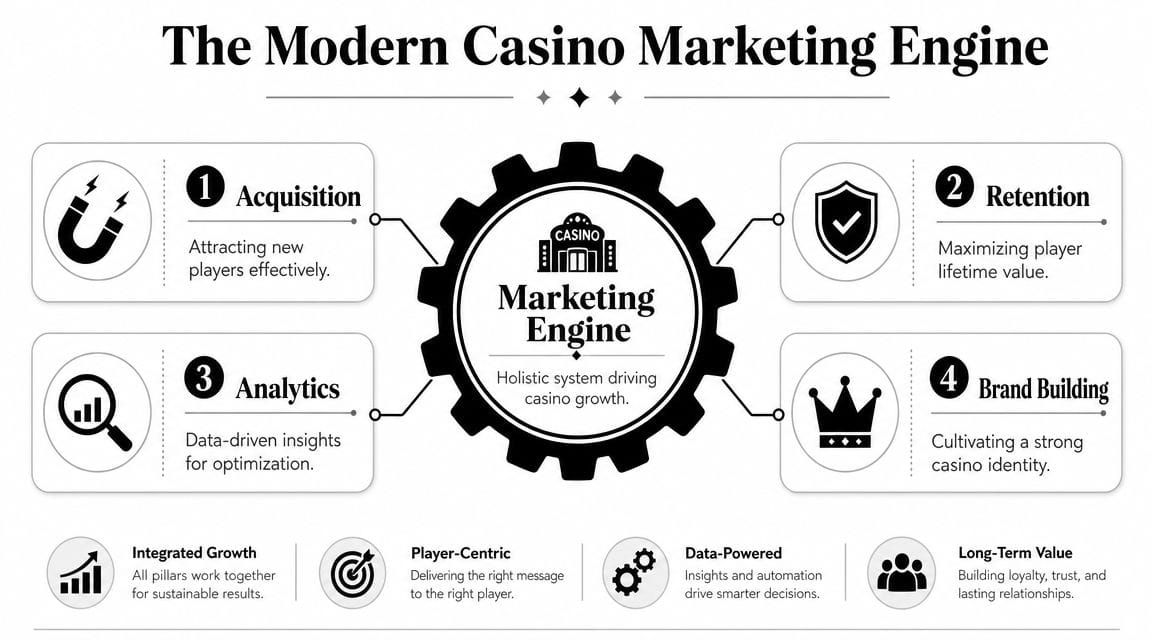
A marketing engine fixes that by forcing interdependence. Acquisition brings in the player. Retention increases value. Analytics proves which actions changed behavior. Brand building improves trust and response across all channels.
How the engine actually works
Think of the engine as four connected layers.
| Pillar | Job | What strong teams do |
|---|---|---|
| Acquisition | Bring in new qualified players | Prioritize intent, compliance, and source quality |
| Retention | Increase frequency and long-term value | Segment by behavior and personalize timing |
| Analytics | Measure contribution and detect waste | Connect source data, CRM data, and product events |
| Brand building | Make the offer believable and memorable | Keep message, tone, and experience consistent |
The mistake new operators make is funding these in sequence. First acquisition. Later retention. Measurement after volume grows. That's backwards. The infrastructure has to be in place before spend scales, or you lock in bad habits.
A casino doesn't need more campaigns than it can measure. It needs fewer campaigns tied to clearer commercial outcomes.
In practice, that means setting up campaign taxonomy, CRM event feeds, deposit attribution logic, and audience definitions early. It also means agreeing on what counts as a quality player before launch. Some teams learn this too late. They optimize for cheap registrations, then spend months discovering those users never became profitable.
The engine model also changes how teams report. Instead of presenting separate channel updates, present flow. Which sources produced engaged first-time depositors. Which player cohorts returned. Which segments responded without margin-heavy incentives. Which creative themes brought in players with stronger downstream value.
When marketing for casinos is run this way, budget allocation becomes less political. The data won't eliminate judgment, but it will narrow the room for opinion-based spending.
Mastering Player Acquisition Channels
Acquisition is where most operators overspend first.
The reason is simple. New player numbers are visible, immediate, and easy to celebrate. But not all acquisition channels produce the same kind of player, and not all reported conversions deserve equal credit. The job isn't to buy traffic. The job is to acquire players with realistic retention potential.

Search and content for high-intent demand
SEO and content still matter, especially for operators entering a market where players research games, bonuses, payment methods, and legality before registering. The mistake is publishing broad lifestyle content that attracts curiosity instead of intent.
Useful acquisition content for casinos usually falls into narrower buckets:
- Jurisdiction-specific pages: Users often want clarity on where a product is available and what the rules are.
- Game-intent content: Pages focused on a game category, title, or feature can attract players closer to action.
- Bonus comparison and education pages: These help users evaluate fit, not just headline offers.
- Trust-building content: Payments, licensing, withdrawal flows, and responsible gaming information reduce hesitation.
A lot of the playbook overlaps with disciplined SaaS customer acquisition strategies, especially around funnel mapping and matching content to buyer intent. The difference is that casino operators need tighter coordination between content, compliance, and conversion design because user trust can collapse quickly if the landing page overpromises or obscures restrictions.
If you're defining who to target in the first place, this guide to profiling the online casino target audience is a useful companion. It helps operators move beyond broad personas and think in terms of actual player motivations and behaviors.
Paid media under platform pressure
Paid search and paid social can still work, but they require restraint. Platform policies, geo limitations, and creative constraints make casino media buying less forgiving than in many other verticals.
Strong operators do three things well here:
- Separate prospecting from retargeting. Don't let blended reporting hide where true demand is coming from.
- Build landing pages for one audience and one action. Casino pages stuffed with every offer, every game, and every promo usually convert poorly.
- Match message to state, product, and readiness. A casual browser and a comparison shopper shouldn't hit the same page.
Operator note: If your media team can't explain why a campaign exists beyond "scale," pause it. Expansion without audience logic usually turns into expensive noise.
Why affiliates deserve board-level attention
Affiliate marketing isn't a side channel in iGaming. For many operators, it's central. One industry guide states that 74% of iGaming operators use affiliate marketing as their primary customer acquisition channel, because it is performance-based and often captures pre-qualified traffic from review sites and bonus comparison environments, as detailed by Rainmaker Agency.
That matters because affiliate traffic often arrives with more context. The player has already compared brands, checked offer terms, or filtered by market and game preference. The click isn't cold. It's informed.
That doesn't mean every affiliate is valuable. Some send intent-rich traffic. Others send volume that looks fine in top-line reports and disappoints after deposit. Operators should evaluate affiliates using criteria like:
- Content quality: Review depth, jurisdiction accuracy, and how clearly terms are explained.
- Traffic alignment: Whether the affiliate attracts users that fit your licensed markets and product strengths.
- Attribution cleanliness: Whether source, click, registration, and deposit data reconcile without dispute.
- Compliance behavior: Whether the affiliate follows approved language, creative standards, and restrictions.
The main trade-off is control. Paid media gives you more direct levers. Affiliates give you reach and intent, but you need strong governance. The best operators don't treat affiliate management as vendor administration. They treat it as portfolio management.
Building a High-LTV Retention Strategy
Retention is where casino margin gets protected or destroyed.
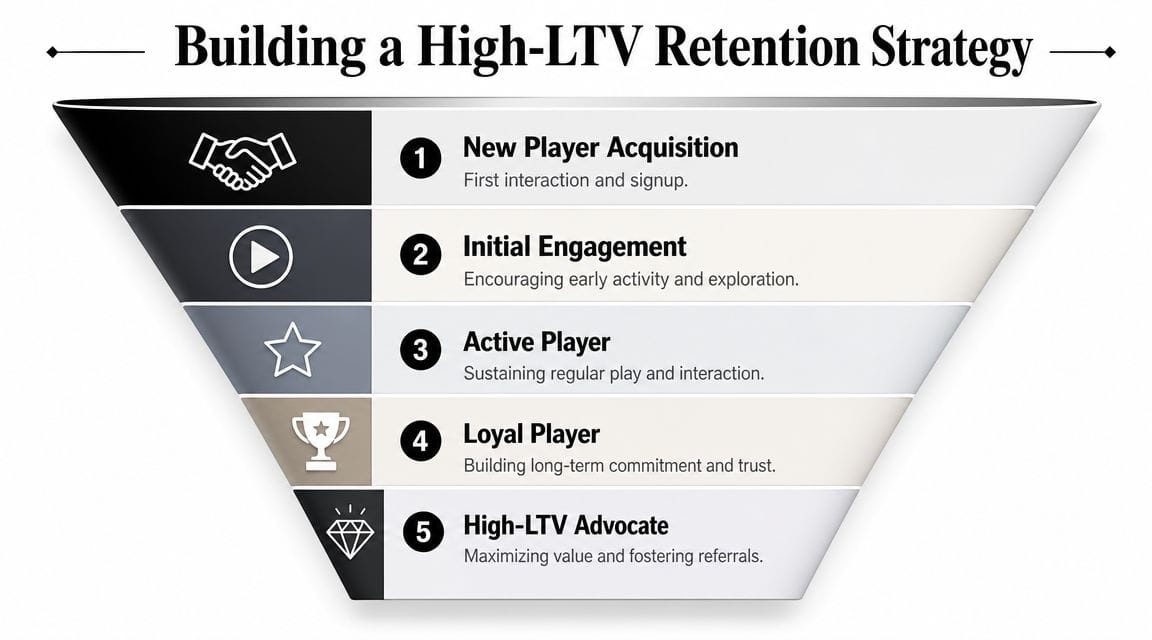
A new player who deposits once and disappears isn't a growth story. That's a lead-generation cost wearing a casino badge. The point of retention is to turn early activity into repeat value without conditioning players to respond only when the bonus gets bigger.
Research hosted by PubMed Central found that moderate-risk gamblers were significantly more likely than non-problem gamblers to report seeing gambling promotions on social media, at 66.2% versus 39.8%. The broader takeaway for operators isn't to push harder promotions. It's that marketing exposure influences behavior, which is exactly why retention needs tighter segmentation, cleaner governance, and more deliberate use of incentives.
Segment behavior not just demographics
Demographic segments are easy to build and usually weak on their own. Behavioral segments are harder, but they help a CRM team decide what to send and when.
Start with signals that affect player value and communication relevance:
| Signal | What it tells you |
|---|---|
| Game preference | What content and offers are likely to feel relevant |
| Deposit pattern | How aggressively or carefully to structure incentives |
| Visit frequency | Whether the player is building a habit or fading |
| Session depth | Whether curiosity is turning into engagement |
| Campaign response | Which channels and messages the player actually reacts to |
Many retention programs falter due to a critical oversight. They assume all active players want more of the same thing. In reality, one player wants tournament energy, another wants familiar slots, and another only responds to event-driven offers tied to timing.
Use the right channel for the right player moment
Channel choice matters as much as offer choice.
Industry guidance summarized earlier notes that email remains one of the strongest channels for loyalty and VIP communication, while SMS works well for urgent and time-sensitive offers. Social can support community and event promotion, but it isn't the place to carry your retention program on its own.
A working rule set looks like this:
- Email for depth: Weekly value, tier updates, personalized recommendations, and VIP treatment.
- SMS for immediacy: Short windows, reminders, and event nudges where timing matters.
- On-site and in-app messaging for context: Surface recommendations when the player is already active.
- Support and host outreach for premium segments: High-value players should feel known, not automated.
For operators experimenting with engagement mechanics, this article on gamification in casino loyalty programs and player enjoyment is worth reading. Gamification works best when it reinforces progress and identity, not when it disguises a weak CRM calendar.
Retention improves when players feel recognized. It degrades when every message looks like it was sent to everyone.
Retention offers should feel earned
Blanket bonus blasts create short-term spikes and long-term fatigue. They also distort your understanding of player demand. If every return visit follows a subsidy, you still don't know whether the underlying product and experience are strong enough.
A more durable retention program mixes incentives with relevance:
- Early-stage onboarding: Help the player discover games, navigation, and payments.
- Habit-building prompts: Reinforce consistent use with timely, modest triggers.
- Preference-based recommendations: Suggest content based on actual behavior.
- VIP differentiation: Increase service quality and exclusivity, not only bonus value.
- Reactivation with limits: Bring back lapsed users carefully, and stop if reactivation only happens through escalating cost.
The best retention teams act like portfolio managers. They don't ask, "How many offers did we send?" They ask, "Which interventions increased value without increasing dependency?"
Navigating Regulations and Advertising Constraints
Casino marketing doesn't get to improvise around regulation. Operators have to build campaigns that are commercially sharp and operationally safe at the same time.
That means compliance can't sit at the end of the workflow as a final review step. It has to influence audience setup, creative production, affiliate terms, landing page structure, and reporting logic from the start. Teams that bolt it on later usually slow themselves down and still miss things.
Build compliance into campaign setup
The practical way to handle regulation is to turn it into launch criteria.
Before a campaign goes live, operators should confirm:
- Geo controls are correct: State or market targeting has to match where the product is authorized.
- Audience restrictions are active: Age gating and exclusion logic should be built into platform setup, not handled informally.
- Offer terms are clear: Bonus language, qualification criteria, and restrictions need to be visible and consistent.
- Responsible gaming language is present: Creative and landing pages should reflect the market's expectations and requirements.
- Affiliate instructions are explicit: Approved claims, prohibited language, and brand usage rules must be documented.
If your team operates across multiple regions, legal variation becomes a process problem, not just a legal problem. This overview of iGaming legal compliance and regulations around the world is useful for understanding how quickly the rules can diverge between markets.
Creative approval needs operational discipline
Creative is where many avoidable issues show up. A designer crops out required text. A paid social team reuses approved copy in a context where it no longer fits. An affiliate summarizes a promotion too aggressively. None of that looks dramatic in a project tool, but it can create serious risk.
A stronger review process usually includes:
| Checkpoint | Why it matters |
|---|---|
| Audience review | Confirms the campaign is being shown in the right market |
| Copy review | Removes ambiguous or non-compliant claims |
| Landing page review | Aligns ad promise with on-page disclosures |
| Tracking review | Ensures reporting works without bypassing restrictions |
| Archive review | Preserves approved versions for auditability |
Compliance rule: Fast approval is good. Repeatable approval is better.
There's also an ethical layer that good operators don't ignore. Promotions can influence behavior. That means the team should care not only whether a campaign is allowed, but whether it is responsible, clear, and proportionate. Long-term brand equity in this category depends on that discipline.
Measuring What Matters KPIs and Attribution Models
Most casino dashboards contain too much information and too little clarity.
Clicks, impressions, and registration volume may help channel managers troubleshoot execution, but they don't tell leadership whether the business is buying profitable growth. The metrics that matter most are the ones that connect acquisition cost to downstream player value, then show which channels and campaigns deserve more investment.
The technical foundation matters here. Successful iGaming teams rely on real-time tracking, server-to-server postbacks, multi-device attribution, and CRM integration to attribute deposits correctly, detect fraud, and optimize spend based on LTV rather than click volume, as outlined by Affise's guide to iGaming affiliate tracking and attribution.
The metrics that deserve executive attention
Start with a short list.
- CAC: Total acquisition cost divided by the number of acquired customers you count as valid.
- LTV: The value a player generates over time after accounting for the commercial realities your business tracks.
- LTV to CAC relationship: Whether the quality of acquired players justifies what you paid to get them.
- First deposit rate: Useful, but only if paired with retention and revenue quality.
- Retention by cohort: Shows whether newer player groups are strengthening or weakening.
- Net contribution by channel: Helps stop channels from hiding behind conversion volume.
Teams often get tripped up. They use one definition of acquisition in paid media, another in CRM, and a third in finance. Then every review turns into a reconciliation meeting. Define the metrics once and keep them stable.
Key performance indicators for casino marketing
| Metric | What It Measures | Why It Matters | Team Focus |
|---|---|---|---|
| CAC | Cost to acquire a valid new player | Prevents overspending on low-value acquisition | Paid media, affiliates, finance |
| LTV | Long-term player value | Determines how much acquisition the business can support | CRM, product, finance |
| LTV:CAC ratio | Relationship between value and cost | Shows whether growth is economically sustainable | Leadership, growth |
| First deposit rate | Share of registrants who deposit | Filters weak registration sources | Acquisition, CRO |
| Cohort retention | Repeat activity over time by player group | Reveals whether onboarding and CRM are working | CRM, product |
| Channel ROI | Return by source after downstream behavior | Improves budget allocation | Growth, finance |
If a channel reports strong conversion volume but weak downstream value, it isn't a scaling opportunity. It's a diagnosis.
Attribution should follow the player journey
Casino journeys are fragmented. A player may first discover your brand through content, return through a paid search ad, read an affiliate review, then register on mobile and deposit later on desktop. Any attribution model that pretends this path is simple will mislead you.
Three common models each have trade-offs:
- First-touch attribution is useful for understanding discovery, but it often overcredits awareness sources.
- Last-touch attribution is easy to implement, but it tends to reward whichever channel closes the click.
- Multi-touch approaches better reflect reality, though they require cleaner data and stronger governance.
For teams that need a grounded overview before redesigning their reporting, Trackingplan's guide on marketing attribution is a solid primer.
The practical answer for marketing for casinos isn't to chase a perfect model. It's to build an attribution system your team can trust enough to make budget decisions. Real-time tracking matters because delay creates disputes. S2S postbacks matter because browser-side signals fail. CRM integration matters because first deposit alone is not the finish line.
When the stack is weak, teams optimize for what the platforms can report. When the stack is strong, teams optimize for what the business earns.
The Future AI Personalization and Privacy-First Growth
Privacy pressure isn't a temporary inconvenience. It's a structural change in how casino marketers have to operate.
Data privacy regulations are materially shaping casino marketing, and the stronger approach is now privacy-safe growth, using AI, consented first-party data, and modeled audiences to optimize for LTV in a cookieless environment, as discussed in this video on privacy-first casino marketing strategy.

Privacy-safe growth is the new operating model
A lot of casino teams still act as if better targeting will come from recovering the old third-party playbook. It won't. The smarter move is to treat first-party data as the strategic asset and build around consent, CRM depth, and controlled experimentation.
That changes the acquisition question. Instead of asking which platform claims the most conversions, ask which channels produce measurable incremental value when identity is weaker and reporting is less generous.
A privacy-forward setup usually includes:
- Consented data collection: Registration data, on-site behavior, deposit activity, and communication preferences gathered transparently.
- CRM-centered audience building: Segments based on real player behavior rather than rented audience assumptions.
- Modeled audiences: Expansion based on high-value player characteristics derived from your own data.
- Incrementality testing: A structured way to judge whether a channel is creating lift or merely capturing demand that would have happened anyway.
The operators that adapt fastest won't be the ones with the most data. They'll be the ones with the cleanest permission to use it well.
Where AI helps and where teams misuse it
AI has become a loose term in casino marketing. Some teams use it to write generic copy faster. That's not the highest-value application.
Where AI helps is decision support and personalization:
| Strong AI use | Why it matters |
|---|---|
| Recommendation logic | Aligns games and content with observed player preferences |
| Offer selection | Adjusts incentive type to player behavior and value band |
| Send-time optimization | Improves timing without increasing message volume blindly |
| Churn prediction | Flags player groups that need intervention earlier |
| Audience modeling | Extends acquisition reach from first-party patterns |
Here's a useful perspective on where operators should focus next.
The misuse case is just as important. AI can create a false sense of sophistication if it's layered on top of poor event tracking, weak segmentation, or messy consent practices. It doesn't fix bad foundations. It scales whatever logic you already have, including the bad logic.
Measure lift not just reported conversions
This is the discipline many teams still resist.
Platform-reported success isn't enough in a privacy-constrained environment. You need to know whether spend changed behavior. That means running holdouts where possible, comparing exposed and non-exposed groups carefully, and accepting that some channels will look smaller once you strip out self-attribution bias.
A privacy-first engine is usually stronger for three reasons:
- It survives regulation better because it depends less on fragile external identifiers.
- It improves personalization quality because the data comes from real product and CRM behavior.
- It produces more credible budget decisions because incrementality matters more than vanity conversion counts.
Casino operators that embrace this won't market less aggressively. They'll market with better evidence.
Conclusion Building Your Casino's Marketing Playbook
Strong marketing for casinos doesn't come from collecting more tactics. It comes from building a system that links acquisition, retention, and measurement into one operating model.
The priorities are clear. Acquire players through channels that show real intent. Retain them through behavioral segmentation, better timing, and relevant experiences. Measure performance with infrastructure that can handle fragmented journeys, attribution complexity, and fraud risk. Build the whole machine around consented first-party data so privacy changes don't break your growth model.
The operators that struggle usually chase volume first and sort out economics later. The operators that scale well do the reverse. They define quality, instrument the stack, govern compliance tightly, and use AI where it sharpens decisions rather than adding noise.
That playbook is more demanding than the old one. It's also more resilient.
If you're launching or rebuilding a casino marketing function, start smaller than you want and instrument more than feels comfortable. Clean data beats broad ambition. Once the engine is trustworthy, scaling gets easier.
If you're building an iGaming platform or upgrading the systems behind acquisition, CRM, attribution, and AI-led personalization, Source Code Lab helps operators create the technical foundation that modern casino marketing depends on.
Written with Outrank tool