

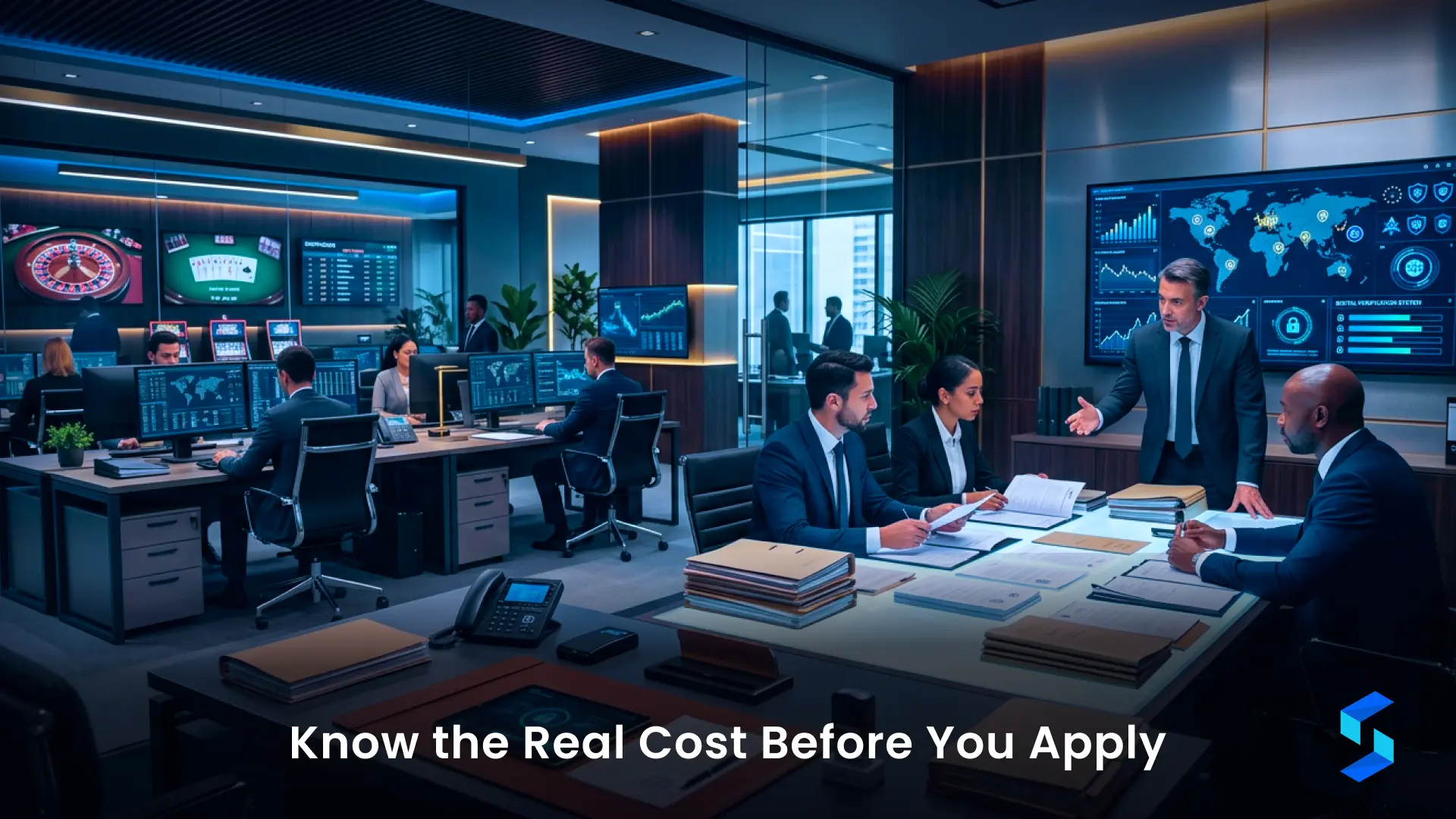
Most operators budget the headline application fee. Then the invoice arrives: legal advisory for corporate restructuring, compliance infrastructure setup, KYC provider contracts, AML monitoring software, responsible gambling tooling, technical platform certification, and six months of operating capital held as financial probity evidence. The application fee which looked expensive turns out to be 15–25% of the actual Year 1 licensing cost.
This guide gives you the real numbers. Not the advertised headline fees, but the total cost of being licensed and operational in each major jurisdiction. For the most current jurisdiction-specific data, the real cost of iGaming licensing 2026 contains detailed jurisdiction breakdowns including Italy’s new €7M concession regime and Curaçao’s updated LOK framework.
The Headline Fee Is Only the Beginning
Every iGaming license has four cost layers that most budget models address inadequately.
- Layer 1 – Application fees: The headline number. 15–25% of Year 1 total cost.
- Layer 2 – Annual license fees: Ongoing. Often larger than the application fee over a 3-year horizon.
- Layer 3 – Compliance infrastructure: KYC provider, AML monitoring software, responsible gambling tools, audit-ready transaction logging. This layer is rarely included in vendor license cost estimates.
- Layer 4 – Legal and advisory: Corporate restructuring for jurisdiction requirements, application preparation, ongoing regulatory counsel. A conservative minimum for any Tier-1 jurisdiction is £30K–£60K in Year 1 legal costs alone.
Major Jurisdictions: Real Year 1 Cost Comparison
| Jurisdiction | Application Fee | Annual License | Compliance Infra (Yr1) | Legal (Yr1 est.) | Total Year 1 |
|---|---|---|---|---|---|
| Curaçao (CGA) | $10K–$20K | $20K–$35K | $15K–$40K | $15K–$25K | $60K–$120K |
| Anjouan (AICGBA) | $2K–$10K | $10K–$20K | $10K–$25K | $10K–$20K | $32K–$75K |
| Kahnawake | $20K–$50K | $10K–$30K | $15K–$35K | $15K–$25K | $60K–$140K |
| Malta (MGA) | €25K | €25K–€35K/yr | €40K–€80K | €30K–€60K | €120K–€200K |
| Isle of Man | £5K | £5K–£35K/yr | £25K–£50K | £20K–£40K | £55K–£130K |
| Gibraltar | £85K | £85K/yr | £40K–£80K | £30K–£50K | £240K–£300K |
| UK (UKGC) | £25K–£100K | £25K–£250K/yr | £150K–£400K | £50K–£100K | £250K–£850K |
| Italy (2026) | €4M | €3M at launch | €500K+ | €200K+ | €7M+ |
For operators considering Curaçao as the entry-point jurisdiction, the updated Curaçao eGaming license fees and understanding iGaming platform setup costs together give a complete budget picture for a new operator.
Jurisdiction-Specific Notes
Curaçao (CGA): The Entry-Level Standard
The updated Curaçao Gaming Authority framework (2024 onwards) requires operators to hold their own licenses rather than sub-licenses from master license holders. This increases compliance obligations but improves market credibility. Approval: 6–10 weeks. Best for: first-time operators validating a market.
See Anjouan gaming license requirements and costs for the closest alternative. Anjouan has emerged as a lower-cost Curaçao substitute with faster approval but narrower market acceptance.
Malta (MGA): The EU Standard
MGA is the benchmark license for operators targeting European players. EU membership enables multi-market access via mutual recognition frameworks. Compliance infrastructure requirements are significantly higher than Curaçao. The Malta gaming license application types and guide covers B2C and B2B license types with their respective application requirements.
UK (UKGC): The Highest Bar
The UKGC requires compliance systems to be demonstrably operational before issuing a license. Affordability checks, GAMSTOP integration, AML monitoring, and responsible gambling tools must be live and tested, not planned. Year 1 compliance infrastructure for a UKGC operation regularly exceeds £200K before the first player deposits.
Multi-Jurisdiction Strategy
Operators targeting multiple markets simultaneously need a licensing strategy that sequences jurisdiction entry to manage capital requirements. The multi-jurisdiction iGaming licensing strategy covers how to sequence market entries, manage overlapping compliance obligations, and build a licensing roadmap that doesn’t require all capital to be committed at once.
For the practical process of obtaining each license type—what documents are required, what regulators inspect, and what common application failures look like—the how to obtain a gaming license for your gambling business is the operational reference, and types of online gambling licences and the obtaining process covers the full landscape including poker-specific and sportsbook-specific licensing requirements.
For Canadian operators considering Kahnawake, the Kahnawake gambling license guide covers the specific requirements and processing timeline for that jurisdiction.
Need guidance on licensing strategy and cost planning?
Source Code Lab provides licensing advisory as part of platform development, helping operators match their jurisdiction to their market, budget, and timeline before committing capital.